Get Full Government Meeting Transcripts, Videos, & Alerts Forever!
Get email alerts on the Healthcare Maternal topic
No spam. Unsubscribe anytime.
Wyoming House rejects amendments to HB1 aimed at restoring maternity reimbursements
Summary
Lawmakers debated amendments to House Bill 1 to restore physician maternity reimbursement rates and backstop rural health funding. Proponents cited lost labor-and-delivery units and a requested 90% Medicare-rate target; the House voted down the amendment and a related contingency amendment.
The Wyoming House on Feb. 18 debated and rejected amendments to House Bill 1 that would have increased maternity-care reimbursements and created a state "insurance" backstop for rural maternal services.
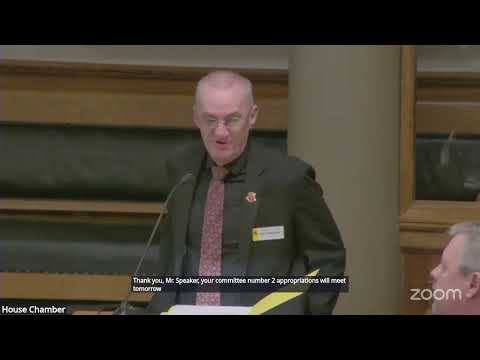
Representative Scott Clauston, who offered amendment 44, said the state has "now fallen down below 80%" of Medicare reimbursement and asked colleagues to restore the traditional 90% level. Clauston described the amendment as a department request and said it represented roughly $2.5 million in federal funds and $2.5 million in state funds over two years for training, equipment, facility upgrades and recruitment — but not to replace existing Medicare or Medicaid payments: "These funds cannot be used to replace or supplement Medicare or Medicaid payments that are already covered." He warned that several Wyoming communities (Riverton, Wheatland, Kemmer, Evanston and Rawlins) have lost labor-and-delivery units since 2024.
Opponents said higher rates alone will not solve provider shortages. Representative Baer urged a no vote, arguing that rebasing rates "doesn't pay the doctors what they really need to be able to be in business" and would not solve shortages in rural communities. Other members acknowledged the problem of access but questioned whether the amendment's approach would be effective without additional provider recruitment and other supports.
The chief clerk called the roll on amendment 44; the vote closed with 26 in favor and 33 opposed. The speaker announced the amendment had not been accepted.
A related amendment (45) described by Representative Provenza as an "insurance policy" to replace funding if the rural transformation program failed also failed on a subsequent roll call, 16 aye to 44 no. Members debating that amendment disputed whether the rural transformation program's restrictions allowed a dollar-for-dollar replacement and whether the state should create a contingency appropriation.
Another amendment (46) proposed striking legislative intent language that would have required a 50% reduction in certain wait-list services for fiscal year 2027; proponents said the metric was a policy directive better addressed elsewhere and might not be achievable without available providers. The voice vote on that amendment was followed by a division; the transcript records the chair first saying the motion "has been adopted" and then later saying "The motion has not been adopted." The record therefore shows the amendment was not adopted as declared on the floor.
The House moved on to other amendments and business and recessed to 10 a.m.
What happens next: House Bill 1 will proceed toward further readings and committee referrals as the session schedule allows. The House did not adopt the proposed reimbursement or contingency-language changes on Feb. 18, leaving the status quo on reimbursement policy and directing further debate or alternative measures to future action.