Get Full Government Meeting Transcripts, Videos, & Alerts Forever!
Get email alerts on the Higher Education Licensure Compliance topic
No spam. Unsubscribe anytime.
Expert urges Illinois community colleges to update policies after new Title IV licensure certification takes effect
Summary
A consultant told Illinois community college staff that a new Program Participation Agreement term effective July 1 requires institutions to certify where licensure programs meet state education requirements, tighten student-location policies, and retain written attestation records when enrolling students in states where programs don’t meet requirements.
Chris Moll, a compliance consultant with Higher Education Licensure Pros, told Illinois community college staff during a webinar that institutions must act now to meet a new Program Participation Agreement term tied to professional and occupational licensure. The change, effective July 1, requires colleges participating in the federal Title IV student-aid program to certify that their licensure programs meet the educational requirements where the institution is located and where distance-education students are located at the time of initial enrollment.
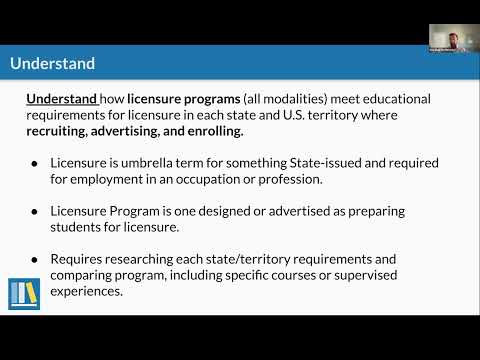
Moll said institutions have three main responsibilities under the Title IV regulation and State Authorization Reciprocity Agreement (SARA): to understand how programs align with state licensure requirements; to certify that programs meet those educational requirements (the new PPA term); and to communicate licensure information both publicly and directly to students. "While I am an attorney, I am not your attorney," Moll said, cautioning that his remarks were informational, not legal advice.
Why it matters: Title IV compliance affects a college’s eligibility to offer federal financial aid, and licensure issues have increasingly appeared in borrower-defense-to-repayment claims, Moll said. He warned that enforcement actions for Title IV noncompliance can carry similar consequences to other Title IV violations, making accurate determinations and documentation a priority for institutions.
Moll outlined how colleges should determine whether a program is a licensure program: examine program design, alignment to occupations that require a license, whether specialized programmatic accreditation applies, and how the program is advertised. He emphasized there is no comprehensive federal list of licensure programs, so institutions must research state statutes, licensing-board rules, and other primary sources and document the basis for each state-by-state determination.
On certification and distance education, Moll noted that the Department of Education is using a broad definition: "If a student will be taking one or more class online during that first term of enrollment in the licensure program, they're considered a distance education student under this subsection of the regulation." That definition can expand the number of states in which a college must show a program "meets" requirements at the time of initial enrollment.
If a program does not meet a state's requirements, Moll said an institution may still enroll the student if it obtains a written attestation: a documented process in which the prospective student affirms they intend to seek licensure and employment in a single state or territory where the program does meet the educational requirements. "Institutions cannot enroll students unless they're located in a meets state or territory or if you secure this written attestation from them," he said, stressing the attestation must reflect a substantive interaction rather than an automated checkbox.
Moll also explained the institutions' communication duties: public disclosures (usually posted on institutional websites) must list states and territories where programs meet or do not meet requirements; direct disclosures must be given to prospective or current students if the student is located where the program does not meet or has not been determined to meet requirements. He noted the regulation no longer requires a separate "not determined" category but that some colleges still publish it to avoid confusion. The Department of Education has indicated that institutions need not determine all 59 U.S. states and territories if they do not advertise, recruit, or enroll students there.
Moll recommended a documented student-location policy that defines how the college determines a student's location (examples include residency at time of application or the physical address where the student will reside during the term). He warned institutions to apply the policy consistently and keep it available for Department of Education review.
On interstate licensure compacts and reciprocity, Moll said colleges may factor them into determinations, but cautioned that compacts differ: some allow temporary practice across state lines while others facilitate earning a license in another state. Institutions should assess the compact's scope before relying on it to conclude a program "meets" requirements.
During Q&A, attendees asked about shared services and disclosure scope. Ike Mosu, vice president at Lakeland College, asked about consortium or statewide subscriptions to Moll’s "bookmark" database. Moll said Higher Education Licensure Pros offers enterprise-level membership and recommended a single contracting entity for consortium agreements to reduce per-seat costs. He also confirmed that public-disclosure obligations may be limited to states where an institution advertises or enrolls students.
Next steps: Moll directed attendees to slides and resources he provided (including links to regulation language and the Code of Federal Register) and left contact information (hire@licensurepros.com) for follow-up. The webinar closed with appreciation from the moderator and a reminder that institutions should consult counsel when implementing compliance policies.
Ending: The presenter said slides and sample student-location and attestation templates would be available after the session and encouraged institutions to document determinations and retain attestation records for potential audits.