Get Full Government Meeting Transcripts, Videos, & Alerts Forever!
Get email alerts on the Public Health Tobacco Policy topic
No spam. Unsubscribe anytime.
Newark council advances tobacco retail licensing ordinance after wide public support
Summary
After extensive public comment from parents, students and public‑health groups, Newark city staff and council advanced a tobacco retail licensing ordinance that would require annual licenses, broaden the definition of tobacco retailers, and authorize inspections and escalating penalties; the council voted 3–0 to move the ordinance forward with two members recused.
The Newark City Council voted to advance a proposed tobacco retail licensing ordinance after a lengthy staff presentation and more than two dozen public comments urging stricter local rules to curb youth access to tobacco products.
City staff described the ordinance as a licensing program that would require every business that sells tobacco products to obtain an annual tobacco retail license. Community preservation manager Oscar Carrillo said the license fee would be set to achieve “100% cost recovery,” covering application processing, annual inspections and enforcement work. Carrillo said the proposal also broadens the current definition of a tobacco retailer so any business that sells tobacco or nicotine products — even if those sales make up only a small share of total sales — would need a license and would be subject to proximity and product restrictions.
The proposal includes 1,000‑foot proximity limits around schools, parks, day cares and other tobacco retailers, a ban on sales of flavored tobacco (including hookah and products that create cooling or numbing sensations), and an escalating penalty structure starting with fines and moving to suspensions and revocation for repeated violations. Carrillo told the council staff had identified roughly 39 tobacco retailers in Newark and that the city plans to work with Alameda County Public Health on implementation and enforcement.
Why it matters: Parents, school officials and public‑health advocates said local licensing will close enforcement gaps left by intermittent state inspections and will make it easier to keep tobacco and flavored vaping products away from children. Several speakers cited the California Healthy Kids Survey and prior decoy inspections showing underage sales in Newark as reasons for expedited local action.
Public comment and council response: More than twenty speakers urged the council to adopt a strong TRL with annual compliance checks and no exemptions. Vinita Verma, president of the Peralta District PTA, told the council a city ordinance must be “strict and comprehensive, leaving no room for exploitation.” Phong Nguyen, a Newark Unified School Board member, said he supported the ordinance but urged the council to consider future amendments to address unflavored vaping products.
Alameda County Public Health senior program specialist Rachel Gratz Lazarus told the council the county could provide materials and technical assistance and highlighted past state decoy operations in Newark, which documented underage sales. Eden Youth Center offered to partner on youth decoy compliance checks if the city lacked sufficient staffing.
Council members asked staff about enforcement capacity and the department responsible for inspections. Carrillo said two community preservation/code enforcement inspectors will handle TRL inspections and that staff will perform annual inspections and respond to community complaints. Mayor Michael Hamm said the city will conduct unannounced inspections and review program outcomes after implementation.
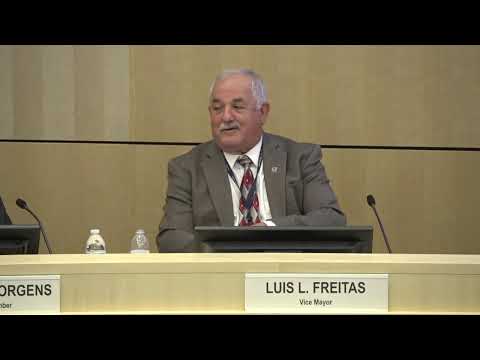
Recusals and vote: Councilmembers Coyazzo and Apodaca recused themselves from the ordinance discussion and vote because of property interests near tobacco retailers. Vice Mayor Freitas moved to advance the ordinance and Councilmember Jorgens seconded; the motion passed 3–0 with two recusals. The vote advanced the ordinance to the next legislative step; councilmembers and staff said they expect to revisit aspects such as minimum pack sizes, price minima and transfer rules as the program is implemented.
What's next: Staff said it will finalize licensing materials, calculate the fee to achieve cost recovery, and begin mailing applications and invoices to existing retailers in 2025. The council asked staff to return with annual reports on enforcement outcomes and to consider additional policy refinements based on observed results.