
Warren County delays decision on proposed 250‑foot Verizon tower after commissioners ask for co‑location analysis
Get AI-powered insights, summaries, and transcripts
Subscribe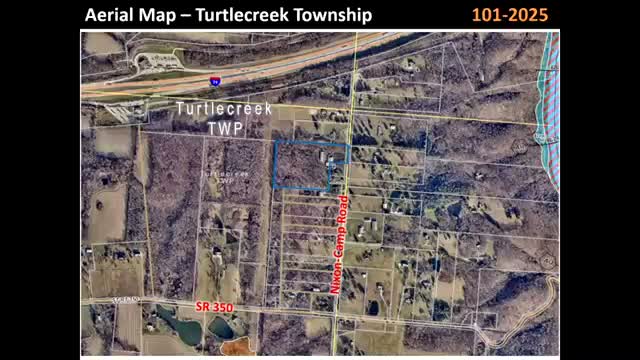
Summary
Warren County commissioners continued a hearing on a proposed Verizon/Tague Towers 250‑foot wireless facility at 1105 Nixon Camp Road after testimony from Verizon engineers, site‑acquisition staff and residents; commissioners asked the applicant to further document why existing towers (notably reference 5) cannot meet coverage or capacity needs and set a new hearing for April 14, 2026.
Warren County commissioners on Feb. 3 continued a zoning hearing on a proposed wireless communications tower at 1105 Nixon Camp Road, asking the applicant to return with additional analysis of alternatives, including co‑location on an existing tower the board called “reference 5.”
The applicant, represented by Rodney Carter of Husch Blackwell, said Verizon needs a new tower in the area to close a persistent coverage gap and to offload capacity from an overloaded site to the west. Carter told the board Verizon’s engineering shows a tall, new site is required to provide reliable service and “911 access,” and introduced witnesses who testified under oath about outreach, mailings and RF analysis.
Fred Lau, identified in the record as a site‑acquisition representative for the applicant, said the applicant mailed certified notices to nearby tower owners and multiple landowners and conducted searches for alternate sites. Lau said a small number of potential landowners were initially willing but negotiations failed for reasons ranging from family objections to compensation. “We looked at co‑location first,” he told the board, saying Verizon already occupies four of the nine nearby towers the parties reviewed and that the remaining structures “don’t solve the coverage gap.”
Kurt O’Lane, Verizon’s RF/macro tower engineer, explained the company’s technical case. He distinguished coverage (signal availability) from capacity (how many users the network can handle) and said the proposed site’s search ring was designed to address both problems. “If we can offload capacity and gain coverage, that’s what we’ll do,” O’Lane said, describing maps submitted to the board that show limited indoor coverage in the river valley and capacity constraints at an existing western site.
Commissioners pressed the applicant for more targeted evidence. Multiple board members said a co‑location on an existing tower labeled Reference 5 (Tower Number 2 on State Route 350 in the materials) appeared to deliver much of the same public‑safety benefits and would avoid placing a tall structure in a residential backyard. One commissioner summarized the board’s concern: Reference 5 “accomplishes 80% of what you need and it’s not in somebody’s backyard.”
Commissioners asked the applicant to return with three specific items: (1) documentation that Reference 5 is not technically or practically available for co‑location (including whether it would meet Verizon’s capacity needs), (2) an assessment of whether a taller tower sited in a lower‑density, wooded area could meet the same RF objectives with less community impact, and (3) the certified‑mail and direct‑contact evidence for all towers the applicant said it contacted. Rodney Carter and witnesses agreed to provide the follow‑up.
Residents in the room reiterated opposition to the proposed backyard location. A local resident, Mike Kirby, handed the board a 911 call log and told commissioners he found no records of dropped 911 calls in the area over the past year. Zoning staff had previously supplied a Turtle Creek Township letter saying trustees had not initially received certified‑mail notice to the township board; the applicant later provided certified‑mail receipts dated Jan. 26, 2026 and many deliveries logged Feb. 2–3, 2026.
After discussion the board voted to continue the hearing at the applicant’s request so the company can provide the focused comparisons and capacity analysis. The board set the next hearing for April 14, 2026 at 9:10 a.m. and voted unanimously to continue. Commissioners also voted to enter executive session on pending litigation and property negotiation matters under state ORC provisions.
What’s next: The applicant will return with technical documentation about Reference 5’s availability and capacity, additional evidence about alternate lower‑impact sites and the certified‑mail correspondence the board requested. The hearing resumes April 14, 2026 at 9:10 a.m., when opponents and the applicant will have an opportunity to present further evidence and cross‑examine witnesses.