Get Full Government Meeting Transcripts, Videos, & Alerts Forever!
Get email alerts on the Police Accountability topic
No spam. Unsubscribe anytime.
Council reviews proposed changes to Police Accountability Board; members debate appointments, training and reporting
Summary
Council members reviewed Ordinance 26‑002, which would have the county executive appoint the Police Accountability Board chair, broaden member eligibility while barring certain family ties to law‑enforcement, require 20 hours of community training (satisfiable via the Citizen Police Academy or equivalent), and add Public Safety’s response language to annual reports; councilmembers requested clarifying amendments and timeframes.
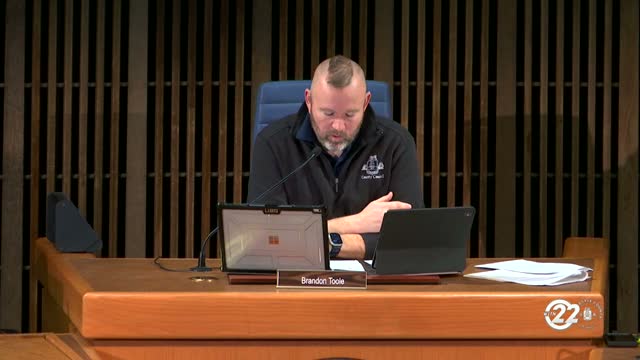
Brandon Toole, chair of the New Castle County Council Public Safety meeting, opened discussion on Ordinance 26‑002, a county executive proposal to amend Chapter 2 (Administration), Article 5 of the New Castle County Code to change the composition and responsibilities of the Police Accountability Board.
The ordinance would move appointment of the board chair to the county executive and update member‑eligibility rules aimed at broadening the pool of volunteers while preventing certain family members of current or former law‑enforcement officers from serving. The measure also codifies an initial community‑training requirement of 20 hours for board members; the text says attendance and completion of the New Castle County Citizen Police Academy would satisfy that requirement but allows the county police department to provide equivalent training.
Art Lee, representing the county executive’s office, told council the administration’s intent is to expand diversity on the board and keep training standards consistent: “The members of the board must complete 20 hours of community training. If they attend the Citizen Police Academy, that will complete the 20 hours,” he said, adding the department may also provide the training.
Some councilmembers raised procedural and independence concerns. Councilmember Street said shifting appointment power to the executive risks undermining the board’s independence and said the board appears not to have been consulted on the executive‑driven changes. Council co‑chairs Kevin Kaneko and Brandon Toole said they had reached out to the board for comment and that the ordinance originated in the executive’s office, not from either co‑chair; they said amendments and substitutes remain available before a final vote.
A major point of debate focused on report timing and the inclusion of the Department of Public Safety’s response in packet materials. Several councilmembers worried that requiring Public Safety’s reply to appear with the board’s annual report could delay the council’s receipt of the board’s recommendations. Colonel Leonard of the Division of Police explained that the added language was not intended to prevent the board from submitting its report but that prior drafts sometimes did not include the department’s written response. “The additional language ... did not preclude the submissions of the report, but there was no language in there that specifically spoke to our response being part of the actual packet,” he said, adding that the department’s practice has been to provide responses to be included when available.
Lisa Minutola, assistant county attorney and counsel to the Police Accountability Board, said the county code requires an annual report but the draft ordinance is meant to allow the board to submit recommendations throughout the year and not wait until an annual summary. “We wanted this to be a fluid process, where, if in April the board makes a recommendation and they get a response, they wouldn’t have to wait until the next January to do anything with that,” she said.
Councilmembers suggested clarifying edits: making the annual report requirement explicit while allowing interim submissions; adding phrasing such as “Public Safety’s response, if available” to avoid unintended delays; and specifying due dates tied to appointment timelines so reporting does not lapse. No final vote on Ordinance 26‑002 was recorded during the meeting; councilmembers said the item remains subject to amendment and will return for action at a later date.
The council did not receive public comment on the ordinance during the item’s review.
Next steps: the ordinance will return for further consideration and possible floor amendments; council members requested a formal response or comment from the Police Accountability Board before final action.