Get Full Government Meeting Transcripts, Videos, & Alerts Forever!
Get email alerts on the Zoning topic
No spam. Unsubscribe anytime.
Council approves zoning text amendments to clarify residential height measurement and tier drive‑through review (ZOA2025‑0003)
Summary
After a public hearing, the council approved ZOA2025‑0003, which clarifies how residential building height is measured (average front grade to highest roof point), restricts residential height exceptions while leaving nonresidential/mixed‑use exceptions to be clarified, and implements tiered drive‑through definitions that change review authority based on intensity.
The Meridian City Council voted to approve zoning text amendments (file ZOA2025‑0003) that clarify measurement of residential building height and add tiered definitions and review procedures for drive‑through establishments.
Staff presented changes to the measurement section and residential zoning chapters to make clear that residential height is measured from the average grade at the front property line to the highest point of the roof. The amendment narrows height exceptions for residential structures while preserving existing exceptions for nonresidential and mixed‑use buildings; staff said multifamily and vertically integrated residential buildings remain subject to different standards and that further review of nonresidential exceptions could follow.
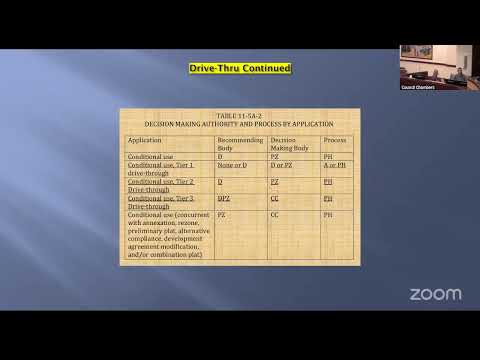
The ordinance also implements tier 1–3 drive‑through categories tied to design intensity (stacking lanes, ordering areas, number of windows) and assigns review authority accordingly: tier 1 can be administrative or conditional; tier 2 generally goes to Planning & Zoning; and tier 3 drive‑throughs would require Planning & Zoning recommendation and City Council decision for cases that do not meet dimensional standards. Councilmembers discussed rooftop appurtenances, multifamily treatment, and how to define exceptions. Councilwoman Shaner described the height changes as “closing a major loophole in our code.”
Council closed the public hearing, motioned to approve the file as presented with an agreed edit to extend nonresidential/mixed‑use exception language, and the ordinance passed on roll call.