Get Full Government Meeting Transcripts, Videos, & Alerts Forever!
Get email alerts on the Policing Technology topic
No spam. Unsubscribe anytime.
New Castle County weighs Axon technology package and drone-first-responder program amid funding and privacy questions
Summary
New Castle County public safety officials presented a plan to build a Real Time Information Center and a 24-drone "drone-first-responder" network with Axon technology. Officials said the phased contract reduces up-front cost, but council members raised questions about long-term funding, data release policy and operational details.
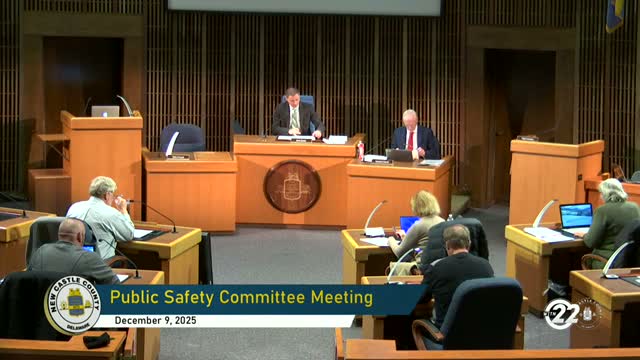
New Castle County's Public Safety Committee heard a detailed presentation on Dec. 9 about a proposed technology package with Axon that would add a Real Time Information Center (RTIC), live-integrated body- and dash-cam feeds, language-translation-enabled bodycams and a Drone-First-Responder (DFR) network intended to put drones on scene before patrol units.
The presentation by Colonel James Leonard and Lieutenant Cumberbatch, the county's technology executive officer, described how Axon FUSIS would aggregate live video, device telemetry and Prepare 911/Live 911 call monitoring to give officers and supervisors a single operational view. "FUSIS is what brings everything together," Cumberbatch said, adding it would allow the county to see live body-worn camera feeds, dash-cam footage and mapped field-unit locations in real time.
Why it matters: County officials said the package is designed to increase officer and public safety, reduce response times and allow the county to handle low-priority calls without dispatching patrol units. Cumberbatch described a three-week pilot with 177 flights in which a test drone arrived on scene first roughly 90% of the time and cited incidents where drones located stolen vehicles and thermal signatures that prevented ambushes.
Scope and features: The proposal would deploy an initial 12 drone sites and add 12 more over five years to reach 24 units countywide, with fixed rooftop installations and the option to move sites if coverage is suboptimal. The package also includes automated report-writing tools, Smart Capture license-plate scanning, My90 community-feedback tools, Axon Translate for real-time language detection on bodycams, automatic feature updates and new bodycams, tasers and helmet cams.
Costs and funding: Officials gave multiple figures during the discussion. Cumberbatch said the package's value is about "$1,200,000 a year, $12,000,000 over the whole package." Leonard described a phased payment schedule intended to reduce near-term burden, noted the county is in year 3 of an existing Axon contract, and said the administration cut $1,000,000 from the fleet allocation to offset costs. He also said the county is pursuing grants and an ability to add service fees to municipalities that use the system. Council members repeatedly asked for clearer long-term funding plans and reserve impacts.
Operational detail and privacy: Committee members asked whether bodycam feeds would be monitored live. Leonard said live streaming is technically possible and that supervision and RTIC analysts could monitor critical incidents, but continuous live monitoring of every camera is "unreasonable" from an FTE perspective. He said RTIC staff would perform callbacks for CAD-entered calls (for example, to confirm an abandoned-vehicle complaint), and that drones would only launch in response to CAD entries, not for non-dispatch 'joy flights.'
Questions and concerns: Several council members voiced financial and policy concerns. Councilman Hollins said the county's reserves and prior borrowing raised doubts about approving a multi-year package without clearer funding and a policy on access to bodycam footage. Hollins said he would not support the plan "till we get some more money." Council members also asked about jurisdictional issues for incidents near Wilmington and the disposition of replaced hardware; Leonard said Axon refurbishes returned devices and that firmware concerns with prior Taser models were addressed after county feedback.
Next steps: For the record the committee discussed R-25-203, which would authorize the county executive to execute a contract with Axon Enterprise, Inc., and reviewed three related ordinances: O-25-147 and O-25-148 (grant appropriations) and O-25-158 (a $750,000 appropriation from the realty transfer tax reserve for the first payment on the renegotiated Axon contract). The committee did not record a formal vote on the Axon agreement during the hearing; members asked for additional financial detail and assurances before proceeding.
What to watch: Council members asked staff to return with clearer long-term funding plans, specific policy language on bodycam data access and release, and a detailed implementation schedule for staffing and pilot training before the committee advances any contract authorization.