
Senate education committee advances university budgets to finance after multi‑campus hearings
Get AI-powered insights, summaries, and transcripts
Subscribe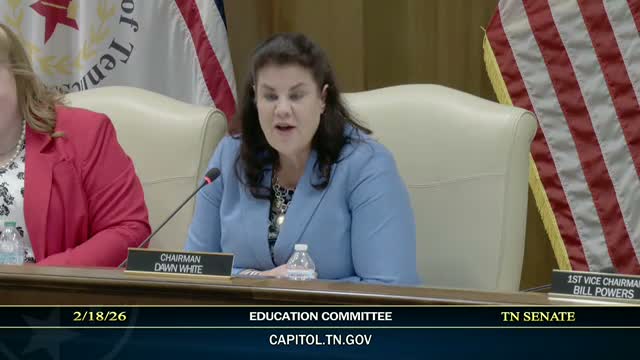
Summary
The Senate Education Committee unanimously moved multiple public university budgets to the Finance Committee after budget hearings in which presidents outlined enrollment gains, capital needs and specific supplemental requests including quantum research and deferred‑maintenance funding.
The Tennessee Senate Education Committee moved the budgets of several public universities to the Senate Finance Committee after hearing multi‑hour presentations from campus leaders who described enrollment trends, capital maintenance needs and specific supplemental requests.
Tennessee State University President Dwayne Tucker told the committee TSU has set a 2026 freshmen target of about 1,200 and is working through a large graduating senior class that will create a drop in enrollment to be managed through an MOU with the legislature. Financial consultant Jim Grady said the governor’s baseline included outcomes funding and other cost increases; TSU asked for supplemental help with deferred maintenance and capital projects. The committee voted to send TSU’s budget to Finance with a positive recommendation (9 ayes).
University of Tennessee system officials, joined in the hearing by David Miller, senior vice president and CFO, asked the committee to seek inclusion of a roughly $2.14 million reoccurring shortfall for non‑formula units and to support salary pools for specialized units. Miller said prior equipment funding had been expended as intended and described systemwide cybersecurity subscriptions in use to protect campuses. The UT budget was sent to Finance with a committee letter asking Finance to consider the shortfall (committee vote recorded as 9 ayes when taken).
Middle Tennessee State University President Sydney McPhee pressed for a $25 million supplemental investment to expand quantum research and workforce programming with Oak Ridge National Laboratory and regional partners. McPhee said the funds would support a regional quantum lab and educational hub tied to K–12 pathways. MTSU’s budget moved to Finance with a positive recommendation.
Other campuses highlighted similar themes: Tennessee Tech said the governor’s capital maintenance allocation falls short of an estimated $11 million annual need to stabilize deferred maintenance; the university cited a roughly $3 million outcomes funding gap. The University of Memphis warned of more than $400 million in deferred maintenance across its campus and described buildings nearing the end of useful life. East Tennessee State University and Austin Peay similarly described enrollment gains and program investments requiring continued state support. Each campus budget the committee considered was advanced to Finance with the committee’s recommendation (votes recorded in the hearing transcript).
What happens next
Each budget will be considered by the Senate Finance, Ways and Means Committee as the General Assembly continues negotiations over the governor’s proposed appropriations and any supplemental requests. The committee’s action is procedural: moving the budgets to Finance does not by itself provide the supplemental funding campuses requested but ensures the Finance committee will consider those requests.