
Wallingford‑Swarthmore previews 10‑year capital plan; SRS roof grant could cut district share to about $287,500
Get AI-powered insights, summaries, and transcripts
Subscribe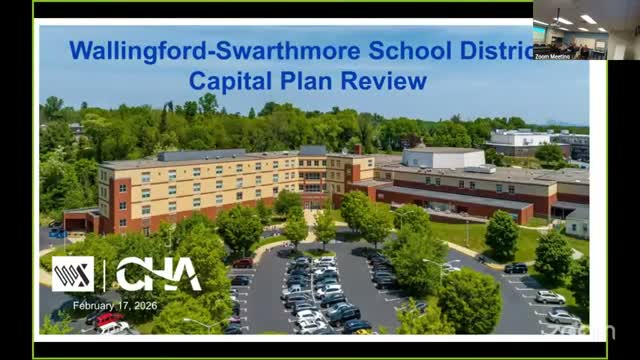
Summary
District administrators previewed a detailed, itemized capital plan and said a Public School Facility Improvement Grant would cover most of an SRS roof project; the district will pursue grant documentation and hold CHA presentations in March while pausing major solar installations until high‑school work is complete.
Wallingford‑Swarthmore School District administrators on Feb. 17 previewed a more detailed, school‑by‑school version of a 10‑year “Warm, Safe, Dry” capital plan the board approved last June and described two grant opportunities that could change near‑term project timing.
Dr. Johnston, who led the capital discussion, said the district has hired CHA as infrastructure manager to translate the district’s existing high‑school planning into an inventory of prioritized, per‑building capital needs. “We drew the line around Warm, Safe, Dry knowing that there are additional improvements that we could be making to our schools,” Johnston said, adding the district will publish more itemized project lists and lifespan estimates so the board can bundle similar work across schools to reduce costs.
The administration flagged two separate grant opportunities. One is a state solar grant that the presenter said could cover roughly 30% of an eligible solar project (the example figure cited was about $360,000 on a $1.0 million‑plus project) but that statewide second‑round funds total only $25 million. The administration recommended staying focused on the high‑school project and the district capital plan now, and revisiting broader solar implementation after the high school work is complete (the district anticipates larger, eligible roof area around 2029).
Separately, the presenter described the Public School Facility Improvement Grant as the vehicle for an SRS roofing renovation. Administration said contractors (Tremco Roofing and ProCom Roofing) have completed walkthroughs and that a nuclear scan to confirm moisture and insulation conditions is pending. The presentation gave a total project cost estimate of $1,150,000; if the facility grant is awarded, the district’s share was listed as $287,500 and the grant portion as $862,500. Administration said it would file the grant application after the roof scan and solicited board approval of a funding‑match resolution this month.
Board members asked for more detail on timelines, contingencies if a grant is not awarded and the steps the district will take between now and 2029 to be ready for large solar decisions. Administrators said CHA will present initial conceptual designs and costs at the Feb. 23 full board meeting and will return in March with more detailed survey results.
Public commenters raised site‑specific concerns: one resident asked whether placing a large solar array on Cades Field was viable or appropriate for the neighborhood; another resident urged the board to investigate a nearby heavy construction project at a college that he said could create runoff and pose a health or safety risk to students using adjacent fields.
The administration said those neighborhood‑level concerns will be part of later community engagement and reinforced that the district’s immediate capital work will prioritize roof and systems needed to maintain safe, dry learning environments.
The facilities committee adjourned and the finance mini meeting began later the same evening.