Power Ahead Colorado proposes Round 2 subawards with $2 million regional services carve‑out
Loading...
Summary
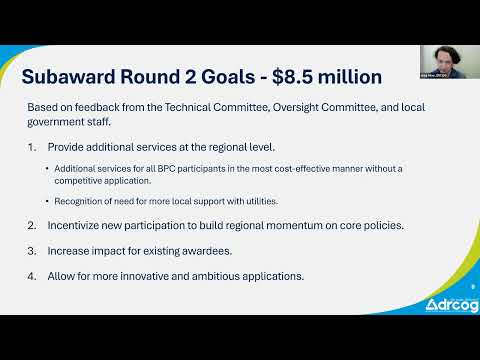
Staff proposed a competitive Round 2 of the Jurisdictional Subaward Program to distribute roughly $8.5 million in remaining funds, introducing three funding tiers and repurposing up to $2 million for region‑wide services including BPC facilitation and utility engagement support.
Power Ahead Colorado staff presented a proposal for Round 2 of the Jurisdictional Subaward Program, showing about $8.5 million available and recommending changes to attract smaller jurisdictions and fund regional services.
Greg Miao, who led the presentation, summarized Round 1 outcomes: "we awarded 27 sub awards in round 1 representing, or covering about 85% of the population of the DRCOG region" and said the majority of those awards were used to add jurisdictional staff capacity. He told the committee that staff had "obligated about 75% of our total funds" from Round 1 and that remaining funds would be reserved for an additional competitive round.
To respond to jurisdiction feedback, staff proposed three changes for Round 2: (1) expand eligible uses to include certain non‑capital demonstration costs, permitting support, and participant support/subsidies; (2) raise minimum award tiers to $100,000–$250,000, $250,000–$500,000 and $500,000–$750,000; and (3) repurpose up to $2,000,000 of the round to provide region‑wide services administered by DRCOG/Power Ahead Colorado, focused on additional BPC facilitation, utility engagement, and residential policy implementation and data support. As Miao described it, the $2 million carve‑out is intended to provide "additional regional services" that smaller jurisdictions requested.
Committee members asked how federal regulatory shifts would affect the program. Emily Baer said the "statement that the EPA has given approval to support this program statewide kinda jumps out at me" in light of a recent EPA announcement; staff replied that the program will continue under existing, signed contracts and that the agency remains engaged. Members also pressed on how the revised tiers would help small mountain towns and whether jurisdiction size would limit eligibility; Miao said jurisdictional size would not be a hard criterion and estimated 5–10 additional smaller jurisdictions might apply under the new design.
Staff proposed a staff‑led scoring process with a review committee including DRCOG staff and local government reviewers (excluding jurisdictions that apply). The tentative public schedule is: open the application window in April, score applications in June, bring recommendations to committee and board in July, and begin contracting or amending contracts in August.
Next steps: staff will finalize the policy language and evaluation criteria, run a webinar for applicants after the opportunity opens, and return to the committee with the formal materials ahead of the public launch.