Get Full Government Meeting Transcripts, Videos, & Alerts Forever!
Get email alerts on the Housing Property Protection topic
No spam. Unsubscribe anytime.
Bill would bar municipalities from declaring or expropriating Department of Housing properties; DOJ and Housing back protections, mayors urge coordination
Summary
House committee reviewed House Bill 996, which would clarify that properties owned by Puerto Rico's Department of Housing cannot be declared 'estorbo público' or expropriated by municipalities. Justice and Housing argued the change avoids federal-funding conflicts; the Association of Mayors warned it could unduly limit municipal authority and urged a coordination process.
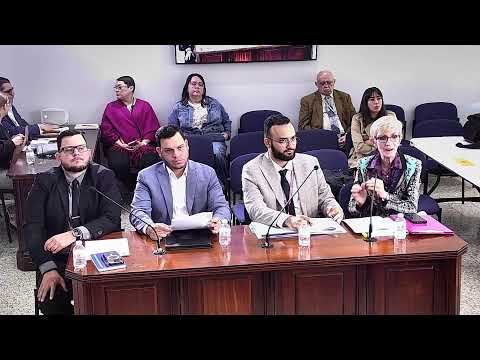
San Juan — Lawmakers heard competing views on House Bill 996 on Feb. 18, a measure that would amend inciso H of Article 1.008 of Ley 107 (the Código Municipal) to specify that real property under the Department of Housing’s title may not be declared an estorbo público (public nuisance) or expropriated by municipalities.
Gerardo Rodríguez Ortiz of the Puerto Rico Department of Justice told the committee that Housing-owned properties serve essential public purposes and often are bound to federal programs and conditions. “las propiedades bajo la titularidad y administración del departamento de vivienda responden a un fin público esencial,” he said, arguing the bill would reduce the risk of conflicts with federal requirements and avoid litigation stemming from divergent readings of the municipal code.
The Department of Housing, represented by Subsecretary Omar Figueroa Vázquez, recommended the measure and described operational risks if municipalities pursue expropriation or nuisance declarations over federally constrained parcels. Housing said it administers roughly 1,000 properties across Puerto Rico tied to programs such as CDBG and disaster-recovery funds and cited the R3 relocation program as an example in which demolished parcels are subject to federal restrictions on future use. Figueroa noted that improper municipal actions could force the commonwealth to return funding or lose future eligibility: “Si el municipio...expropia...tenemos que devolver el dinero...y tendríamos un incumplimiento con FEMA,” he said.
The Association of Mayors, through Joel Sánchez Ayala, opposed an absolute prohibition. Sánchez Ayala argued the amendment would curtail municipal autonomy enshrined in the Código Municipal and leave local governments without tools to address urgent public-health or safety problems. He and other mayors who were consulted — municipalities cited in testimony included Isabela, Caguas and Humacao — recommended a notification-and-coordination framework with clear deadlines (for example, allowing municipalities to proceed after a set number of days if the central agency does not respond), rather than an outright ban.
DOJ recommended technical drafting changes to harmonize the new prohibition across several code articles (including sections that govern estorbo identification and expropriation procedures) to prevent contradictory judicial interpretations. Justice also advised consulting the Office of Management and Budget, the Federation of Mayors and other agencies during the drafting process.
The committee chair asked Justice to analyze whether the proposed prohibition should extend to other agencies that hold real property (the Department of Education, the architecture/public-works office, PRICO and similar instrumentalities). DOJ said it had not performed that analysis and agreed to provide a written assessment within five days at the committee’s request.
Members pressed Housing officials for operational details. Housing said it maintains inventories and rotulates (signs) many open-space parcels, can provide georeferenced lists of those sites and has ongoing, informal collaboration with some municipalities; officials said they would provide the committee with documentation of use-permitted lists and existing municipal agreements.
No vote was taken during the hearing. The committee recessed for a brief interval during the session and adjourned at 11:25 a.m. The measure remains under consideration pending the requested technical edits and follow-up information from Justice and Housing.