
Jackson County lays out five-year road and bridge plan, flags $6.7M Iron Bridge replacement
Get AI-powered insights, summaries, and transcripts
Subscribe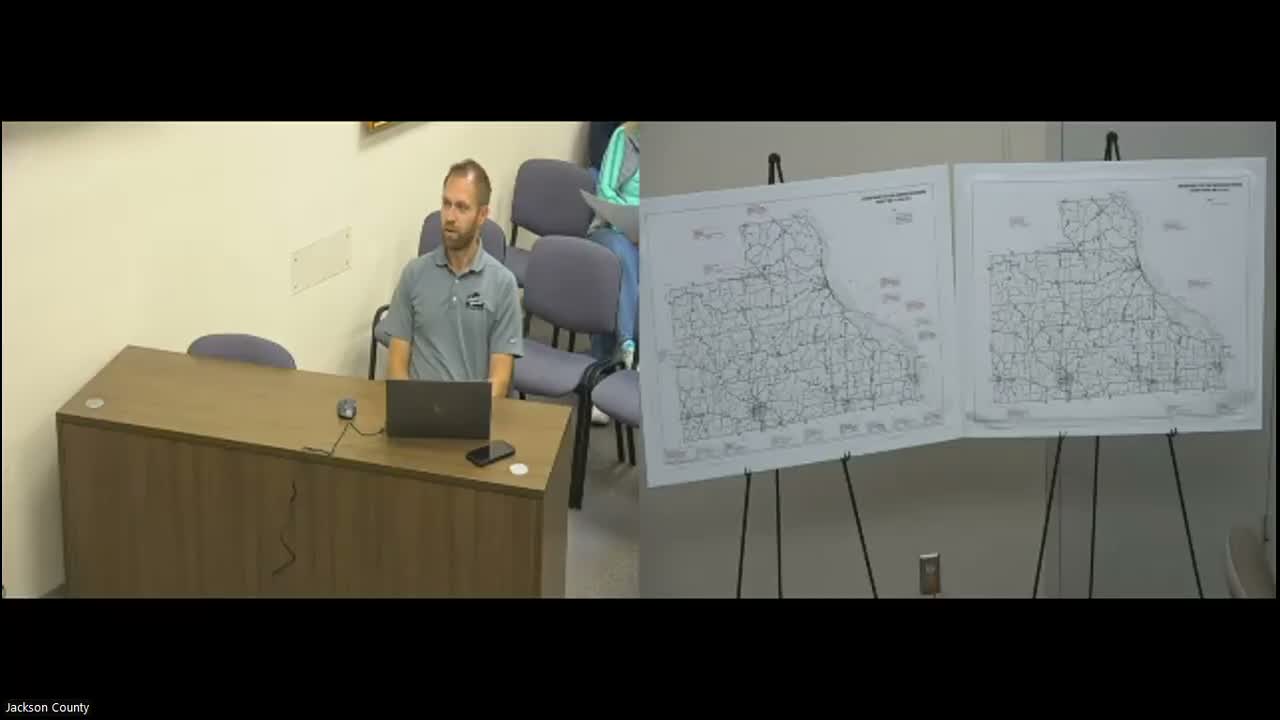
Summary
County staff presented the draft five-year road program highlighting two FY27 federal bridge projects, a $2.53M road rehab on 395th Avenue, locally funded bridges and a proposed $6.7M Iron Bridge replacement whose timing depends on federal BUILD grants and county funding trade-offs.
Jackson County officials presented a draft five-year road and bridge program at a public hearing, identifying near-term federal and local bridge replacements, road rehabilitation projects and funding trade-offs that would be driven by grant awards.
Jane (county presenter) told the audience the county’s fiscal year 27 federal bridge projects include bridge EE0237 on 189th Street over Brush Creek (planned as a 110-by-30-foot continuous concrete slab; estimated cost $660,000) and local bridge 1984 on 12th Avenue (Monmouth/West Street) for which the city received up to $500,000 in DOT funding and the county will be the lead agency for design and DOT submittals. The county also plans two locally funded bridge replacements in FY27, citing aging structures, poor substructure ratings and weight restrictions (examples given: 28-ton and 19-ton limits).
On roads, the county proposed full-depth reclamation for about 1.5 miles of 395th Avenue north of Bellevue because existing asphalt is thin (about 2 inches) and cannot be effectively milled. Jane said the total estimated cost for that project is roughly $2,530,000 and described multiple grant sources supporting the work: a Traffic Safety Improvement Program (TSIP) award of about $445,000, a jointly applied USTEP grant with the City of Bellevue for an offset turn lane (approx. $250,000), and a pending BUILD grant that could cover the remainder. She emphasized the county is planning conservatively and, if the BUILD grant is not awarded, the county could cover the shortfall from its FM account.
The largest item highlighted was the Iron Bridge replacement (FY28) on Iron Bridge Road over the Copa River, proposed as a 409-foot prestressed concrete-beam bridge with an estimated cost of $6.7 million. Jane described environmental constraints and the historic classification of the existing bridge as cost drivers, and said relocation upstream would require rock drilling and blasting with additional costs in the $2 million range. She said county staff will meet with the DOT to explore replacing the structure in its current location—an in-place option that could reduce the total cost by an estimated $2–2.5 million.
Funding for Iron Bridge was shown as a mix of existing DOT county bridge funds ($2,000,000 awarded previously), a build-grant request (seeking $3,900,000), local FM funds (county-proposed $1,000,000 in a no-grant scenario) and STBG federal dollars (shown at $1,500,000 in the slide). Jane warned that advancing the bridge without full grant support would borrow ahead against the county’s bridge account, which receives roughly $580,000 annually from the DOT; she showed scenarios where the county would be several years borrowed ahead of that account’s typical annual receipts and might need to pause other bridge projects to absorb the cost.
Jane closed by listing other priority bridges and road rehab projects planned for FY28–31, noting project sequencing is driven by pavement condition index (PCI) data from Iowa State and by grant success. She directed attendees to maps and hard-copy materials and noted the DOT must still approve the five-year program before the county can act.
Ending: The presentation concluded with staff offering to answer follow-up questions and to continue coordinating with DOT and local partners as grant determinations become known.