
Urbana preservation panel reviews Section 106 timeline as MTD pursues downtown transit center
Get AI-powered insights, summaries, and transcripts
Subscribe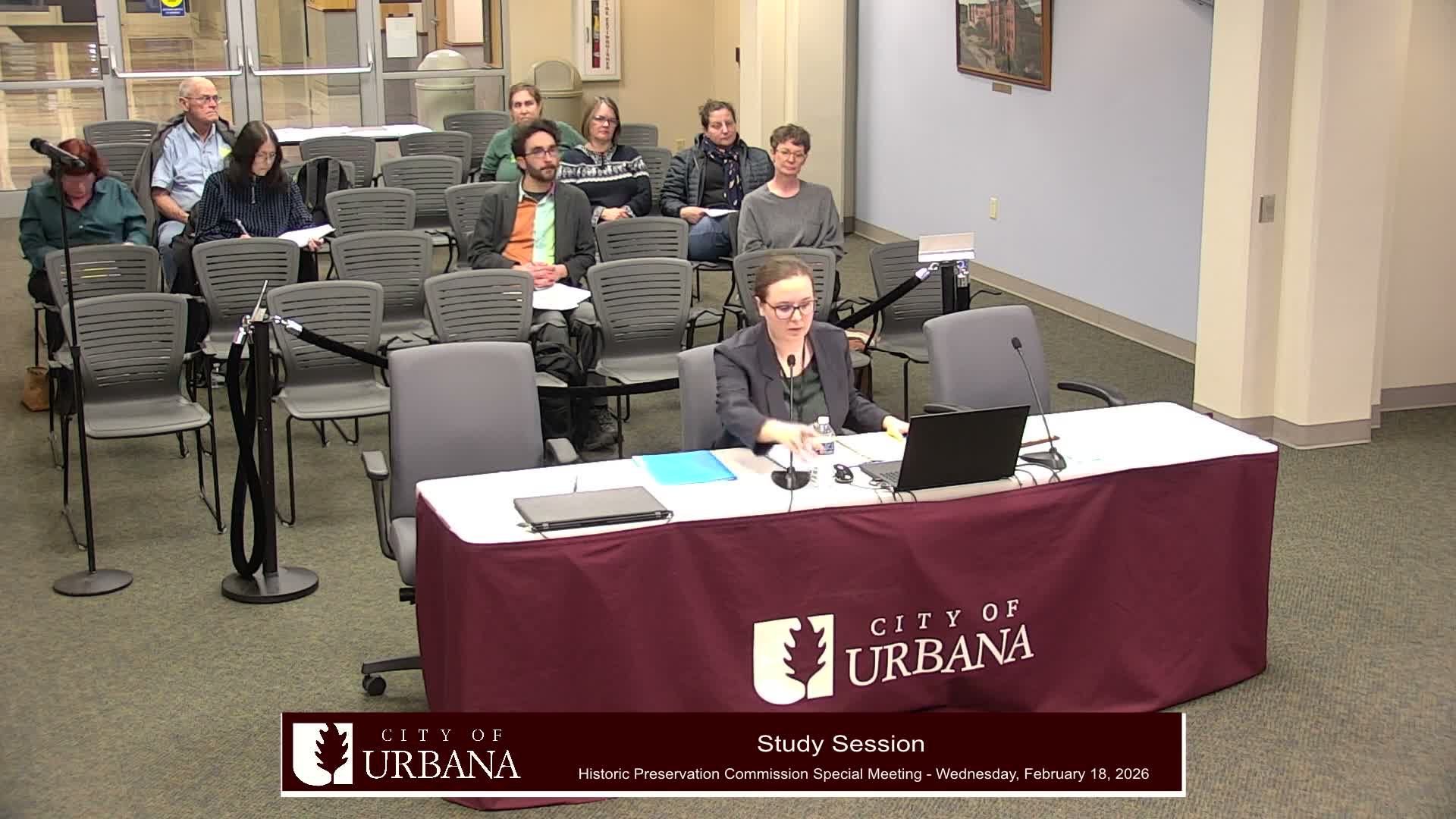
Summary
At a Feb. 18 special study session the Urbana Historic Preservation Commission reviewed the federal Section 106/NEPA history for the Urbana Civic Center, heard public pleas to explore adaptive reuse and learned an MOA requires mitigation if demolition proceeds; commissioners set a March 4 continuation to consider next steps.
Urbana Feb. 18, 2026 The Urbana Historic Preservation Commission on Wednesday held a special study session on the future of the Urbana Civic Center as the Mass Transit District (MTD) and the Federal Transit Administration (FTA) move through NEPA and Section 106 review for a proposed downtown transfer center.
Commission staff presented a timeline showing the Civic Center closed in late 2018, city documents listing the site for potential divestment, MTD and FTA initiating NEPA in March 2024 and subsequent Section 106 consultation. MTDs consultant initially found the building not eligible for the National Register and no adverse effect; the State Historic Preservation Office (SHPO) later disagreed, concluding the Civic Center is eligible under NRHP criteria for community use and modernist design and that the project would create adverse effects.
Why it matters: the divergence between the consultants report and SHPOs finding prompted a revised FTA submittal and a memorandum of agreement (MOA) signed in late 2025 requiring mitigation if demolition occurs. That mitigation includes professional recordation of the building (HIBS Level 3) and acceptance of documentation by SHPO before any demolition.
"The MTD was clear that adaptive reuse was not the primary...they were clear that that wasn't their goal," said Joseph Altschuler, an assistant professor at the University of Illinois Urbana-Champaign who presented student studio work showing alternatives to wholesale demolition. Altschulers students proposed options ranging from building a new structure adjacent to the Civic Center and rehabilitating the existing building to selective removal of non-significant annexes to allow bus circulation.
MTD staff emphasized the operational constraints that shape the agencys planning. "As a transit agency using federal transit funding, doing a NEPA review is a requirement...we do not believe we can utilize it for transit purposes" in its current footprint and "some portion of it would have to be demolished to have 40 and 60-foot vehicles circulating on the site," said an MTD representative.
Staff also told the commission MTD is preparing a USDOT BUILD grant application that could provide up to $25 million if awarded, and that MTD would not advance grant-related design or procurement unless the site can meet transit operational needs.
Public commenters and several commissioners pushed back against demolition as the default. One commenter summarized the Preservation and Conservation Associations view: "We reuse, we save it," and asked the commission to consider alternatives that preserve the civic and architectural character of the building. Commissioner Dennis Roberts urged officials to consider using part of any grant for adaptive reuse: "If they're getting a huge grant to build a building, why don't they use a quarter of the grant to fix the roof?" he asked.
Commissioners pressed staff for documentation of the Feb. 25 city letter that previously agreed with FTAs initial no-adverse-effect finding and said they were concerned the Historic Preservation Commission had been bypassed in parts of the consultation. Staff offered to provide the letter and a fuller record of consulting-party invitations.
Options on the table include continuing study sessions, council testimony, filing a local landmark nomination, pursuing the National Register process (SHPO has already found the building eligible) and seeking more collaborative design work that could reconcile transit requirements with preservation priorities. Staff cautioned commissioners about Open Meetings Act limits on informal gatherings but affirmed individual commissioners may submit testimony or letters as citizens.
The commission scheduled a continuation of the study session for its March 4 meeting to consider next steps and to review additional materials, including student design materials and the requested city letter.
The study session produced no formal votes or decisions; the MOA and NEPA review remain the controlling federal processes for mitigation and potential demolition.