Lifetime Citizen Portal Access — AI Briefings, Alerts & Unlimited Follows
Urbana commissioners question scope, training and jurisdiction in proposed surveillance-oversight role
Loading...
Summary
The Urbana Human Rights Commission discussed a proposed surveillance-technology ordinance that would assign oversight responsibilities to the Commission alongside the Civilian Police Review Board; members expressed concerns about workload, training needs and legal jurisdiction under section 12-22(g).
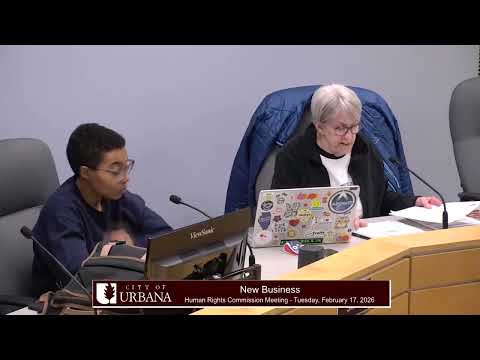
Urbana’s Human Rights Commission spent much of its Feb. 17 meeting weighing whether it should share oversight duties of police surveillance equipment under a proposed surveillance technology ordinance that cites the commission alongside the Civilian Police Review Board (CPRB).
Commissioners said the ordinance’s text (section 8) is brief but could create substantial new responsibilities. “The section itself is small, but I think the amount of work could be big,” the chair said during the meeting, noting uncertainty about training and whether commissioners would be equipped to perform investigative work.
Several commissioners urged the council to clarify exactly what it expects the commission to do. One commissioner, speaking during the meeting, said the assignment “does seem like a task better suited to the CPRB,” arguing the CPRB has more experience with police oversight. Commissioners repeatedly returned to the same themes: whether complaints would be limited to city services (making them squarely the commission’s responsibility), whether complaints might involve vendors or manufacturers outside Urbana, and how the commission’s standard authority under section 12-22(g) would intersect with the new language.
Staff and commissioners noted jurisdictional limits could complicate investigations: complaints against contractors or manufacturers located outside Urbana may need referral to state agencies such as the Illinois Department of Human Rights (IDHR) or to other jurisdictions. Commissioners also recalled a prior, complex local matter (referred to as “Hope Village”) to illustrate how quickly an initially straightforward complaint can require extensive inquiry and legal guidance. Several participants stressed the need for formal training on discrimination standards, including how to distinguish disparate treatment from disparate impact.
The commission agreed to prepare written concerns and clarifying questions for the city council, including requests that the council insert ‘‘sharp edges’’—precise, limiting language—so the commission’s duties are clear. Commissioners planned to review the drafted minutes at the next meeting and approve a statement to be delivered to the council; Chair Anne Panthen was suggested as the commission’s representative to convey the position at the council meeting on March 17.
What happens next: Commissioners will draft concerns for the council, seek to clarify whether oversight applies only to city services under 12-22(g) or more broadly, and ask for clarity about training and jurisdiction before agreeing to take on the oversight role.