
Committee holds bill to share longitudinal criminal‑justice data after law-enforcement concerns
Get AI-powered insights, summaries, and transcripts
Sign Up Free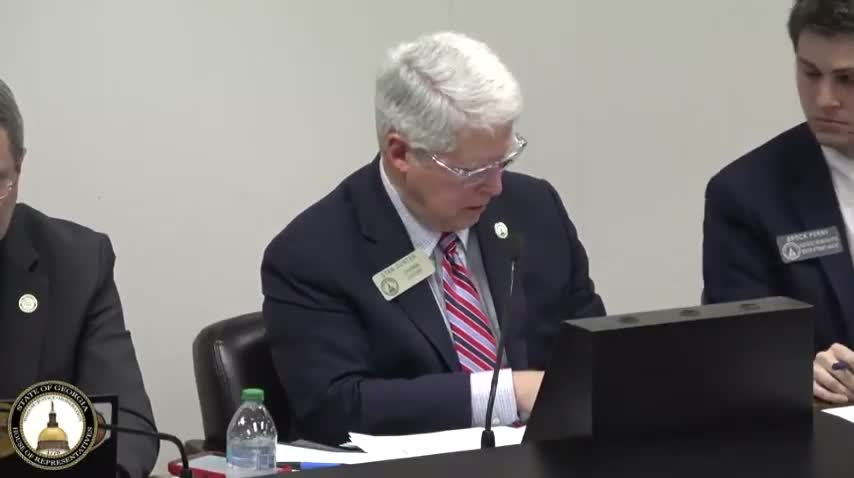
Summary
Representative Hawkins’ bill to create a longitudinal criminal‑justice dataset for researchers was held for further work after prosecutors, sheriffs and the GBI raised privacy and federal-compliance concerns about criminal-history disclosures and sealed records.
The Judiciary Committee held House Bill 1243 after witnesses warned the measure as written could conflict with state and federal criminal-history rules and pose privacy risks. Representative Hawkins said HB1243 would collect longitudinal criminal-justice data, including individual identifiers, for use by bona fide researchers under strict confidentiality protocols so the state can measure outcomes and policy impacts over time.
Robert Smith, general counsel for prosecuting attorneys, expressed support for the bill’s aim but urged stronger guardrails to protect criminal histories, victim information and attorney work product and asked what sanctions would follow a breach. “We have criminal histories. We have personal information of defendants, of victims…making sure that it is protected and made sure not to ever become public,” Smith told the committee.
Mike Mitchell, deputy director of the Georgia Sheriffs Association, warned the measure might put law‑enforcement access to federal CJIS and FBI systems at risk if disclosures conflict with those systems’ rules. Philip Curtis, an attorney with the Georgia Bureau of Investigation, told members the bill’s language (lines 78–81 in the draft) “provides for a disclosure of criminal record information, without exemption, without redaction, without any type of consideration of currently existing state and federal law,” and cautioned that violating those rules could jeopardize agency access to national criminal-justice data.
Committee members discussed comparative models in other states and asked the GBI and sponsor to consult colleagues in larger states that run similar programs. The sponsor agreed to work with the GBI and other stakeholders; the committee decided to hold HB1243 to allow time to resolve compliance and data‑governance issues.