Columbia County adopts new 20‑year comprehensive plan after heated public comment on data‑center rezonings
Loading...
Summary
After a consultant presentation and extended public comment focused on recent map changes and data‑center rezonings, the Columbia County Board of Commissioners adopted Resolution 26‑6, transmitting the "Foundations for the Future" comprehensive plan to regional and state reviewers. Residents urged more outreach, green space and clearer infrastructure projections for large projects.
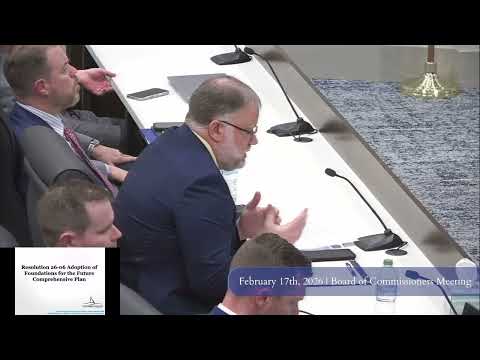
The Columbia County Board of Commissioners voted Feb. 17 to adopt Resolution 26‑6, the county’s new comprehensive plan titled "Foundations for the Future," after a consultant presentation and extended public comment focused on recent map changes and data‑center rezonings.
Consultant Carrie Papelbon, representing the planning firm listed in the presentation materials, told the board the plan is intended as a 20‑year “road map” and a policy guide rather than zoning. She described a 12‑month process that included three waves of public engagement — kickoff events, visioning workshops and public review — and said the project website, interactive map and pop‑ups drew substantial interest. “This is your road map for how to proceed into the future,” Papelbon said during her presentation.
Many residents, however, told the board the outreach did not reflect how the character map changed during the process. Lee Munn, a longtime resident who said he participated in the county’s Vision 2035 process, criticized the current effort as rushed and underengaged, saying the county paid $267,000 for public engagement yet reached “less than 1% of the community.” He urged commissioners to reject the plan or delay adoption to allow more input.
Other public commenters raised more specific objections. Rachel Dixon asked whether the revised map reduces industrial uses in the Appling area and urged preserving the community’s agricultural character. Ron Gilchrist described recent on‑the‑ground tree clearing in areas he said had been shown as forest and wetland. Dan Lanning and others asked staff and the consultants to explain what changed between the August and October drafts and whether subsequent rezonings — including data‑center approvals — prompted map revisions; Lanning asked the board to postpone adoption to allow time to review those changes.
The board’s staff and consultants said the map evolved iteratively with staff and the steering committee and that some map changes reflected development activity and recent rezoning actions. Staff also noted an amendment to the character map tied to the Pumpkin Center rezoning: an area south of I‑20 and east of Highway 221 will be amended to show commercial or open/green space rather than the industrial/technology classification shown in earlier drafts.
Environmental concerns were also raised. Catherine Minor, speaking for the local chapter of the Georgia Native Plant Society, urged access for plant surveys on sites slated for development, recommended native plantings in landscaping, and warned against relying on species in the county tree list that may be invasive in certain settings.
On procedural questions about utilities and site impacts, staff said many details — including precise water, power and stormwater projections — are site‑specific and require site plans and permits from applicants. The county engineer noted stormwater systems must be designed to keep post‑construction runoff at or below predevelopment rates.
After hearing testimony and commissioner discussion, the board voted by raised hands to adopt Resolution 26‑6 and authorized transmittal to the Central Savannah River Area Regional Commission and the Georgia Department of Community Affairs. The transcript records the chair announcing, “That motion carries.” The transcript does not include a roll‑call vote or a numerical tally.
Next steps noted by staff include the transmittal to regional and state reviewers; adoption preserves the county’s compliance with the Georgia Comprehensive Planning Act and allows the county to continue to have zoning tools in place. Several residents requested additional review and urged commissioners to consider further amendments or a delay if substantive changes are proposed in the coming weeks.