Get Full Government Meeting Transcripts, Videos, & Alerts Forever!
Get email alerts on the Transportation topic
No spam. Unsubscribe anytime.
Beaumont adopts Neighborhood Traffic Management Plan, sets 70% petition threshold for speed humps
Summary
The City Council adopted a formal Neighborhood Traffic Management Plan that establishes a data-driven five-step process for resident requests and a specific speed-hump approval policy requiring petitions from 70% of affected households; staff said speed-hump timelines range from six months to two years depending on the measure.
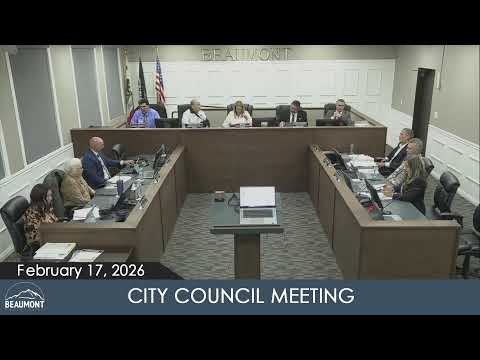
Beaumont — The Beaumont City Council unanimously adopted a Neighborhood Traffic Management Plan (NTMP) on Tuesday that formalizes the city’s process for handling resident traffic-safety requests and introduces a policy for installing speed humps on qualifying residential streets.
Plan details and policy
Public Works staff described the NTMP as a five-step, data-driven framework: (1) request or petition (initiated by residents, staff or council), (2) evaluation (traffic studies, field review), (3) response (findings and potential solutions shared with residents), (4) implementation (approved measures installed), and (5) review (post-installation monitoring).
Staff explained that the speed-hump policy is new to the formal document and includes strict eligibility criteria: the street must be residential with one lane in each direction, at least one-quarter mile long, a posted speed limit of 25 mph or less, a width no greater than 40 feet, a grade no greater than 8%, and cannot be a primary emergency or transit route.
"The action today is to adopt this policy," Public Works (Robert Bridal) said during his presentation.
Petition threshold and process
The policy requires a resident petition securing signatures from 70% of affected households on a candidate street before staff will schedule evaluation and review with emergency services. Staff said the timeline from request to installation will vary by measure — traffic signals can take up to two years, stop-sign studies may take from a week to six months, and speed-hump requests typically fall within a six-month to two-year window depending on data and coordination with fire and police.
Council discussion and alternatives
Council members discussed whether administrative approvals by the public-works director would be adequate for installations that meet all criteria versus bringing the item back to the council as a consent item for notice. One councilmember proposed using a consent notice approach, which would allow the public an opportunity to pull items for discussion. Council also asked staff to evaluate alternatives to humps (for example, larger truncated-domes) and to consider maintenance implications.
Adoption and next steps
A councilmember moved to adopt the Neighborhood Traffic Management Plan; the motion passed by unanimous roll call. Council directed staff to prepare implementation steps, return with details for any design alternatives, and incorporate the policy in the city’s CIP or operating workflows as needed.