DeSantis, advocates ask Kentucky committees to back balanced-budget amendment; no vote taken
Loading...
Summary
Florida Gov. Ron DeSantis and Lauren Ends of the national balanced-budget campaign addressed a joint meeting of two Kentucky House committees on House Concurrent Resolution 45, urging support for a federal balanced-budget amendment or an Article V convention limited to a single subject. Committee members pressed presenters on enforceability, delegate selection and emergency exceptions; the measure was discussed for information only.
Governor Ron DeSantis and campaign leader Lauren Ends urged Kentucky legislators on Tuesday to lend support to House Concurrent Resolution 45, a measure that would back a federal balanced-budget amendment or a state-initiated Article V convention limited to the single subject of balancing the federal budget.
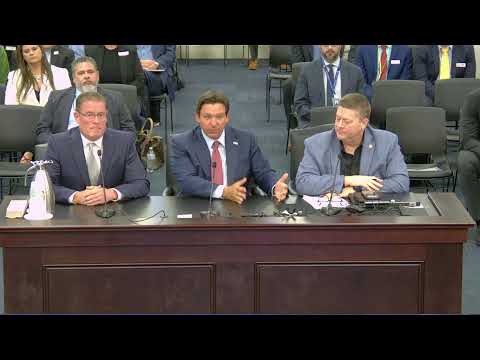
"We have the power to do it in our states," Governor Ron DeSantis told a joint meeting of the House Elections, Constitutional Amendments and Intergovernmental Affairs Committee and the House State Government Committee. He framed the proposal as a way for states to check long-term federal deficits and to change the incentives facing members of Congress.
Representative Jason Petrie (introducing the resolution and the panel) told the committees the resolution is intended to start a conversation at the state level. "This is for information only, so I'm not asking for a vote today," Petrie said.
Lauren Ends, who leads the national campaign for a balanced-budget amendment, presented numerical context the panel used repeatedly throughout the hearing. "What I would remind you is the mathematical impossibility that we are facing," she said, citing campaign figures for federal debt and revenue and using an illustrative debt-to-income analogy to show projected strain on public finances.
Presenters from Florida argued two routes exist to propose a constitutional amendment: passage by two‑thirds of both houses of Congress or a convention called under Article V after two‑thirds of state legislatures submit matching calls. DeSantis and Ends said the convention route can be limited to a single subject if states pass legally binding, narrowly worded calls and if states commission delegates under state law.
Committee members raised procedural and legal questions during a lengthy Q&A. Representative Heff asked whether a "sole purpose" limit on a convention is enforceable; DeSantis and Ends pointed to state "faithful delegate" laws and other guardrails that some states have enacted, and to Congress's role in counting and recognizing convention calls. Ends noted roughly 18 states have passed laws specifying delegate limits, and the campaign cited 28 states that have passed balanced-budget calls, short of the 34 needed to trigger a convention.
Members also pressed on implementation mechanics. Representative Lehman asked who would enforce a balanced-budget requirement at the federal level and whether presidential emergency powers could be used to evade it. Ends said amendment language can include explicit emergency exemptions subject to a supermajority congressional approval and annual reauthorization; she and DeSantis said those and other details would be worked out either by Congress or by the convention delegates.
Several lawmakers voiced concerns about special-interest capture and misinformation. Representative Hancock asked how the process could be shielded from well-funded outside influence. DeSantis and Ends replied that a dispersed, state-by-state process with legal limitations on delegates would reduce the influence of single national actors compared with federal lobbying, though they acknowledged the risk of misinformation in the public sphere.
Supporters on the committee urged Kentucky to join the movement as a check on federal fiscal policy; some members said they remained unconvinced and raised constitutional or political objections. Representative Chester Burton asked technical questions about delegate selection and vote counting; presenters referenced historical precedent and state-level selection rules and emphasized that many procedural details would be finalized if the federal or state processes moved forward.
The hearing concluded without a vote on HCR 45. Representative Petrie said the item was for information and that he may seek a vote later after continued discussion.