
Federal changes to waiver oversight, rate rebasing spotlighted in Alaska health budget hearing
Get AI-powered insights, summaries, and transcripts
Subscribe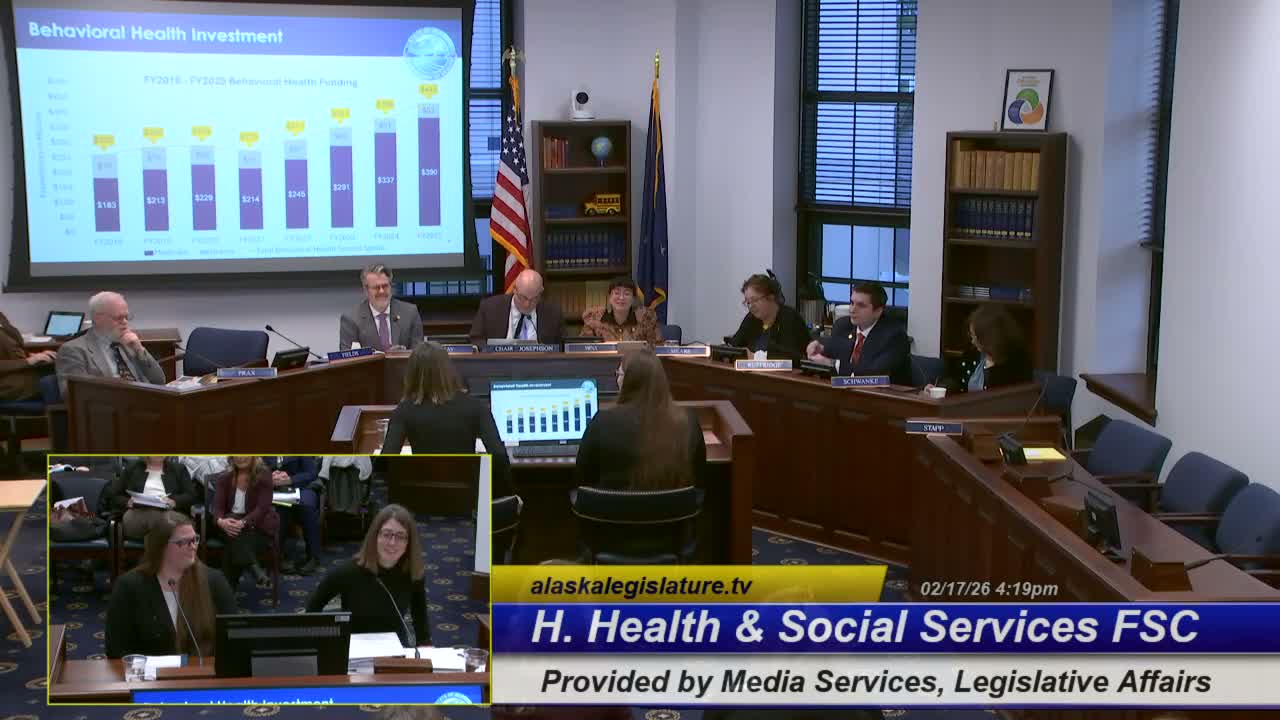
Summary
Deputy Commissioner Emily Ricci told the subcommittee that H.R. 1 now requires an actuary review for Section 1115 waivers and that Alaska’s current demonstration meets existing budget‑neutrality practice; the department described Guidehouse/Milliman rate work and next steps for public comment and implementation.
Emily Ricci, deputy commissioner of the Department of Health, said at the Feb. 17 House Finance Health Subcommittee meeting that a provision of H.R. 1 explicitly requires the federal office of the actuary to review the budget neutrality of Section 1115 Medicaid demonstration waivers.
Ricci said the Department of Health meets existing budget‑neutrality practices and that staff and the division meet regularly with the Centers for Medicare and Medicaid Services to validate projections. “There is a section of H.R. 1... that does make changes to 1115 requirements,” Ricci said; she added that the department’s team meets with CMS about every three months to review projections.
Context: the division and department described a broader program of rate methodology work intended to align Medicaid payments with desired outcomes. Acting Deputy Director Amaris Rosario said consultants Guidehouse and Milliman were engaged to review payment foundations and propose updated rates. “We did move forward with adopting Guidehouse’s proposed recommendations for new rates, with a hold‑harmless approach through FY27 that’s available for public comment now,” Rosario said.
Members asked how those changes translate into future costs and whether new federal actuarial requirements could constrain state demonstrations. Ricci said current requirements meet federal standards and that the actuarial review is effectively making explicit a practice that has largely been applied in prior reviews.
Lawmakers also pressed for accessible actuarial materials and for clearer outcome measures the public can use to judge whether increased Medicaid spending reduces hospitalizations and other high‑cost care. Ricci said the materials are publicly posted and the division will provide additional documentation on measures and methodology.
Sources: Testimony by Emily Ricci, Deputy Commissioner, Department of Health; Amaris Rosario, Acting Deputy Director, Division of Behavioral Health; committee Q&A on Feb. 17, 2026.