
Alaska DOT describes large-scale Typhoon Halong response, warns documentation is crucial for FEMA reimbursement
Get AI-powered insights, summaries, and transcripts
Subscribe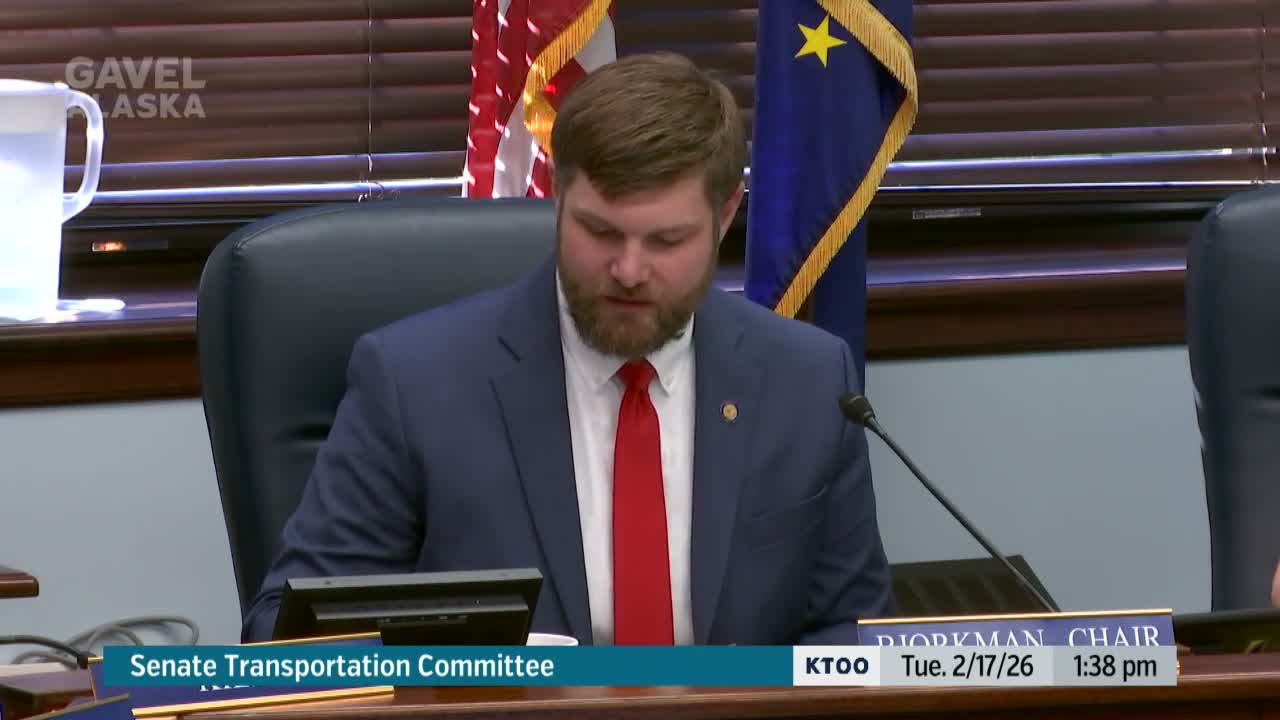
Summary
Department of Transportation and Public Facilities officials told the Senate Transportation Committee that October 2025’s Typhoon Halong damaged dozens of Western Alaska communities, displaced hundreds of structures and required rapid drone-enabled assessments, emergency contracting and a race to finish work before spring thaw; officials stressed rigorous documentation to preserve FEMA reimbursement.
Juneau, Alaska — Department of Transportation and Public Facilities officials told the Senate Transportation Committee on Feb. 17 that their statewide response to the October 2025 West Coast storm and Typhoon Halong required an unprecedented mix of drone assessments, emergency contracting and multimodal logistics to stabilize remote communities and restore lifeline access.
“Drone missions generated high-resolution ortho mosaic imagery and geospatially referenced assessment data for 35 communities within three days,” said Merle Sena, a DOT project engineer who led Bethel-area operations, describing how aerial imagery compressed assessment timelines so contractors could be mobilized faster.
Deputy Commissioner Catherine Keith said DOT led the construction-focused response under the governor’s disaster declaration because the department has existing contracting authority and construction capacity. “This is typical where we take that lead in getting out our emergency contracts because we can leverage our resources within contracting, within procurement, to get contractors out and be able to work with them and our construction staff in days or sometimes months following,” Keith said.
DOT officials gave these key figures to the committee: more than 50 communities sustained impacts; more than 200 structures were displaced from foundations (some carried over a mile); more than 12 miles of board roads were destroyed or severely damaged; five airports sustained damage; 15 schools were damaged; about 250 DOT employees worked under an incident command structure; and DOT reported moving more than 8,000,000 pounds of materials with another roughly 8,000,000 pounds remaining to move before the spring thaw.
Officials said the department used a layered communications approach where responders carried AT&T FirstNet-capable phones and Starlink terminals to mitigate local cellular outages, a necessity in areas where GCI towers were down and local cellular service took weeks to restore.
DOT described season-driven logistics: barges and fixed-wing flights were used immediately after landfall, then aircraft and finally overland transport (piston bullies, snow machines and packed snow trails) when rivers froze. That winter window is time sensitive; staff said roughly two months remain before spring thaw will limit heavy hauling and housing relocation.
Committee members pressed DOT on several operational points. Senator Tobin asked whether responders had multiple communications methods when local service failed; Keith said teams were equipped with FirstNet and Starlink and noted local staff in places such as Nome and Kipnuk. Senators also asked about materials backhaul and waste handling; DOT said contractors are stockpiling debris at barge landings and a backhaul contractor (Delta Backhaul) is managing burning, crushing and removal operations until rivers thaw for barging.
Amber Shumpert, DOT’s statewide safety systems manager and deputy incident commander for the response, told the committee that FEMA accepted DOT’s geolocated and time-stamped imagery and that digital records formed a “common operating picture” shared with FEMA and state partners. “For the first time, they accepted these digital records, and they accepted that the damage assessments conducted by Alaskans would not be then rerated by an external validation team,” she said.
Though officials expressed greater confidence because FEMA personnel participated closely with DOT during assessments, they warned that reimbursement is not automatic. “Without proper documentation, we are at high risk of not getting reimbursed,” Keith told senators, saying the Department of Military and Veteran Affairs is leading negotiations with FEMA on cost-share levels.
DOT described its contracting approach during the emergency: roughly 15 prime contractors were engaged overall, with nine active primes at the time of the hearing; many contracts used time-and-materials temporary work authorizations because early scopes were uncertain. Officials said DOT is moving toward unit pricing where feasible and is maintaining ICS finance tracking and detailed daily reports to support FEMA public assistance claims.
Members heard community-specific examples: in Kipnuk DOT prioritized runway repairs so fixed-wing aircraft could land and evacuate residents and deliver supplies; in Quig, washed-out board roads and bridges isolated the east side and forced use of smaller aircraft; in Nightmute, the landfill was compromised and DOT and DEC built a replacement.
DOT said local hires have been an important part of the workforce (DOT reported nearly 150 local hires among contractors) and that many homes have been stabilized or relocated — DOT reported roughly 170 homes substantially complete, about 160 in progress and 50 homes returned to place so far — while emphasizing much work remains before thaw.
The committee closed with bipartisan appreciation for DOT’s work and a stakeholder tribute that described the response as timely and comprehensive. The chairman noted the committee will next meet to discuss pedestrian safety in Anchorage.
What’s next: DOT said near-term objectives are to maximize the winter construction window, complete pile-supported boardwalks and relocations, maintain thorough documentation tied to FEMA categories, and continue to coordinate logistics and contracting until spring conditions change.