
DOT outlines advanced construction balances, says AC is a cash‑flow tool for large projects
Get AI-powered insights, summaries, and transcripts
Subscribe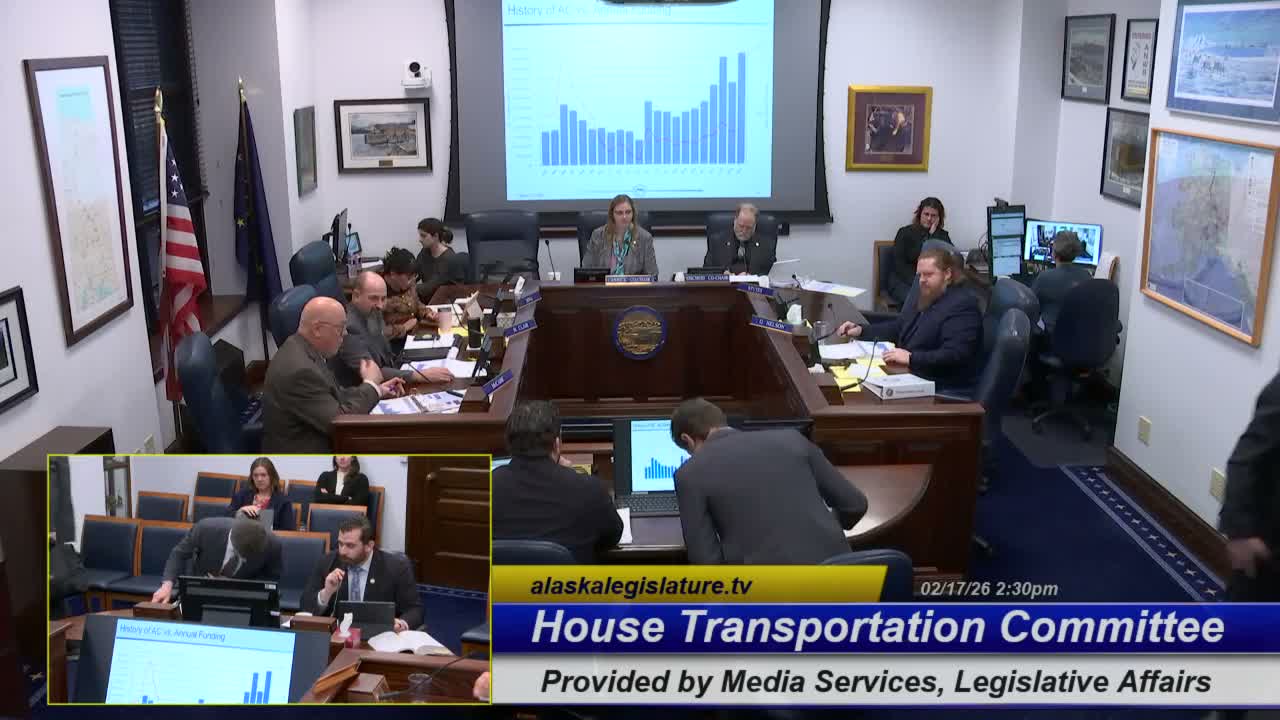
Summary
DOT financial staff briefed the House Transportation Committee on federal funding programs and the agency's use of advanced construction (AC) to obligate large projects early; officials said AC provides timing flexibility but requires careful conversion to appropriate federal funding streams.
Adam Moser, program management chief with the Alaska Department of Transportation and Public Facilities, told the House Transportation Committee on Feb. 17 that advanced construction (AC) is a cash‑flow and timing tool that lets DOT obligate work early and later convert those obligations to the most appropriate federal fund sources.
Moser explained that AC balances have fluctuated over 20 years; Dom Pinon summarized the department's AC history, saying, "All the way back to 2004, we had roughly $175,000,000 of projects authorized on advanced construction," and that in earlier years (2006 cited) AC authorizations at times exceeded an entire year's federal apportionment. Moser said the National Highway Performance Program (NHPP) has been the largest annual federal source (roughly $350,000,000 annually cited) and that AC obligations are often converted to funds such as bridge funding or other targeted programs when appropriate.
Committee members asked whether the state operating budget shows a breakdown of federal fund sources; Moser and Pinon said DOT tracks more than 35 unique FHWA fund types and that the STIP fiscal constraint tables provide those details. Representative Kerrick asked for a snapshot of recent years' funding breakdowns; Moser agreed DOT can provide that information to the committee.
Moser walked the panel through major federal funding streams: NHPP (primary source cited), Surface Transportation Block Grant (STBG, roughly $160,000,000), the Highway Safety Improvement Program (HSIP, roughly $60,000,000), CMAQ (for air quality areas), PROTECT (about $18 million to the state annually), tribal transportation channels and Federal Transit Administration programs (Sections 5307/5311/5339). He also reviewed discretionary IIJA programs (carbon reduction, rural surface transportation grants, wildlife crossings, Reconnecting Communities) and emphasized that many programs are specialized, have specific eligibilities, and are distributed either by formula, suballocation or competitive award.
Using the Cooper Landing bundle as an example, Moser explained DOT can obligate construction costs early under AC and later convert those authorizations to the most suitable funding pot as projects mature. He concluded: "Advanced construction is a tool that we use for cash flow and timing."
Ending: The committee requested a clearer breakdown of federal fund sources and a status update on a local CMAC request; DOT agreed to provide a funding snapshot from recent years and to investigate the CMAC inquiry.