
CFEC asks Legislature for more IT funding as commissioners discuss carry-forward risk and leadership change
Get AI-powered insights, summaries, and transcripts
Subscribe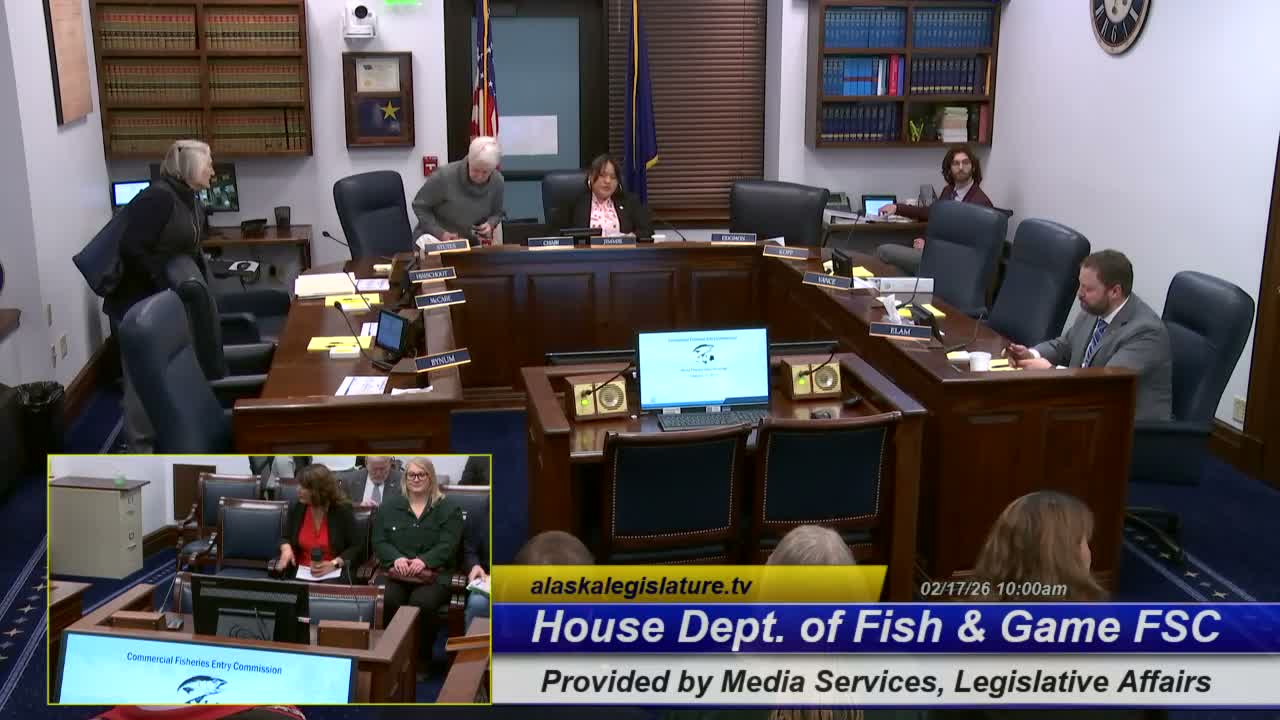
Summary
The Commercial Fisheries Entry Commission told the House Finance Subcommittee on Fish and Game it needs additional IT modernization funding and warned of carry-forward shortfalls that could disrupt operations; commissioners also discussed an imminent leadership change and how remote residency may affect oversight.
The Commercial Fisheries Entry Commission asked the Alaska House Finance Subcommittee on Fish and Game on Feb. 17 for additional funding to finish an IT modernization effort and warned the agency faces carry-forward shortfalls that could disrupt operations.
Glenn Haight, commissioner and chair of the Commercial Fisheries Entry Commission, introduced the presentation and said the commission will provide a follow-up memo to correct and clarify figures in the slide deck. "We will do a follow-up memo," Haight said.
Commissioner Rick Green said CFEC is a small agency with a large footprint: "almost 17,000 permits, a little over 7,000 vessels permitted each year, on a staff of less than 20 people," and that the fleet produced an estimated $1.8 billion in 2024 and contributes about $6 billion to Alaska’s economy. He said CFEC also holds confidential commercial-fisheries and economic data and must protect the integrity of the state’s limited-entry system.
On the budget, commissioners showed a multi-year chart of costs and revenues and said CFEC relies on an adequate carry-forward to cover low-revenue months. Haight said an adequate carry-forward is "in the order of $1.516 million" as presented and cautioned that staff and accountants advise not letting the carry-forward go negative.
CFEC explained an apparent drop in the 'services' category from about $904,000 in FY26 to $297,000 in FY27 largely reflected the prior allotment of IT modernization funds; the agency said $450,000 had been authorized as a three-year increment in FY25 but additional funding is likely needed to complete the project. "That was a good start," Haight said of the prior increment, and CFEC is requesting an additional $500,000 over three years to finish the work.
Haight described recent IT and records work: a records-reduction and archival project that digitized files and reduced storage costs, new hardware purchases (he estimated about $200,000 worth), a new firewall and improved backup, and upgrades to the online permit-renewal platform. He said some internal systems still run on legacy code and that final scope and costs depend on how much funding is available. "It depends how much funding we can get to what we can do," Haight said.
Members pressed for specifics. Representative Elam, noting an IT background, asked for technical detail; Green and Haight offered a follow-up memo and invited staff-level meetings. Representative Bynum asked what the initial $450,000 increment was expected to cover and why CFEC now requests an additional $500,000 for FY27–29; CFEC said the earlier amount was intended as a modest start and that pilot projects and shifting methodology informed the new request.
The presentation also covered limited-entry program work, including optimum-number studies and a reference to Senate Bill 158 concerning Cook Inlet setnet fisheries; commissioners said statutory buyback authority exists but no buybacks have occurred to date.
Several members asked about leadership and operations after Haight’s departure. Representative Benjamin asked about the succession plan and whether Commissioner Green – who said he lives in Anchorage – would relocate to Juneau. Green said the executive director handles day-to-day operations and the chair can step in as needed, and that meetings and IT tools have so far prevented communication problems. Representative Benjamin cautioned that not having a commissioner based in Juneau is "unsettling" and asked whether service would suffer; CFEC said it expected no loss of services but committed to follow up with details.
No formal motions or votes were taken at the Feb. 17 session. CFEC committed to provide corrected slide figures and a follow-up memo with technical details on the IT project and staffing questions. The subcommittee scheduled further follow-up at its next meeting.
The subcommittee recessed with a plan to reconvene next Tuesday.