
Alaska committee hears bill to allow automated traffic safety cameras, seeks more info from APD
Get AI-powered insights, summaries, and transcripts
Subscribe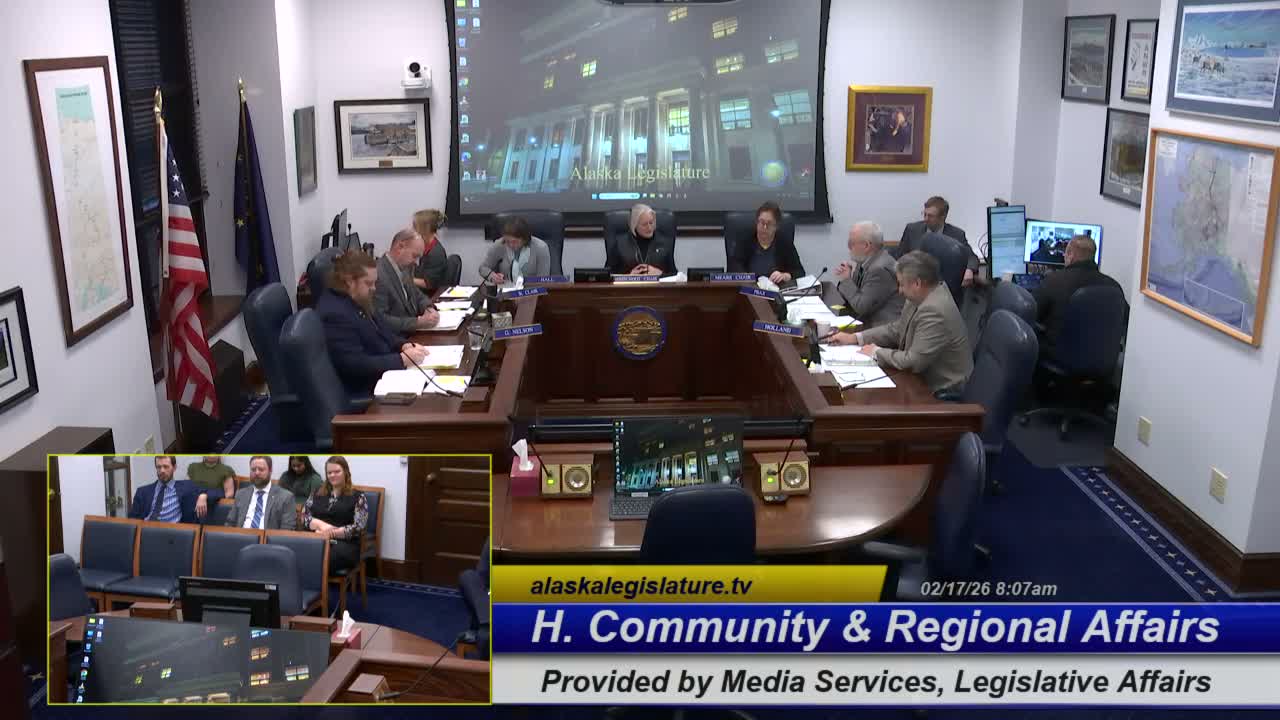
Summary
On Feb. 17 the House Community and Regional Affairs Committee held a first hearing on HB 282, which would reserve state regulation of automated traffic cameras and allow municipalities to use them to address high traffic fatalities; witnesses said cameras can reduce red-light running but members sought clarity on enforcement, local authority and costs.
Representative Zach Fields, sponsor of HB 282, told the House Community and Regional Affairs Committee on Feb. 17 that the bill would allow municipalities to use automated traffic safety cameras — including speed, red-light and railroad-grade crossing cameras — and reserve regulation of those cameras to the state. "All it does is allow them to, if in their judgment, it is necessary for public safety," Fields said during the committee's first hearing.
The bill would add a paragraph to Alaska Stat. 29.10.2 and create a new section in AS 29.35 (29.35.0.143) to clarify that regulation of automated traffic enforcement cameras is a state matter that applies to both home-rule and general-law municipalities, according to Michael Motti, who provided the sectional analysis.
Sponsor and witnesses stressed Anchorage safety concerns. Lindsay Hajduk, director of community engagement at NeighborWorks Alaska, said Anchorage has experienced "a transportation safety crisis," telling the panel that "15 pedestrians were killed, including one bicyclist last year," and that about 30 people die in vehicle collisions in Anchorage annually. She and other witnesses said automated enforcement is a proven Vision Zero strategy to reduce red-light running and collision severity.
Supporters described operational gaps that cameras can fill. Fields and his staff said some intersections are physically impossible for an officer in a patrol vehicle to document with the evidence a prosecutor would accept, pointing to Minnesota & Benson and Northern Lights as examples. Fields said the bill does not compel a jurisdiction to install cameras but provides the legal path for localities that choose to use them.
Committee members pressed two core concerns. Representative Garrett Nelson asked whether the bill would effectively prevent municipalities from banning cameras in the future; Fields replied the sponsor's intent is permissive and that "nothing in this bill makes them do it." Representative St. Clair raised questions about the practical mechanics and the zero fiscal note, noting that many camera programs are operated by outside contractors and that enforcement often requires additional infrastructure and police review.
DOT and data perspective: Andy Mills, legislative liaison for the Department of Transportation, told the committee that national and state DOT research and meta-analyses show red-light camera enforcement and related automated programs can reduce red-light running roughly 18–25 percent depending on site and implementation, while cautioning Alaska faces specific challenges such as winter maintenance and plate visibility.
Invited testimony added local viewpoints. Jade Powell (North Star Community Council) and Nancy Pease (Rabbit Creek Community Council) described near-miss incidents and family crash experiences at Anchorage intersections and urged the committee to keep automated enforcement on the table while refining implementation standards to avoid contractor-driven misuse. Powell noted that implementation details are sparse in the bill and cautioned against designs that prioritize revenue over safety.
What happens next: Committee members requested invited testimony from the Anchorage Police Department and APD legal to clarify the burden of proof and enforcement procedures, and the committee set HB 282 aside for further work and follow-up. The hearing record shows the committee intends additional technical briefings before advancing the measure.
Quotes from the hearing "All it does is allow them, if in their judgment, it is necessary for public safety." — Representative Zach Fields "Fifteen pedestrians were killed... that is just unacceptable." — Lindsay Hajduk, NeighborWorks Alaska "Studies ... show a range between 18–25% [reduction in red-light running], depending on location and implementation." — Andy Mills, DOT legislative liaison
Ending The committee did not vote on HB 282 and set the bill aside after requests for more technical details and invited testimony from APD. The panel signaled interest in refining statutory language and clarifying implementation, fiscal and evidence standards before considering the measure again.