
Senate Finance hears Department of Revenue primer on Alaska production tax, forecasts
Get AI-powered insights, summaries, and transcripts
Subscribe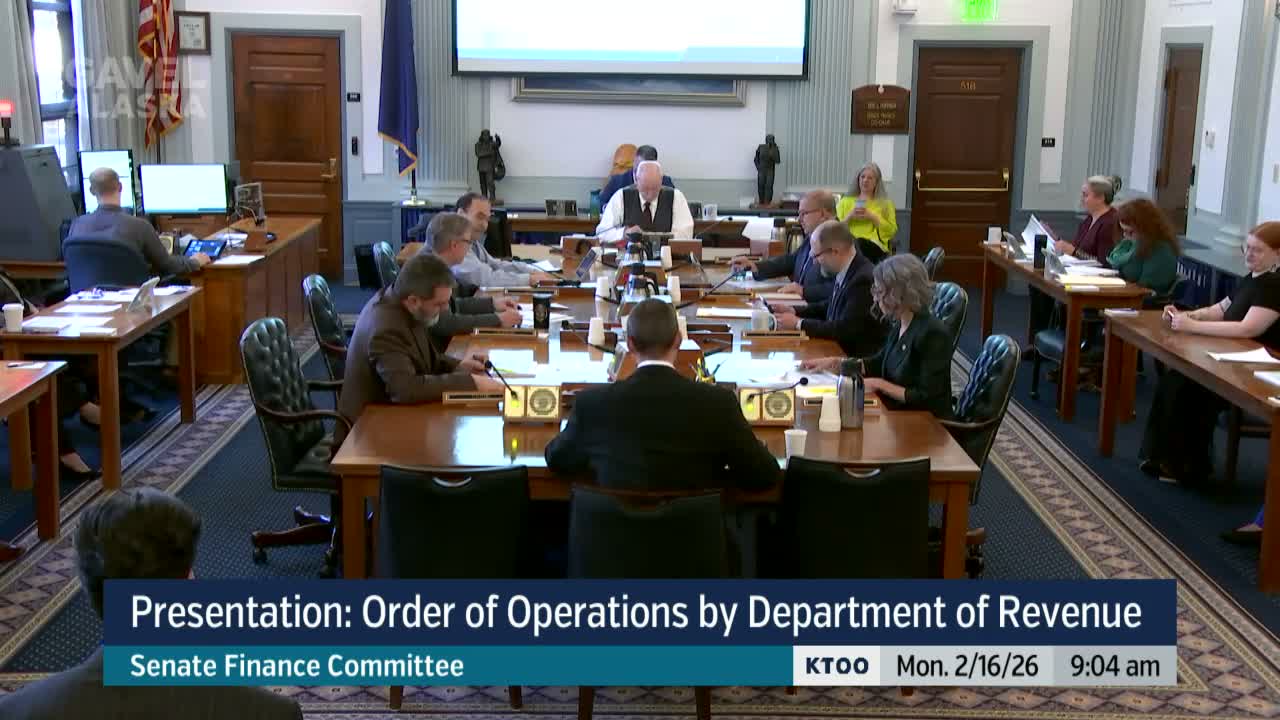
Summary
The Department of Revenue told the Senate Finance Committee how Alaska’s production tax is calculated, why a 4% minimum tax floor matters, and how company-specific credits and lease expenditures produce divergent outcomes; FY2027 estimates show a wide gap between aggregate credits earned and credits applied.
Dan Stickle, chief economist at the Alaska Department of Revenue, told the Senate Finance Committee on Feb. 16 that the state’s production tax is calculated by segment and then summed statewide, with credits and a 4% minimum tax floor applied after that aggregation.
Stickle said the production tax calculation for the North Slope begins with gross value (price minus transportation and royalties), subtracts allowable lease expenditures, and then applies a net-profits style tax and a statutory minimum. "Our production tax is based on segments," he said, describing separate calculations for North Slope oil, North Slope gas, Middle Earth fields and Cook Inlet leases.
Why it matters: the order of operations and per-barrel credits determine whether a company pays above, at, or below the minimum tax floor — producing widely different outcomes across firms. For fiscal year 2027, Stickle presented a scenario with an average North Slope price of $62 per barrel, daily production of about 518,000 barrels and a North Slope gross value for tax purposes of roughly $8.5 billion.
Key numbers presented by the Department of Revenue included an estimated FY2027 net tax calculation of about $542 million for North Slope oil, a 4% minimum tax floor (about $340 million on the gross value), and approximately $6.6 billion of lease expenditures applied in the FY2027 calculation with roughly $1.5 billion carried forward into future years. Stickle also noted that while about $1.2 billion of per-taxable-barrel credits may be earned in the year, only a little over $200 million are actually applied in the calculation.
The Department emphasized the difference between aggregate, slope-wide calculations and company-specific outcomes. "Some companies are paying below the minimum tax floor based on their tax calculation. Others are paying at the minimum tax floor, and others are paying above the minimum tax floor," Stickle said, explaining the reconciliation adjustment used in the revenue forecast.
Committee members pressed for additional, company-level modeling and inflation-adjusted breakdowns of historical lease expenditures. Senator Kaufman asked whether the department could provide more detailed field-level economic analysis to show whether projects would proceed without incentives; Stickle said more detailed work exists but was not included in the 62-slide deck and offered to return with it.
The session closed with the chair thanking Stickle and staff for an introductory review ahead of deeper modeling and policy discussions to come. The committee adjourned at 10:47 a.m.