Get AI Briefings, Transcripts & Alerts on Local & National Government Meetings — Forever.
Senate panel weighs sweeping changes to Alaska trust law, including sealed records and shorter creditor lookback
Loading...
Summary
At a second hearing on SB225, the committee reviewed a 26‑section bill that would allow courts to seal certain trust litigation records, expand non‑judicial settlement agreements and decanting authority, and shorten creditor lookback periods; members raised privacy and public‑interest concerns and left the bill open for more work.
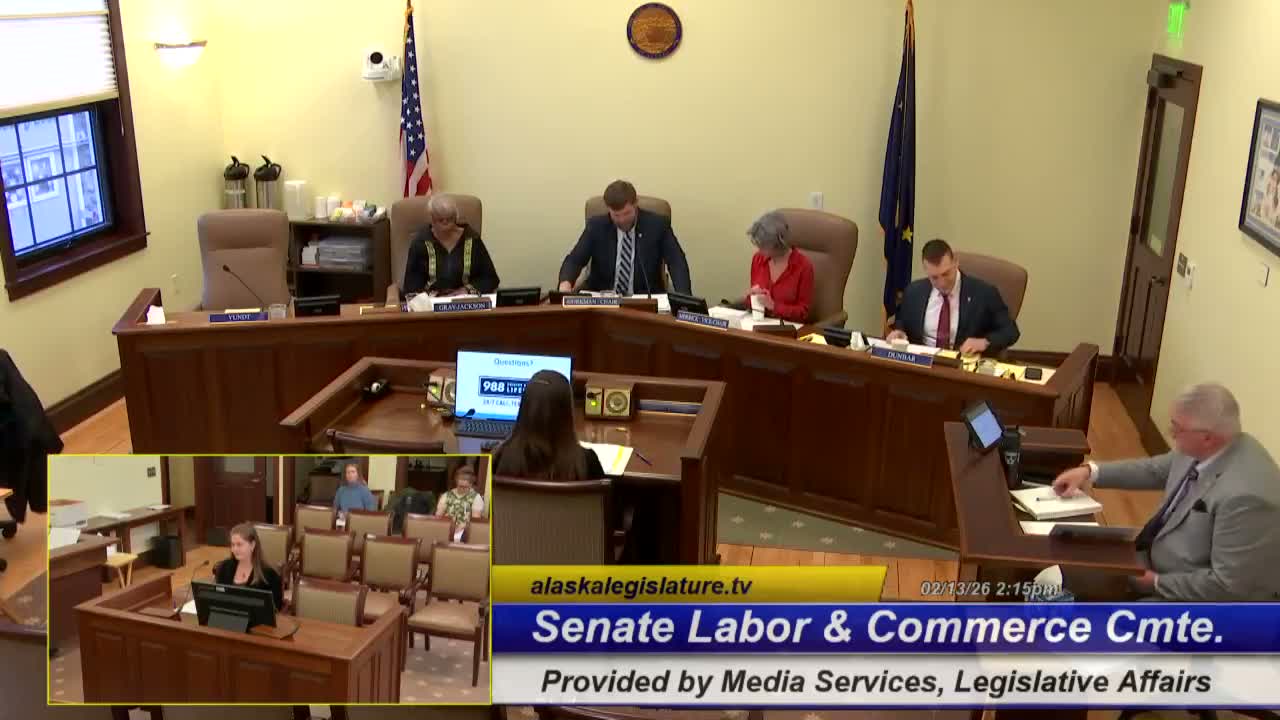
Juneau — The Senate Labor and Commerce Committee held a second hearing Feb. 13 on Senate Bill 225, a broad update to Alaska trust law that includes provisions to seal certain trust litigation records, expand decanting authority and shorten the creditor lookback period.
Anna Latham, deputy commissioner at the Department of Commerce, Community and Economic Development, described SB225 as a 26‑section bill designed to modernize Alaska's trust statutes and enhance the state's competitiveness for trust business. "Senate Bill 225 requires courts to seal records," she said, and the bill also expands non‑judicial settlement agreements, creates statutory notice for proposed fiduciary actions, and broadens decanting authority.
Industry testimony supported the bill as improving clarity and competitiveness. Matthew Blattmacher, president and CEO of Peak Trust Company, said the measure ‘‘clarifies and modernizes Alaska's law’’ and argued that making Alaska more predictable for trustees would bring jobs and business to the state. He said corporate‑trust clients tend to be larger and estimated that the average trust where a corporate trustee is used is "probably 10,000,000 plus." Blattmacher recommended passage while offering to provide supporting documentation to the committee.
Committee members, led by Senator Dunbar, pressed the administration and legal staff on policy tradeoffs. Dunbar asked why Alaska should follow South Dakota's example for sealing trust litigation files and whether the changes could create a ‘‘race to the bottom’’ for consumer protections. "Is this a race to the bottom in some way where we are doing things that are perhaps counter to the public interest?" Dunbar asked the committee.
Department of Law representative Amy Robinson told the committee that access to sealed trust litigation records would require a showing of compelling public interest: "The journalist would be required to present evidence to the court that there's a compelling public interest to be served by granting access to the information," and the draft uses a "clear and convincing evidence" standard consistent with Title 13 practice.
Nancy Mead, general counsel for the Alaska Court System, provided volume context: courts receive roughly 1,300 to 1,700 trust registration filings per year but only about 30 trust litigation cases are filed annually; SB225's sealing provision would make those litigation dockets confidential by default, with limited access on a showing of good cause.
Members also explored the substantive effect of shortening the creditor lookback from four years to one, with proponents arguing it aligns Alaska with other jurisdictions and enhances competitiveness, and critics warning it may reduce creditor protections. Committee members asked the department and Department of Law for comparative data, statutory drafting options (for example, dollar thresholds), and examples showing practical effects on judgments such as child support enforcement.
No vote was taken; the committee left public testimony open and set SB225 aside for future consideration. The committee asked staff to provide additional data on lookback periods and to clarify the practical implications for enforcement of judgments and access under the proposed sealing rules.