Senate committee hears proposal for 98¢ monthly phone surcharge to fund behavioral‑health crisis services
Loading...
Summary
Senators heard SB196, which would add a 98¢ monthly surcharge per phone line to create a behavioral health crisis services fund to support 988, mobile crisis teams and crisis stabilization centers; supporters said it would provide predictable funding, while committee members asked for revenue comparisons and implementation details.
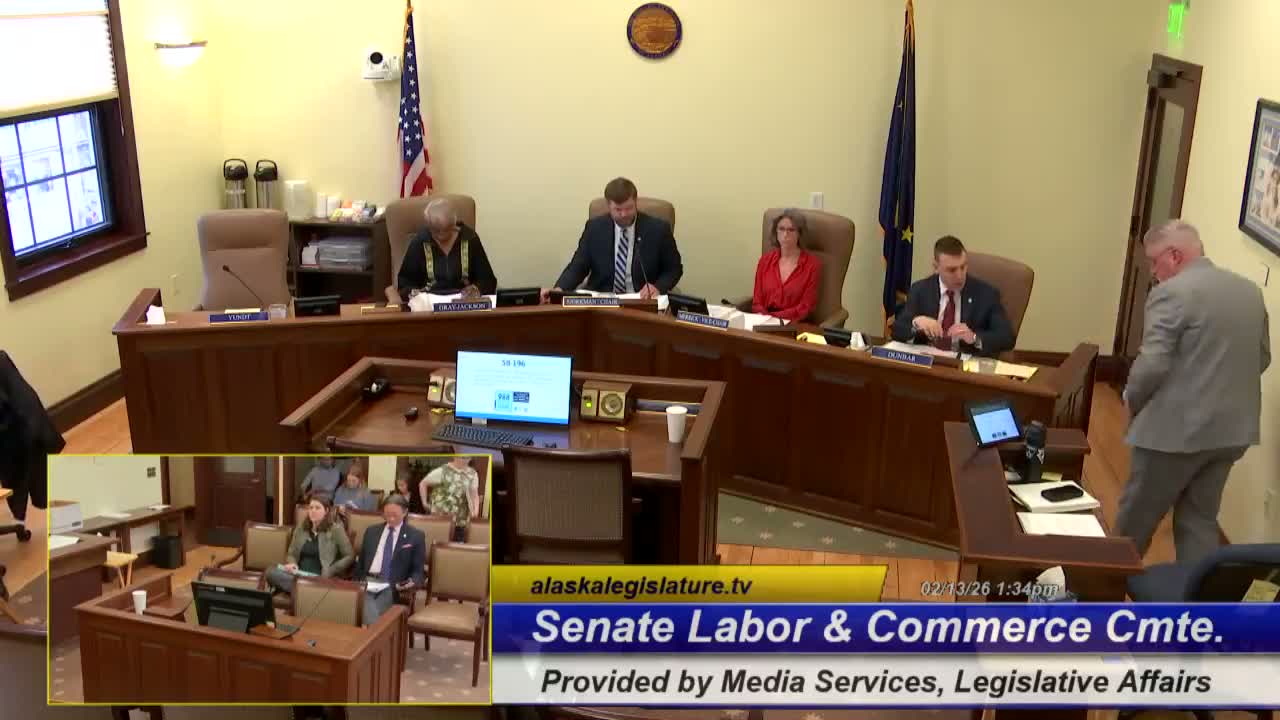
Juneau — The Senate Labor and Commerce Committee on Feb. 13 heard testimony on Senate Bill 196, which would impose a 98¢ monthly surcharge on each wireline and wireless telephone line billed in Alaska to create a fund for behavioral‑health crisis services.
Sponsor Senator Scott Kawasaki said the bill aims to provide sustainable, predictable funding to expand crisis response capacity and reduce pressure on emergency departments and law enforcement. "By investing in this initiative, Alaska can improve public safety, reduce the strain on emergency department services, and provide better outcomes for those experiencing behavioral health crises," he told the committee.
Staff to the sponsor, Jenna Calhoun, outlined the bill's mechanics: the surcharge would appear as a separate line item on phone bills, apply to both wireline and wireless lines with a cap so accounts with more than 100 local exchange access lines would be charged only on the first 100 lines, and require telephone companies to remit collected funds within 60 days. Carriers would be entitled to the greater of 1% of amounts collected or $150 per remittance as an administrative fee, and would not be obligated to file legal actions to collect unpaid surcharges. The bill creates a behavioral health crisis services fund within the general fund and directs the legislature to appropriate the annual estimated balance to the Department of Health.
Calhoun and others cited rising 988 call volumes as evidence of growing demand: she said Alaska's 988 centers handled 16,878 calls in 2024 and 22,458 calls in 2025, citing 988lifeline.org. She and witnesses estimated the proposed surcharge would generate roughly $6 million to $8 million annually; the transcript contains a conflicting later figure of "68,000,000," which appears inconsistent with the prior estimates and should be treated as a transcript anomaly.
Several invited witnesses urged the committee to advance the bill. Angela Kimball, chief advocacy officer at the mental‑health advocacy nonprofit Inseparable, said quick access to trained 988 counselors and mobile crisis teams can save lives and urged the committee to move the bill forward: "I respectfully urge you to advance SB196." Sean Case, chief of the Anchorage Police Department, said the proposal is "a critical investment in Alaska's public safety and public health systems" because timely behavioral‑health response reduces unnecessary arrests and repeat emergency calls. Dennis Lasley, a 911 dispatch supervisor and vice president of the Anchorage Police Department Employees Association, described the operational value of a well‑staffed 988 system, saying, "On average, we receive approximately 60 to 70 calls per day with individuals that are experiencing some form of crisis." Testimony read into the record from the American Foundation for Suicide Prevention emphasized the acute needs of rural and Alaska Native communities where access is limited by geography and workforce shortages.
Committee members asked for further detail about existing revenue streams and whether other taxes — such as the state share of cannabis or alcohol taxes — could be directed to behavioral health. Kawasaki and staff said those sources are smaller or unstable compared with a dedicated surcharge and agreed to seek revenue‑office participation in a future hearing to clarify comparisons.
No vote was taken. The committee set SB196 aside for further consideration at a later hearing, with staff asked to provide additional revenue analysis and implementation details.