Get Full Government Meeting Transcripts, Videos, & Alerts Forever!
Get email alerts on the Criminal Justice topic
No spam. Unsubscribe anytime.
Committee hears bill to elevate hit‑and‑run deaths when drivers flee and fail to render aid
Summary
Rep. Chuck Kopp’s HB 239 would create an aggravated form of criminally negligent homicide for motorists who cause a death and knowingly fail to stop and render reasonable assistance, elevating the offense from a Class B to a Class A felony with a 7–11 year presumptive sentence and mandatory consecutive time when applicable. The committee set an amendment deadline for Feb. 19 and took no final action.
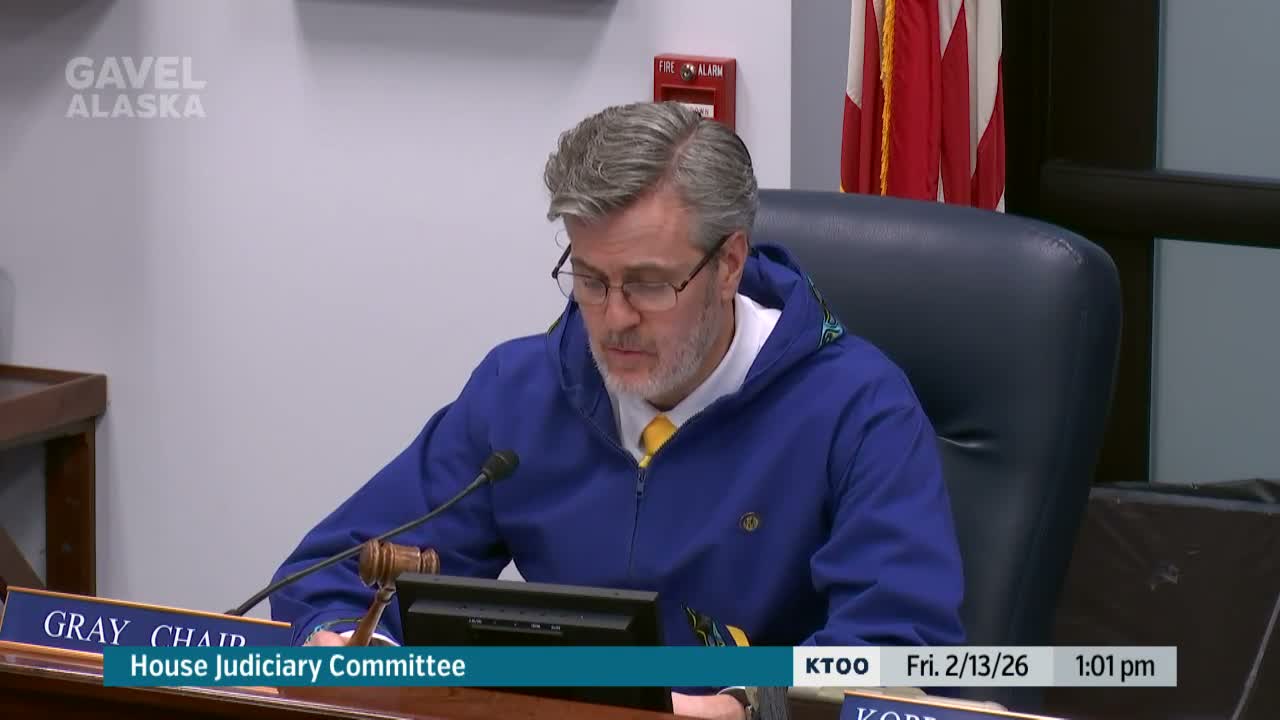
Representative Chuck Kopp introduced House Bill 239 on Feb. 13, 2026, asking the House Judiciary Committee to elevate certain fatal hit‑and‑run cases when a driver "knowingly fails to stop and render reasonable assistance." The proposal would create an aggravated form of criminally negligent homicide when a death is caused by criminal negligence with a motor vehicle and the driver fails to render aid; it would elevate the offense from a Class B to a Class A felony with a presumptive sentencing range of 7 to 11 years for first‑time offenders and require certain consecutive sentences when both the homicide and failure‑to‑aid convictions arise from the same incident.
The bill’s sponsor and staff framed the measure as filling a sentencing gap they say has produced outcomes out of step with community expectations. Gary Zapp, staff to Representative Kopp, cited Anchorage data presented to the committee showing 221 pedestrian deaths over the previous decade, about 25 percent of which the presenters attributed to fatal hit‑and‑run crashes. Zapp pointed to the case of Chase Bowerson as motivating the bill and said concurrent sentencing and low presumptive ranges have sometimes produced only months of incarceration in fatal cases.
Kelly Trent, the mother of Chase Bowerson, testified during public testimony that the defendant in her son’s case pleaded to criminally negligent homicide and leaving the scene and received a sentence she described as inadequate: "The sentence that Chase's killer received is not justice," she said, urging the committee to support HB 239 so other families would not face the same outcome. Anchorage Police Chief Sean Case also testified in support, saying the measure would "deter hit‑and‑run behavior by establishing stronger penalties" and affirm that "leaving the scene of a fatal crash is not just irresponsible, it is criminally inexcusable."
Committee members asked about legal and practical effects, including whether mandatory consecutive sentencing would remove judicial discretion. Senior Assistant Attorney General Casey Schroeder confirmed the bill text states the sentence "shall run consecutively" in the prescribed circumstances. Members also probed how "reasonable assistance" is defined; the committee heard that a jury instruction and a reasonableness standard apply and that Alaska recognizes a Good Samaritan civil immunity that typically shields people who stop to help.
The staff sectional refers to statutory amendments described in the hearing: an amendment to 11 41 1 30 (criminally negligent homicide), a change to 28 35 0 6 0 (duty to give information and render aid), and additions to sentencing provisions under 12 55 1 25; it lists an effective date of 07/01/2026 in the draft. The committee set an amendment deadline of Thursday, Feb. 19 at 5 p.m., and the bill was set aside for further action; no vote was taken at this hearing.
Next steps: HB 239 remains pending; members and staff indicated they will circulate comparative state data and potential amendments before the Feb. 19 deadline.