Lawmakers Press DEED on Mount Edgecumbe Budget, Land Sale and Deferred Maintenance
Loading...
Summary
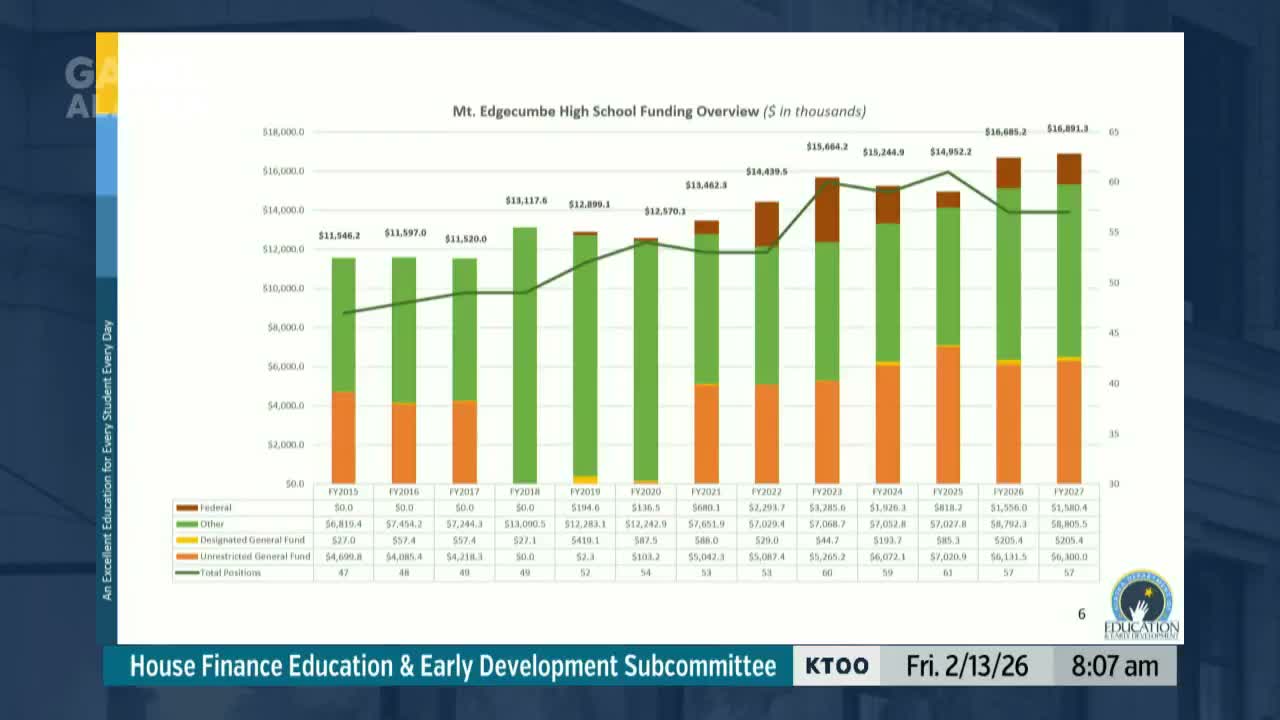
At a Feb. 13 House Finance Education Subcommittee hearing, legislators pressed the Department of Education and Early Development on a $1.6 million shortfall at Mount Edgecumbe High School, use of land-sale proceeds authorized in enacted budget language, staffing levels (57 authorized, 42 funded), and mounting maintenance and utility costs.
SITKA, Alaska
Legislators on the House Finance Education Subcommittee pressed the Department of Education and Early Development on Feb. 13 over how Mount Edgecumbe High School has closed a roughly $1.6 million budget shortfall and how ongoing maintenance needs will be funded. Committee members asked DEED officials for more detail on the department's accounting, the use of proceeds from a prior land sale and whether that approach can be avoided going forward.
The department's deputy commissioner, Karen Morrison, and Administrative Services Director Dawn Hannish told the committee the school currently has 57 authorized position control numbers but only 42 positions funded; two of those funded positions were vacant and actively being recruited. Morrison said DEED did not pursue a legislative supplemental to replace expiring COVID-era funding used for personnel, a trend she said affected many districts across the state.
"We did not put forward a supplemental to keep those positions," Morrison said.
Co-chair Representative Himshut said committee members were alarmed that proceeds from a land sale had been used to shore up operations rather than placed into an endowment, as an advisory board had recommended in 2021. "The sale's gone through, the money's been spent," Himshut said, noting the advisory board had conditioned support on establishing an endowment to benefit current and future students and to avoid using proceeds for ongoing operations or the aquatic center.
Hannish told lawmakers that language in the enacted budget gave the department authority to use land-sale proceeds to address the deficit. She said the department's course of action prevented a staffing reduction that, she said, would otherwise have cut about 14 teaching positions.
"Mount Edgecumbe's leadership solution for that deficit was to reduce their teaching staff by 14," Hannish said, adding that the department was granted authority in the budget to use sale proceeds to address the shortfall.
Lawmakers asked DEED to provide the committee the exact statutory or budget citation authorizing the department's action; department staff agreed to follow up with the precise bill language and location in the enacted budget. Committee members also asked for email documentation of capital and maintenance funding detail that DEED said it could supply.
Committee members and DEED officials discussed multiple causes of the shortfall. Hannish and Morrison said some FY26 and FY27 budget figures reflect spending authority rather than actual receipts, which can inflate comparative totals when a management plan is prepared against authorized authority rather than actual awards. DEED reported that certain fixed costs rose sharply between 2021 and 2024: dorm contracts increased 24 percent, food service contracts more than 100 percent, electrical costs about 33 percent, water and sewage about 72 percent and heating oil about 21 percent.
DEED reviewed COVID-era spending at Mount Edgecumbe totaling about $5.3 million, with roughly 29 percent used for personal services and 53 percent for contracted services. Morrison said converting one-time federal awards into ongoing operations was a known statewide challenge when those funds expired.
Committee members also pressed on facilities needs. Hannish said the department had not found a preventative maintenance plan for the school and described an effort to build one, citing needs such as replacing washers, dryers and mattresses and developing asset-management practices so large replacements are staggered rather than concentrated in a single year. DEED said it had sent facilities staff and an engineer to consult with Mount Edgecumbe maintenance staff last year but that no formal written report was produced from those visits.
On the aquatic center, DEED projected approximately $150,000 in FY27 receipts from public fees and showed annual aquatic costs rising from about $418,200 in FY23 to a projected $614,000 in FY27.
DEED highlighted some positive developments: a comprehensive literacy grant that funded a reading teacher and librarian, a swim-safety grant for student lessons, student hires in food services, and a January 2026 U.S. Department of Agriculture inspection with only four clerical findings.
The committee asked multiple follow-ups, including: (1) the exact bill language or location in the enacted budget (committee members referred to the department's citation as HB 69 and asked DEED to provide the precise reference); (2) a breakdown of capital and maintenance dollars in DEED's accounting versus school-district-style reporting; and (3) whether Mount Edgecumbe can carry UGF fund balances year to year (DEED stated UGF dorm funds cannot be carried in the same way districts can retain fund balances).
DEED committed to transmitting requested documents and clarifications by email and to returning to the subcommittee on Feb. 20 to finish the presentation and provide additional detail. The subcommittee adjourned at 9:30 a.m.