Providers warn tight CMS timelines could hinder Alaska’s RHTP spending
Loading...
Summary
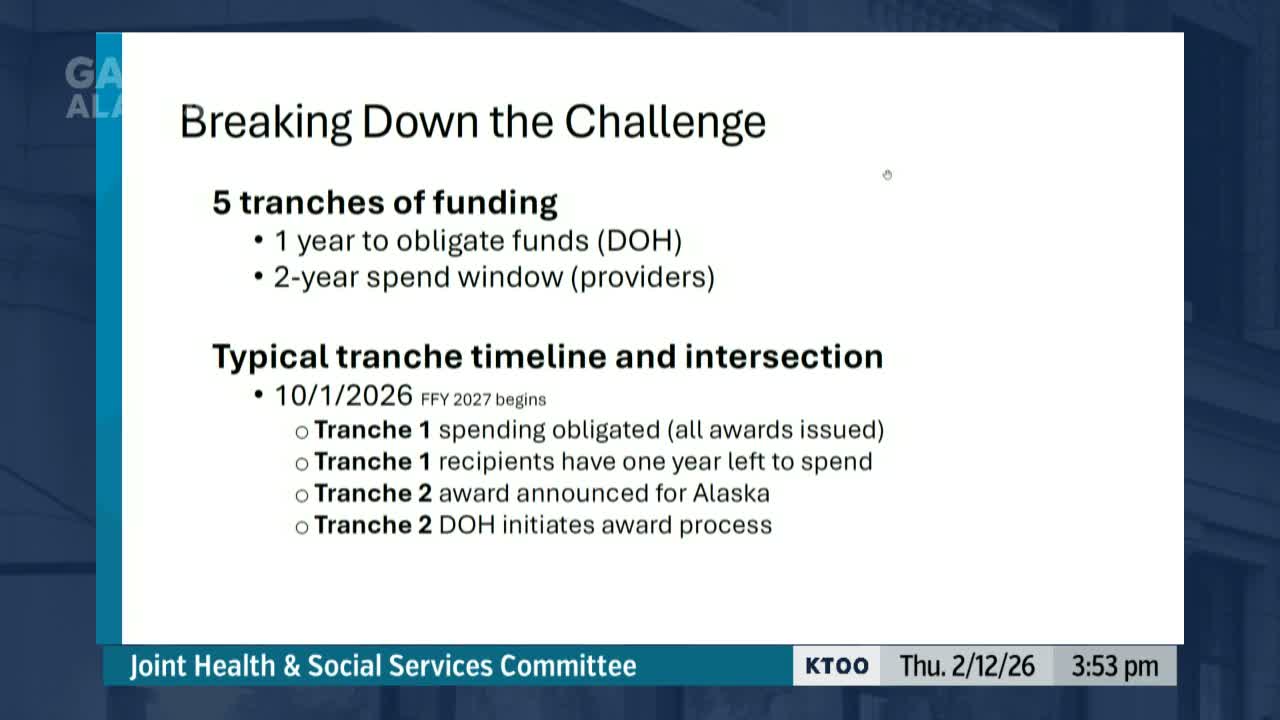
Provider representatives told lawmakers the federal tranche mechanics and short obligation/spend windows create urgent administrative challenges: Alaska must obligate roughly $272 million quickly and providers face narrow two‑year spend windows.
Provider leaders told the joint committee that RHTP’s federal timing rules create the most immediate implementation risk for Alaska.
Jared Kosen, president and CEO of the Alaska Hospital and Healthcare Association, summarized the tranche mechanics his group reads from CMS guidance: "money comes, the award is determined, states have 1 year to obligate those funds, and then whoever gets the funds essentially has 2 years to exhaust them." Kosen said the state’s year‑one obligation clock began Oct. 1 and that, as of the Feb. 12 hearing, Alaska had about 7½ months to establish its grant system, solicit proposals, score applications and distribute awards.
Kosen added that recipients then typically have about 19 months left to expend funds — a period many providers view as compressed for construction‑like projects, extensive procurements, or multiyear service line development. "The clock on spending this money started on October 1," Kosen said. "That means as of this hearing...we have 7 and a half months to stand up our grant system..."
Presenters warned that the combination of short timelines and limits on what funds can cover (notably CMS restrictions on new construction) may push projects toward equipment or programmatic changes that can be implemented more quickly, rather than larger capital investments some stakeholders view as transformative.
The presenters described mitigation steps: pairing smaller hospitals with grant‑writing support, a department 'planning and readiness' pathway to prepare applicants, and use of the Alaska Community Foundation to administer letters of interest. Lawmakers asked for clearer CMS guidance on eligible renovation scopes and for state guidance on scoring and award transparency.
The hearing did not produce a formal timetable change; presenters said the Department of Health is continuing discussions with CMS and developing administrative processes to meet federal deadlines.