Get Full Government Meeting Transcripts, Videos, & Alerts Forever!
Get email alerts on the Cascade Point Project topic
No spam. Unsubscribe anytime.
Lawmakers Hear Warnings on Cascade Point Ferry Terminal: Costs, Process and Environmental Risks
Summary
Witnesses told the Alaska House Transportation Committee on Feb. 12 that the Cascade Point ferry terminal project proceeded through a $28.5 million design-build contract and MOU before comprehensive feasibility, tribal consultation and permitting were complete; testimony raised capital-cost estimates (~$120 million), fisheries risks and calls for fuller NEPA review.
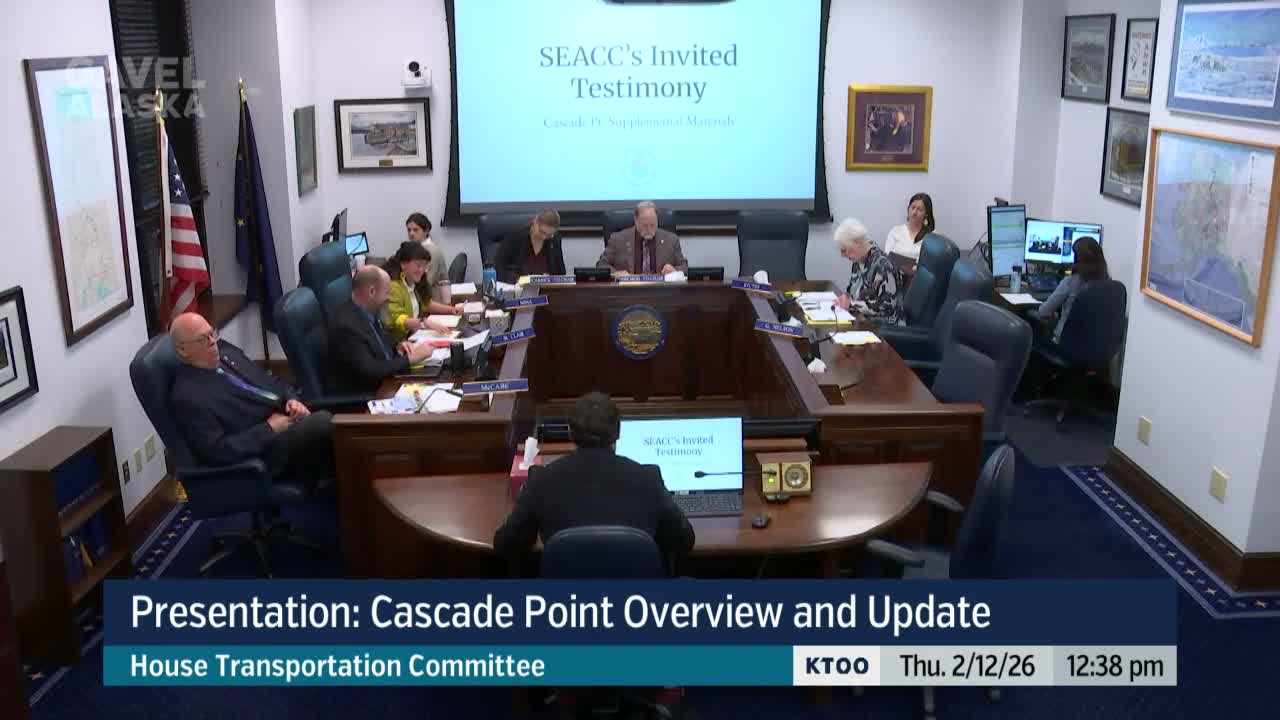
Juneau — Lawmakers on the Alaska House Transportation Committee heard invited testimony on Feb. 12 raising procedural, fiscal and environmental concerns about the proposed Cascade Point ferry terminal.
Tyler Breen, policy analyst with the Southeast Alaska Conservation Council, told the committee the state entered a memorandum of understanding with Gold Belt on March 9, 2023, and later executed a $28,500,000 stage‑1 design‑build contract on July 28, 2025, before required feasibility studies, tribal consultation and permitting were completed. "Our concern is that the state has already committed funds to a project that is not driven by a community expressed transportation need," Breen said, adding that such sequencing can foreclose meaningful alternatives analysis.
The testimony and committee questioning focused on three linked issues: timing and sequencing of decisions and contracts, the size and allocation of project costs, and environmental and subsistence risks to forage fish and anadromous streams near Cascade Point.
Why it matters: Witnesses said the order of actions matters because a Clean Water Act §404 permit application submitted to the U.S. Army Corps of Engineers on Feb. 4, 2026 triggers NEPA and NHPA §106 reviews. Breen warned that a §404 permit review "must evaluate the major federal action and its connected actions as a whole" and that entering a contract that bundles permitting and construction can constrain consideration of alternatives.
Lois Epstein, an Alaska‑licensed engineer and owner of LME Engineering Policy, presented a capital‑cost estimate the committee packet labeled "estimated cost of the Cascade Point terminal project." Including a stage‑3 component (road and bridge upgrades she said were described in a 2019 internal DOT memo), Epstein said the full capital cost could reach approximately $120,000,000, with more than $60,000,000 expected from state capital project funds. "The capital costs for this project are substantial, i.e. over $120,000,000, and Alaska DOT needs to be transparent with the legislature about those costs," Epstein said. She also told the committee the AMHOB (Alaska Marine Highway Operations Board) did not endorse the project and that AMHOB issued a corrective action request on Oct. 29, 2025 noting material changes to the long‑range plan.
Department response: Andy Mills, legislative liaison and special assistant to the DOT commissioner, told the committee the project remains early in design and that a design‑build contract includes final design work. On whether the terminal would operate year‑round, Mills said, "I don't have that answer because it will depend," and that seasonality and final design choices remain to be determined. Mills also described the AMHOB as an advisory operations board and said the department retains responsibility for final decisions.
Committee concerns and requests: Several legislators pressed witnesses and DOT for documentation and clarity. Representative Stutes noted the committee received more than 600 public comments on the project and said 92% were in opposition, citing the public comment tally reported to the committee. Representatives asked for the Ed King report and related economic analyses; committee staff said King had been invited but declined to testify. Legislators requested that DOT and other permit holders provide copies of environmental studies and the Corps application so the committee could review underlying analyses.
Environmental and community impacts: Testimony highlighted potential impacts to forage fish (herring and hooligan) and noted about 40 anadromous streams in the corridor between Herbert Glacier and Cascade Point were identified in testimony as potentially affected. Witnesses also flagged the possibility that the site could be co‑utilized for ore shipment tied to Grand Portage Resources' announced plans, which critics say complicates the transportation rationale for the terminal.
Next steps: Witnesses urged a pause on additional state expenditures until the Southeast Alaska regional transportation plan is updated and until the Corps completes its completeness determination and NEPA/NHPA review. The committee asked DOT to provide a written timeline, the Corps application contents if publicly available, stage‑by‑stage cost estimates and any information from Gold Belt or other partner permit holders. The committee adjourned at 1:36 p.m.
The record: Key documents referenced at the hearing included a March 9, 2023 MOU with Gold Belt; an apparent Sept. 10, 2024 Grand Portage Resources letter of intent; the Alaska Marine Highway System 2045 long‑range plan; an AMHOB corrective action letter dated Oct. 29, 2025; a DOT design‑build contract dated July 28, 2025 for $28,500,000; and a U.S. Army Corps of Engineers Clean Water Act §404 permit application submitted Feb. 4, 2026.