
DEC budget preview: FY27 technical increments, inspection workload, PM2.5 plan and storm response costs
Get AI-powered insights, summaries, and transcripts
Subscribe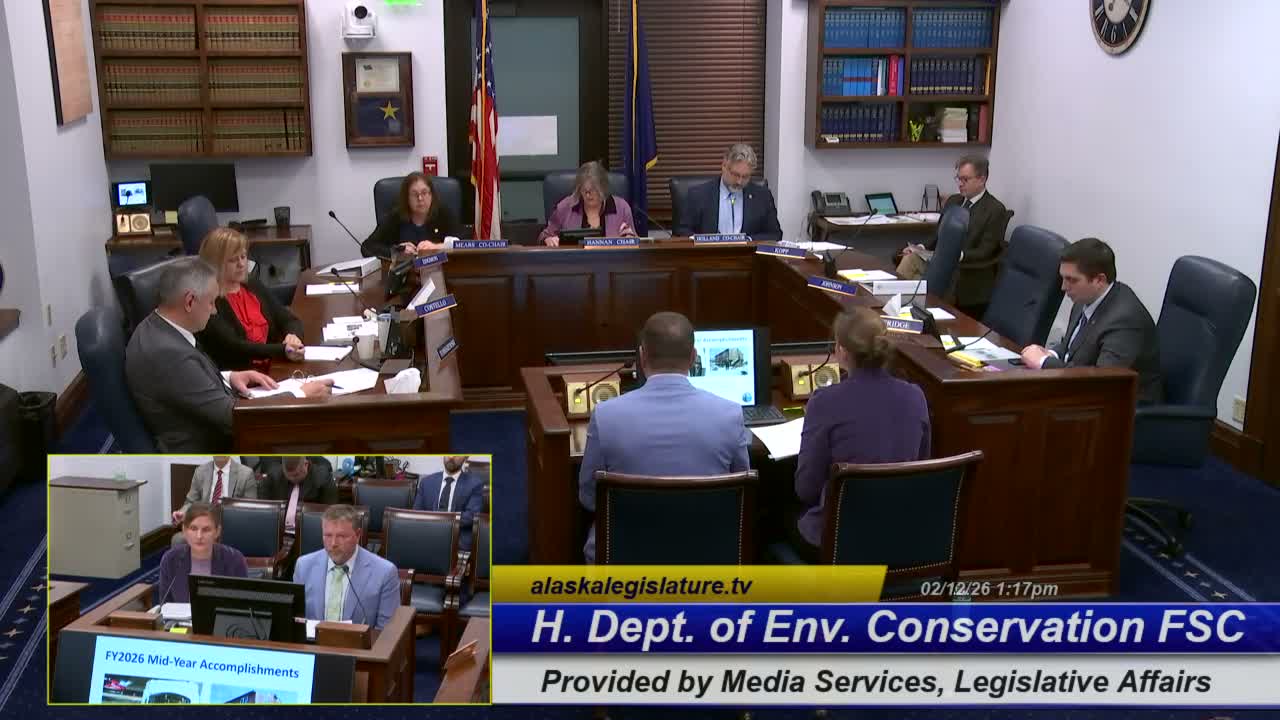
Summary
DEC told the House Finance subcommittee that the FY27 governors proposal contains technical salary and IT adjustments, GFPR carry-forward language, and carry-forward accounting for the triple-F foam appropriation; staff described inspection protocols, Fairbanks PM2.5 attainment, a $450,000 home heating oil cleanup fund and roughly $2.07 million in storm-response costs to date and forecast.
Juneau — Department of Environmental Conservation administrative staff reviewed the FY27 governors proposed budget and related operational issues for the House Finance Department of Environmental Conservation subcommittee on Feb. 12.
Megan Koehler, administrative services director, summarized the FY27 proposal as largely technical changes: salary adjustments, an IT classification study and implementation affecting about 17 positions, and continued use of Infrastructure Investment and Jobs Act funding alongside traditional sources. She noted accounting for the SPAR triple-F disposal reimbursement appropriation shows a $2.5 million reversal in FY27 slides because unspent FY26 balances will be carried forward into the next year.
Inspection and enforcement work
Commissioner designee Randy Bates described DECs inspection regime: the Alaska Pollutant Discharge Elimination System (APDIS) applies to wastewater dischargers; minor permits generally receive an inspection once every five years and major permits every two years, while cruise ships with 50 or more berths receive annual inspections (larger ships inspected twice yearly, including underway inspections). Bates said DEC assigns dedicated inspectors and a marine engineer for vessel work and favors immediate compliance assistance over delaying enforcement.
On the fee side, Koehler and Bates said permit applicants pay fees calculated by staff time or preset regulation; inspections are not separately billed to applicants, and enforcement penalties flow to the state general fund rather than back to DEC programs.
Air quality and other program items
Bates told the subcommittee that DEC and the EPA reached an approved plan for PM2.5 in Fairbanks and that "as of today, maybe yesterday, Fairbanks is in attainment," with North Pole close and additional grant work planned.
On homeowner oil tank spills, Bates said a FY26 capital appropriation of $450,000 is intended to reimburse cleanup costs; the department has expended about $134,000 for 10 approved applications and estimated reimbursements run roughly $13,000 to $17,000 per household.
Storm response and contingencies
Bates described recent storm responses (Merbok and Halong), saying roughly 100 staff of DECs 570 were involved and that costs to date are about $870,000 with an expected additional $1.2 million this fiscal year to cover ongoing field assessment and cleanup mobilization. Koehler told the committee that DEC expects to seek reimbursement through federal DMBA processes where applicable.
Federal funding shortfall and matching costs
Members asked what can be done about federal underfunding of state primacy programs; Bates said states often have to overmatch federal grants to maintain programs. Using APDIS as an example, he said rough federal support was about $1.5 million while the state match reached about $2.5 million, meaning the state bears costs beyond the statutory 25% match.
Gas-line permitting
On an anticipated gas-line project that could create multiple sites, Bates said DEC is already processing and preparing general and routine permits and encouraged early engagement by applicants to avoid late compliance headaches.
The subcommittee recessed after asking staff for follow-ups on FY27 details and operational metrics. The committee will meet again Feb. 19.
Sources: Testimony and slides presented to the House Finance Department of Environmental Conservation subcommittee by Megan Koehler and Randy Bates on Feb. 12, 2026.