DEC says $24.48 million Flint Hills settlement deposited to prevention-mitigation account; PFAS foam reimbursement program has reimbursed 11 entities
Loading...
Summary
Department of Environmental Conservation staff told a House Finance subcommittee that a $24.48 million Flint Hills settlement was deposited into the prevention-mitigation account but cannot be spent by DEC without legislative appropriation; DEC is running a $2.5 million multi-year PFAS firefighting-foam reimbursement program that has reimbursed 11 communities or entities so far.
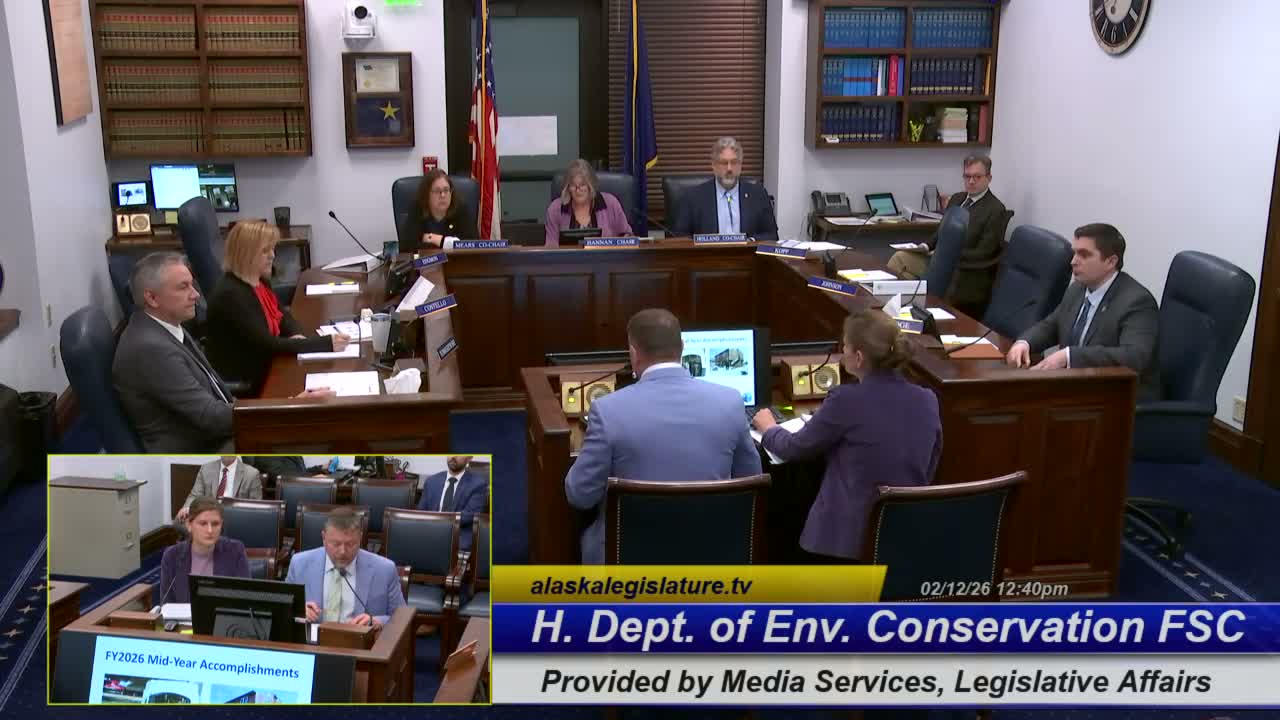
Juneau — Commissioner designee Randy Bates told the House Finance Department of Environmental Conservation subcommittee on Feb. 12 that a judgment tied to contamination at the Flint Hills (North Pole) refinery resulted in $24,480,000 deposited into the states prevention-mitigation account and roughly $2.3 million credited to the general fund to cover legal costs.
Bates said the department has accounted for recovery costs and response expenditures, listing department oversight and response costs at about $5,170,000; piped water system cost recovery at about $15,300,000; and natural-resource damages around $4,010,000. "The judgment identified the apportionment of the proceeds, but it did not impose limitations on the use of those funds," Bates said. He added, "DEC does not have statutory authority to retain, reprogram, or expend these funds without legislative appropriation."
Why it matters: the settlement increases the states funds available for prevention and mitigation but, under DECs reading, the department cannot unilaterally reallocate or spend the money; legislative action would be required to authorize DEC to use the proceeds. That restriction shapes whether any portion of the funds can be directed to cleanup priorities such as PFAS-related work.
PFAS firefighting-foam reimbursement program
The department also briefed the committee on a statutory effort to collect and remove unused PFAS-containing firefighting foam. Bates said DEC established a $2.5 million multi-year firefighting-substance disposal reimbursement program and prioritized removal of the liquid foam; $300,000 of the appropriation has been spent to date on removing that liquid form.
"This is a reimbursement program," Megan Koehler, administrative services director for DEC, told the subcommittee, saying that communities generally must pay up front for removal and then seek reimbursement because DEC cannot front money for liability reasons. Bates said the department is prioritizing the liquid form of foam before funding equipment replacement and other higher-cost items.
Scope and uptake
Bates and Koehler told the committee they do not yet have a comprehensive statewide inventory of sites that still hold foam and that the material is "prevalent in quite a few communities" (Bates and Koehler both said it "could be" hundreds). To date, the department has reimbursed or encumbered funds for 11 communities or entities and has about $2.2 million remaining for second- and third-priority activities, Bates said.
Bates read the list of entities DEC has worked with to reimburse or encumber funds (as provided to the committee): City of Wrangell; King Cove Fire and Rescue; Trident Seafoods Corporation; City of Craig Volunteer Fire Department; Panguine Creek Homeowners Association; City of ADAC; City of Falls Pass; City of Shishmaref; City of Gus Davis; Stebbins Community Association; and Craig Volunteer Fire Department. The department said it is working with an outside contractor that conducts outreach in rural communities to help identify sites and facilitate applications.
Committee questions and next steps
Members pressed DEC on how many communities still hold foam and whether DEC can provide the names of the 11 reimbursed entities and the contractors outreach list; Bates and Koehler said they would provide that information to the committee. Several members noted the practical challenge that communities must have "seed" money to pay upfront removal costs before being reimbursed; DEC reiterated that it cannot advance funds for liability reasons but is seeking partner solutions.
The subcommittee requested written follow-up on the Flint Hills cost-recovery breakdown and the detailed status of the PFAS removal and reimbursement work. The subcommittee is scheduled to reconvene Feb. 19.
Sources: Testimony and slide materials presented to the House Finance Department of Environmental Conservation subcommittee by Randy Bates (commissioner designee) and Megan Koehler (administrative services director) on Feb. 12, 2026.