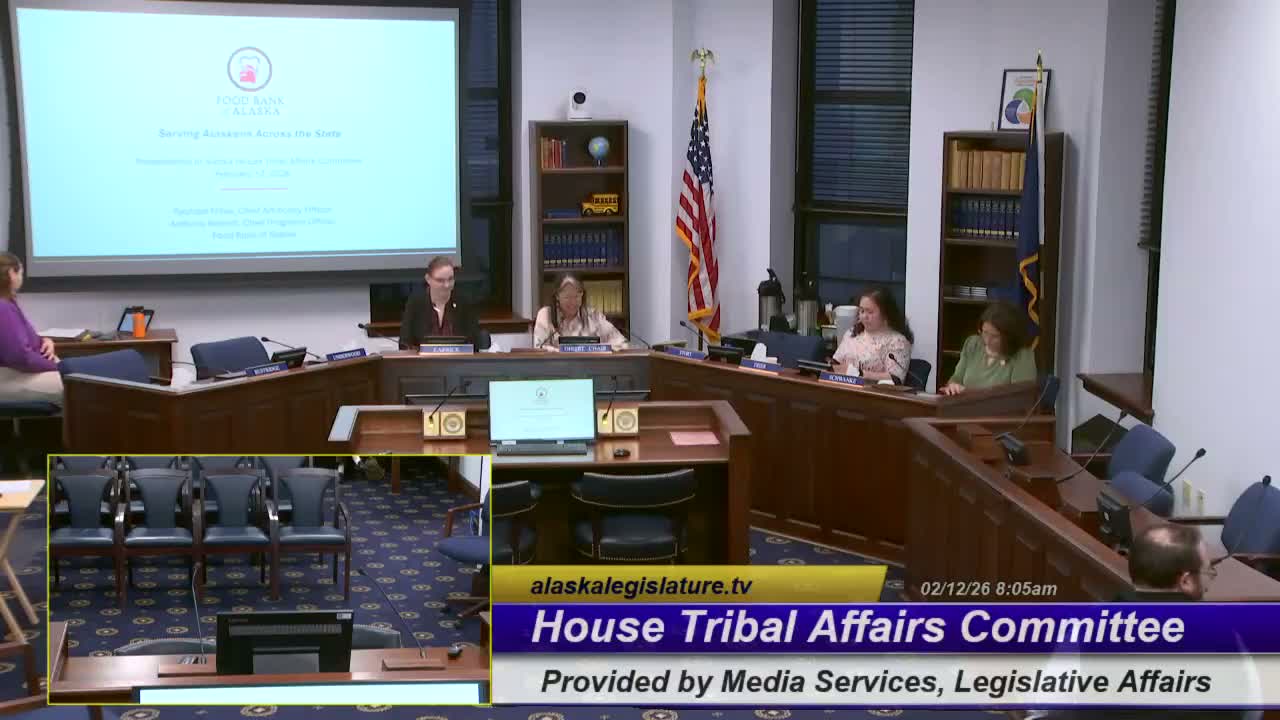
Food Bank of Alaska outlines statewide reach, says 1 in 7 Alaskans face hunger
Loading...
Summary
At a Feb. 12 House Tribal Affairs Committee hearing, Food Bank of Alaska officials said the bank and its network served 185 rural communities, distributed over 10 million pounds of food last year and continue to press for better SNAP access and shipping funds to reach remote villages.
Food Bank of Alaska chief advocacy officer Rachel Miller told the House Tribal Affairs Committee on Feb. 12 that hunger remains widespread across the state and the nonprofit is working through a broad partner network to reach residents beyond the road system.
"One in seven Alaskans experience hunger, and that means one in five kids experience hunger," Miller said, describing the scale of need and the Food Bank’s partnership network of about 150 organizations and work in roughly 185 rural communities. She said last year the Food Bank distributed more than 10,000,000 pounds of food, equal to about 8,200,000 meals.
The presentation framed the Food Bank’s model as a mix of food rescue, purchased items and government commodity programs. Anthony Reinert, the Food Bank’s chief programs officer, said the organization now operates close to 50 employees and a new facility that expands its ability to serve remote areas. He explained the Food Bank coordinates a range of programs — from commodity shipments to targeted senior and youth programs — to match different community needs.
Committee members pressed for geographically specific data. Miller pointed members to an office handout and a statewide map that shows particularly high food insecurity rates in parts of rural Alaska, including Kusklavak (about 25%), Bethel (20.8%), Yukon‑Koyukuk (20.1%), Nome (18.8%) and Northwest Arctic (18.5%).
Miller also described outreach on enrollment in SNAP (Supplemental Nutrition Assistance Program), saying about 1 in 10 Alaskans use SNAP and that Food Bank staff provide application assistance across the state. She noted the Food Bank does not adjudicate claims — the Division of Public Assistance reviews applications — but the nonprofit has tools such as a "text to SNAP" service to support clients in applying.
Committee members asked for follow‑up materials, including lists of partner communities and school districts tied to the Food Bank’s programs. Chair Divert and presenters said staff would provide those lists to committee members after the hearing.
What happens next: Food Bank officials said they would follow up with requested data on community partners and program reach; committee members asked staff to review federal regulatory constraints that affect program delivery.