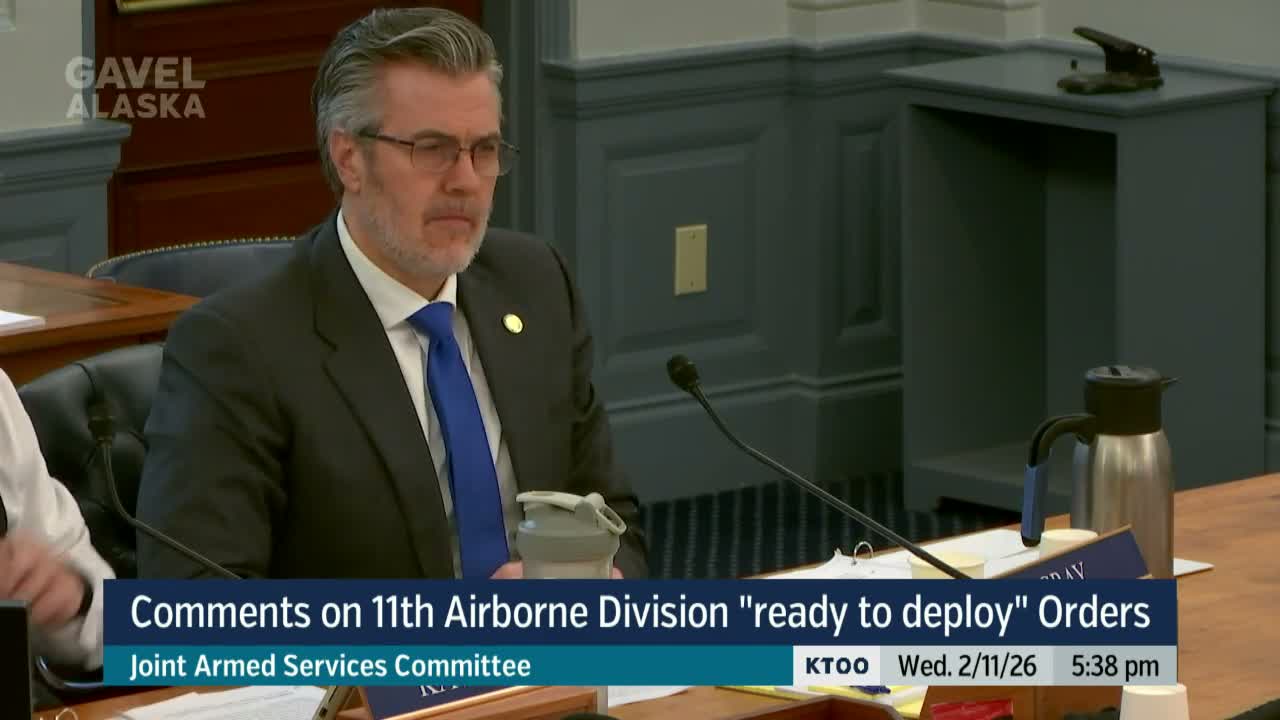
Alaska committee hears experts on limits of domestic military use, Posse Comitatus and the Insurrection Act
Loading...
Summary
Legal experts told Alaska’s Joint Armed Services Committee that Title 10 and Title 32 place different command limits on troops, that some recent federal deployments to support ICE raised Posse Comitatus questions, and that the Insurrection Act provides a broad presidential exception but is infrequently invoked.
Experts testifying Feb. 11 before the Alaska Legislative Joint Armed Services Committee laid out how U.S. law separates military command and authority for domestic operations and flagged how recent deployments prompted litigation and debate.
Dan Mauer, associate professor of law at Ohio Northern University and retired Army lieutenant colonel, told the committee that "the simple distinction is under Title 10, troops are under the command and control of the president and secretary of defense," while "under Title 32, they ... remain under the command and control of the state governor." He said Title 32 forces remain state employees and are generally not constrained by the Posse Comitatus Act in the same way federal Title 10 forces are.
Mauer described recent deployments that placed federal troops and National Guard units near ICE operations in cities including Los Angeles, Chicago and Portland. "Their purpose, ostensibly, was to provide security for ICE," he said, and courts later judged that many missions assigned to those guard members effectively violated the Posse Comitatus Act by enabling law enforcement rather than simply protecting federal property.
Committee members also discussed the Insurrection Act, which Mauer said functions as a statutory exception to Posse Comitatus (he cited Title 10 U.S.C. sections discussed in committee as the statutory framework). "To use the Insurrection Act, the president has to follow certain procedures ... but once he does that, he has an extraordinary amount of discretion under the statute," Mauer said, adding that the statute’s key terms are not tightly defined and therefore give the president broad latitude.
Witnesses cautioned that employing active-duty forces in a law-enforcement role is unusual and raises training and legal risks. Retired Lt. Col. Margaret Stock, a former military police officer, described Army doctrine (Army Field Manual FM 3-19.15) that endorses a negotiated-management model with protest leaders and emphasizes de-escalation and adherence to constitutional protections. "Winning in a civil disturbance situation is about seizing and holding the moral high ground, following the law," she said.
Committee members asked specifically whether ready-to-deploy orders for the 11th Airborne could have been redirected to Greenland; Mauer said that operationally and legally such redirection would have been feasible even if the policy rationale would be controversial.
The committee did not take formal action on statutory changes; members said they intend to continue hearings with additional military and command witnesses.