
Alaska Railroad outlines logistics, equipment gaps and new IRS ruling tied to possible gas pipeline
Get AI-powered insights, summaries, and transcripts
Sign Up Free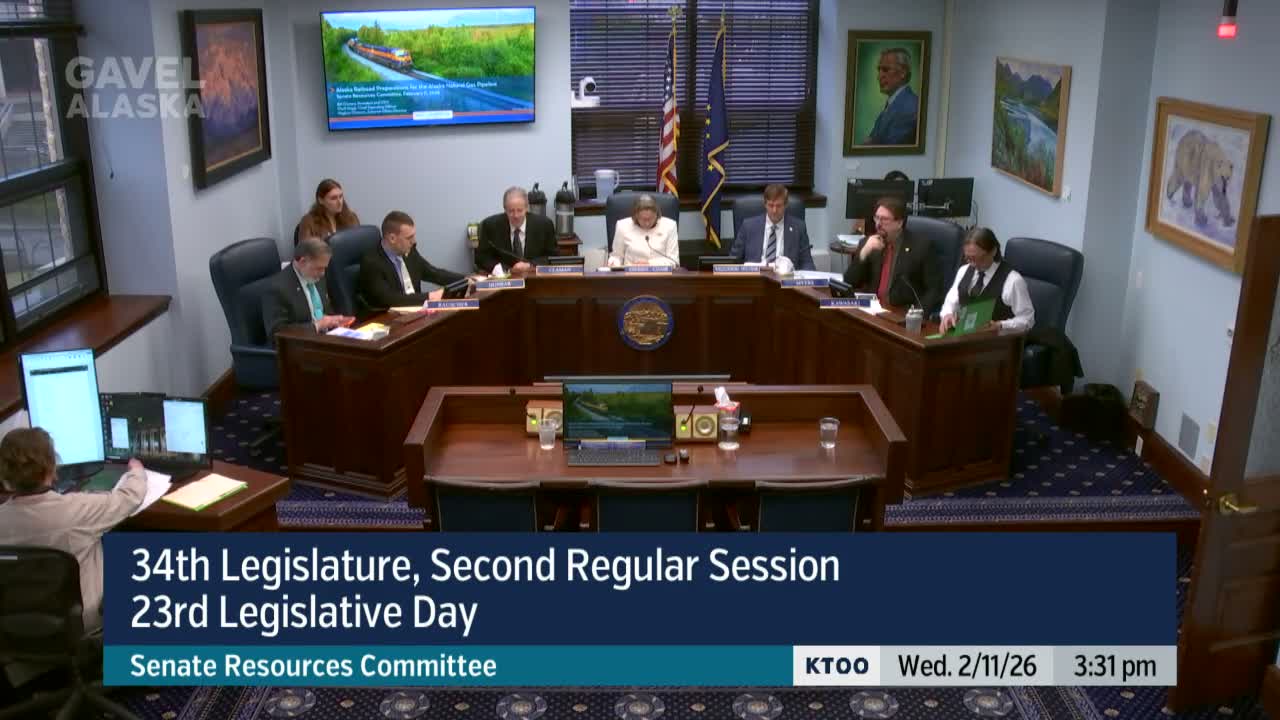
Summary
Alaska Railroad officials told the Senate Resources Committee they can move large-diameter pipe and have identified spurs, terminal work and up to 300 long flat cars as potential needs. They also said a recent IRS revenue ruling could enable tax-exempt conduit bonds, though any bond issuance would require board action and explicit legislative authorization.
ANCHORAGE — Alaska Railroad officials told the Senate Resources Committee on Feb. 11 that the railroad can support large-scale deliveries of pipe for a possible Alaska natural gas pipeline but would need terminal upgrades and additional rolling stock to handle peak surges.
"For the record, I'm Bill O'Leary. I'm the president and CEO of the Alaska Railroad Corporation," O'Leary said as he introduced the railroad's delegation, adding the corporation has been preparing transportation and real-estate plans tied to the proposed pipeline. Megan Clements, external affairs director, said the railroad's main line stretches from Seward to Fairbanks — about 500 miles — with nearly 700 miles of track when yards and spurs are included.
Why it matters: The railroad owns port facilities and significant land that developers and the legislature have identified as key logistics assets for pipe intake and staging. Committee members pressed the railroad on where pipe would arrive, how many trains that would require, and whether the corporation needs capital support to be ready if developers move forward.
Rail capacity and logistics
Clark Hopp, the railroad's chief operating officer, said the developer's FERC filing and subsequent outreach have guided the railroad's planning. "Based on the FERC application...their primary focus to this point has been Seward," Hopp said, describing Seward as the baseline intake port and Anchorage, Whittier or Port McKenzie as surge options.
Hopp explained his transportation model assumes 80-foot double-jointed pipe, with 45–55 cars per train and roughly 130–200 dedicated pipe trains over an 18–20 month construction window depending on pipe type. "We're talking anywhere from 680,000 tons to 800,000 tons" of pipe in total, he said, compared with about 3.9 million tons of freight the railroad moved in 2025.
Equipment and terminal work
The railroad said it already identified 6–8 existing spurs adjacent to potential staging yards and has capital-program allocations to lengthen spurs and expand terminal footprints in Seward and other locations. Hopp noted that while locomotives can be leased from the Lower 48 on 60–90 day timelines, long flat cars present a longer lead-time challenge: "There's a potential 300, 89-foot flat cars that we don't have," he said, adding that new-builds and some leasing options are being pursued.
O'Leary told senators the corporation has included about $10 million in contingency capital in its 2026 program to prepare for the project but said the railroad has not asked the legislature for funds specifically tied to the pipeline. "We will not" make a capital request to the legislature at this time, he said, characterizing the railroad's approach as keeping readiness funding on hand while awaiting developer commitment.
Infrastructure and workforce
Committee members asked whether heavy volumes would require upgrades to bridges or mainline track. Hopp said the railroad has spent heavily on a bridge rehabilitation program and maintains a 263,000-pound-rated system; selective bridge upgrades could temporarily raise capacity toward 286,000 pounds per car to help construction moves. On workforce, Clements and Hopp said a project of this scale would create demand across Alaska and likely require recruiting from the Lower 48 for roles needing longer training lead times.
Financing prospects and legal controls
The railroad briefed senators on a tax and financing development that could affect how a gas pipeline is financed. The corporation submitted an IRS request in June 2025 seeking a ruling on whether tax-exempt bonds issued by the railroad for projects tied to a gas pipeline would be subject to private activity limitations. The railroad said Revenue Ruling 2026-4, released about two weeks before the Feb. 11 hearing, largely affirmed the corporation's earlier legal reading.
The ruling, the railroad said, supports using a conduit-bond structure in which the railroad would issue tax-exempt bonds but the repayment obligation would rest with the developer or a project affiliate, not with the railroad or the state. "There has been no decision at this point to move forward with this," O'Leary told the committee, and he emphasized that statute requires legislative authorization before the railroad may issue bonds.
Senators pressed for safeguards and parliamentary controls. Several members recalled a prior $17 billion authorization tied to an earlier pipeline effort and asked whether such authority still exists; the railroad confirmed the 2003 authorization was repealed in 2018 and said there is currently no standing bonding cap for the railroad — any "not to exceed" amount would need to appear in legislation and be approved by the legislature and the railroad board.
Committee concerns and next steps
Several senators expressed skepticism that a single financing device should determine whether the pipeline proceeds. Senator Dunbar urged the developer and the railroad not to make legislative bond authorization the linchpin for project viability, saying reliance on a single mechanism would put the legislature and Alaskans at undue fiscal risk.
The railroad responded it is proceeding cautiously: planning and contingency work is under way, but the corporation will not spend large sums of capital until there is clearer developer commitment or contractual agreements in place.
The committee did not take action or vote on any bill during the hearing. Chair Giesel closed the meeting, set amendment deadlines for Senate Bill 180 (LNG import facilities) and for the governor's tax bill (referred to in the hearing as Senate Bill 227), both due Wednesday, Feb. 18 at noon, and scheduled the next resources meeting for Feb. 13.
Ending
The railroad presentation left committee members with technical detail on how pipe could move by rail, a clearer picture of terminal and rolling-stock gaps, and new information about a federal revenue ruling that could influence financing options. Lawmakers signaled they expect more legal and fiscal detail before any statutory bond authorization would be considered.