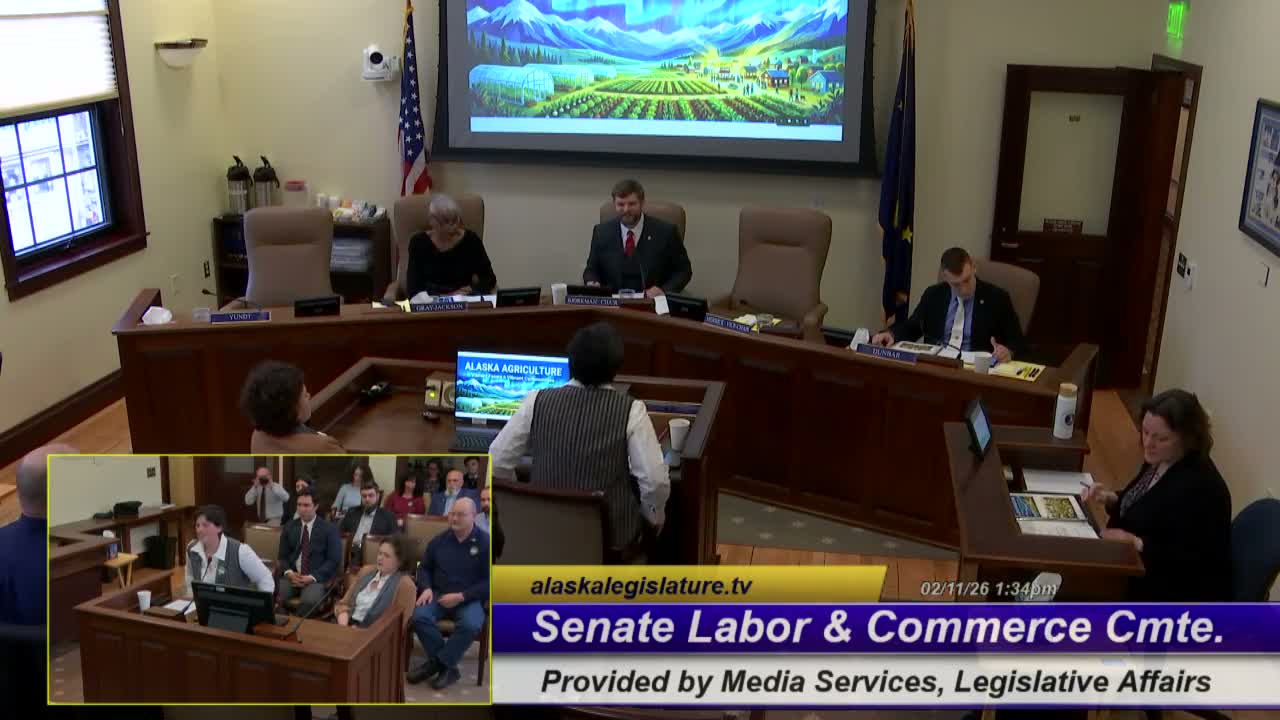
Alaska farmers tell Senate panel they need land access, processing and training to scale production

Senate Labor and Commerce Committee · February 11, 2026

Get AI-powered insights, summaries, and transcripts

Subscribe
AI-Generated Content: All content on this page was generated by AI to highlight key points from the meeting. For complete details and context, we recommend watching the full video. so we can fix them.

Summary

Alaska farmers and advocates told the Senate Labor and Commerce Committee that the state can expand local food production but must reduce land‑access barriers, fund training and technical assistance, build processing capacity and simplify food‑safety audits to connect producers to large buyers.

Juneau — Farmers and agriculture advocates told the Senate Labor and Commerce Committee on Feb. 11 that Alaska’s farming industry could grow substantially if the state removes barriers to land access, builds processing infrastructure and invests in training and market development.

“Agriculture really has a broad reach,” said Amy Seitz, policy director for the Alaska Farm Bureau. Seitz urged lawmakers to view agriculture as a system that includes land, processing, distribution and markets, not “individual little pieces.”

In prepared testimony and answers to senators’ questions, Seitz and Margaret Adson of the Alaska Farmland Trust said Alaska lacks the staff capacity within state agencies to chase federal grants, and that USDA programs often require matching funds or scale that many Alaskan operations cannot meet. “Our agencies are so maxed out from staff capacity and dollars,” Seitz said.

Farmer witnesses gave concrete examples. Emily Garrity, owner‑operator of Twitter Creek Gardens outside Homer, said her operation produced 40,000 pounds of vegetables on 2 acres last year and could triple production if she secured a contiguous 4.5‑acre lease. Garrity testified that a DNR appraisal raised the parcel’s cost and increased an estimated annual lease fee to $9,360, a sum she said would constrain expansion.

Tern Coffey, who operates on land opened for the Nenana project, described converting overgrown ground into productive fields and credited recent road and power investments with enabling commercial shipments to wholesalers. “Access is key,” he said.

Ken Hoffman, who runs Matsu Microgreens, described how the Harmonized Good Agricultural Practices (HGAP) audit required by large distributors can be a barrier for small farms. “It’s a lot of paperwork,” Hoffman said, noting the audit can cost roughly $1,800 and that state technical assistance to prepare farms is limited.

Advocates urged more hands‑on technical support. Adson said the Alabama Farmland Trust’s FarmLink service has logged roughly 85 people seeking farm opportunities and that vocational training, business planning and accounting support geared to Arctic agriculture are missing. Adson called for programs that produce ready‑to‑operate business plans and connecting new farmers to loan guarantees through the Farm Service Agency.

Supporters said co‑operatives and shared processing could help small operators meet the minimum quantities required by institutional buyers such as school districts and wholesalers, but cautioned that co‑op models can be hard to sustain without trust and consistent governance.

The presenters asked the committee to consider policies that simplify early leasing steps, increase DNR and Division of Agriculture capacity for technical assistance, and explore targeted incentives that lower upfront costs for new operators.

The committee did not vote on legislation at the hearing. Chair Senator Bjorkman said the panel will continue farm‑related discussions in future meetings and will take up bills Feb. 12.