
Alaska committee hears bill to allow online Social Security card replacements by enabling limited DMV data checks
Get AI-powered insights, summaries, and transcripts
Subscribe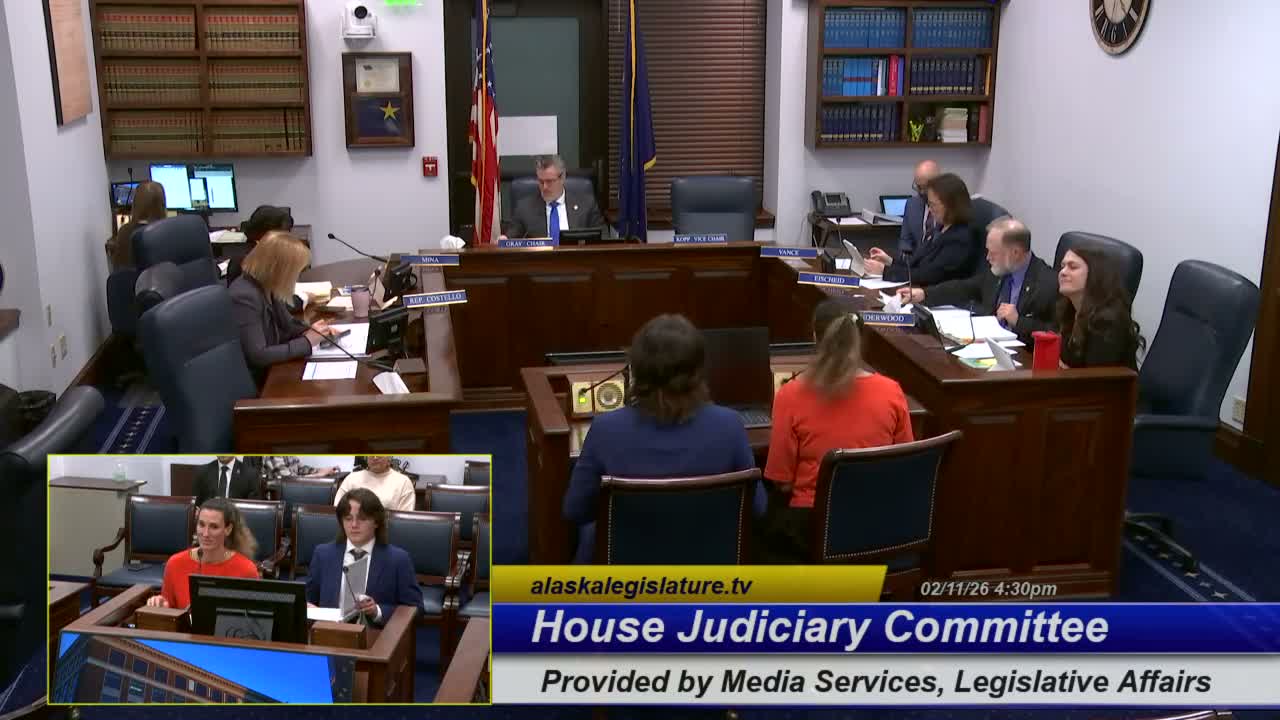
Summary
House Bill 213 would allow Alaskans to request replacement Social Security cards online by authorizing limited, SSA-approved DMV verification through a nonprofit intermediary; Social Security and sponsor staff told the House Judiciary Committee the change could be operational in 4–6 weeks and that SSA would receive only a true/false verification result, while members sought clarity on tribal ID use and statutory authority.
Representative Gray, chair of the House Judiciary Committee, convened the committee on Feb. 11 and opened the first hearing on House Bill 213, a statutory change intended to let Alaskans apply for replacement Social Security cards online.
Rachel Gunn, staff to the bill sponsor, said the bill would restore an online option that 49 other states already use and would help residents — especially those in rural areas — avoid long travel or costly mail processes. "If you don't live in Anchorage, Fairbanks or Juneau, you must either travel a long way to an office or mail documents, which is expensive, time consuming, and stressful," Gunn said.
Hayden Johnson, also staff to the sponsor, provided the committee with operational numbers and a sectional summary. Johnson said roughly 15,000 Alaskans need replacement Social Security cards each year; he gave a breakdown of past usage of Social Security field offices and mail submissions and said the bill contains no state implementation cost and could be operational in four to six weeks after enactment.
Dustin Brown, head of legislative affairs for the Social Security Administration, testified remotely about how online replacement works and about the legal and technical limits on data-sharing. Brown said the proposed statutory changes would allow Alaska's DMV to resume participation in a driver's-license data-verification system operated through the American Association of Motor Vehicle Administrators (AAMVA), a nonprofit intermediary used by other states. "At no point is that data coming to SSA," Brown said. "SSA only receives a true/false on whether or not the data is verified." He added that the intermediary deletes verification data immediately after the check is completed and that AAMVA's service has undergone cybersecurity testing.
Brown also addressed a 2021 pause in Alaska's online service, saying DMV legal review at that time found insufficient statutory authority to continue participation; he said his understanding was that the DMV had authority to initiate the exchange in 2019. Brown provided prior participation counts, noting 2,578 successful online replacements in 2019, 8,894 in fiscal 2020 and 8,248 for about half of fiscal 2021.
Committee members pressed for detail on identity documents acceptable for online verification. Representative Costello and others asked whether a driver's license is required and whether federally recognized tribal IDs would work online. Brown said driver's licenses are a preferred identification source but that other forms — including state identification and tribal IDs — can be used to obtain a replacement card; he said he would follow up to confirm whether specific tribal ID implementations are accepted in the online verification flow.
Legislative Legal (Claire Radford) explained the bill title was drafted narrowly to provide reasonable notice of the bill’s contents, and said she would investigate operational questions about tribal IDs and online processes.
The committee opened public testimony and heard none. Chair Gray set an amendment deadline for HB 213 of Tuesday, Feb. 17, at 5 p.m., and set the bill aside to return to it Friday. No formal vote was taken during the Feb. 11 hearing.
What happens next: staff will coordinate with Social Security and Legislative Legal to clarify whether tribal IDs and specific tribal ID systems can be accepted for online replacement requests; committee members and sponsors have until Feb. 17 at 5 p.m. to file amendments.
Sources and attribution: direct quotes and operational numbers in this article are taken from testimony and sponsor remarks at the Feb. 11, 2026 House Judiciary Committee hearing on HB 213, with Dustin Brown representing the Social Security Administration, Rachel Gunn and Hayden Johnson presenting for the bill sponsor, and Claire Radford answering legal-title questions.