
Rail Belt Reliability Council outlines 2026 standards and IRP timeline at Anchorage briefing
Get AI-powered insights, summaries, and transcripts
Subscribe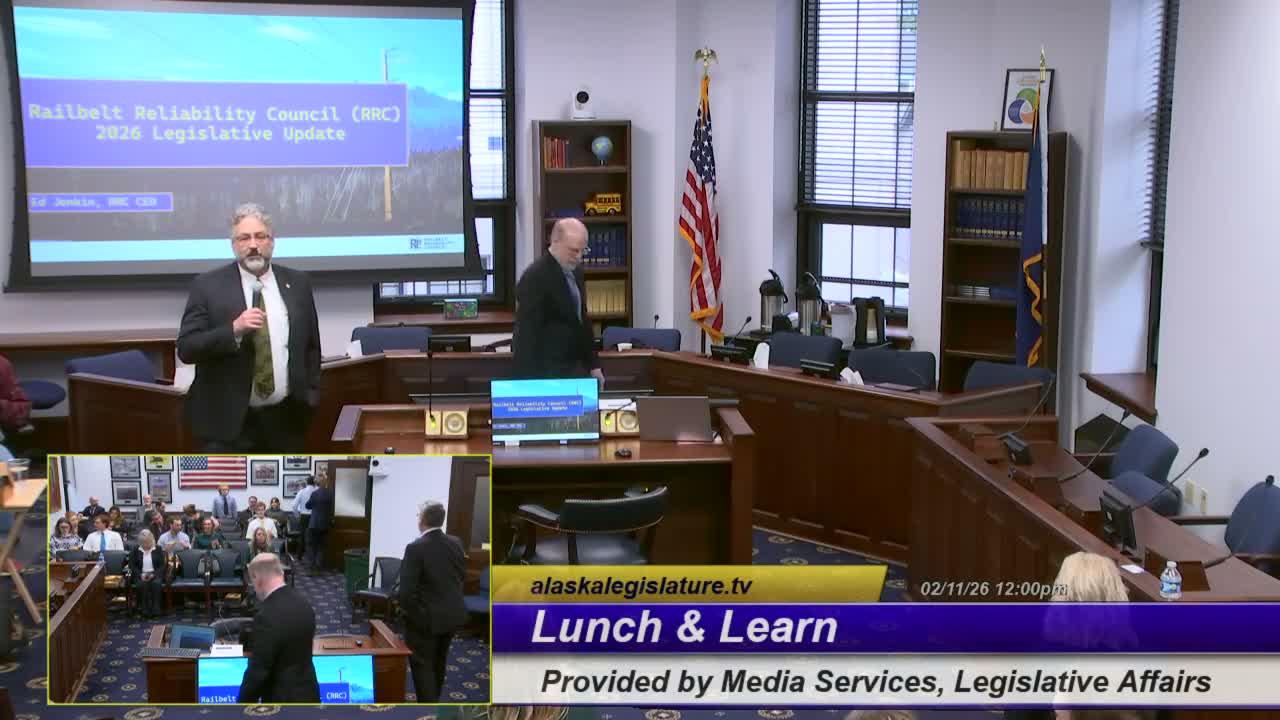
Summary
At an Anchorage briefing hosted by Rep. Kai Holland, the Rail Belt Reliability Council said it has 14 proposed reliability standards before the Regulatory Commission of Alaska and expects a preferred integrated resource plan portfolio in the fourth quarter of this year, with a final filing to the RCA planned for 2027.
Representative Kai Holland convened a briefing in Anchorage where Ed Jenkins, chief executive officer of the Rail Belt Reliability Council, outlined the council’s 2026 priorities: finalizing regional reliability standards, completing an integrated resource plan and coordinating with a Rail Belt Transmission Organization to establish how regional projects will be paid for.
Jenkins told attendees the council has pursued a regional approach because the Rail Belt — the electric corridor from Fairbanks to Homer — has limited parallel transmission and relatively low load density compared with Lower 48 systems. "As we plan, we are planning the rail belt as a region, not as 5 separate utilities," Jenkins said, arguing that coordinated planning can lower costs and improve reliability across the corridor.
Why it matters: the RRC’s standards and IRP affect which projects can be built and how their costs may be recovered in utility rates. Jenkins said the RRC has filed a batch of standards with the Regulatory Commission of Alaska (RCA) and has coordinated a filing schedule with the regulator to avoid overloading the review docket. "We presently have 14 standards in front of the RCA now," Jenkins said, and the council is phasing filings so the RCA can review them carefully.
Standards and governance: Jenkins described a multi-step development process: a technical advisory committee (TAC) drafts standards, working groups with utility, independent power producer, consumer and environmental representatives debate them in public, and the TAC forwards recommendations to the board. The council’s board is described in the briefing as 13 voting members representing a balance of stakeholders, plus two nonvoting seats — one for the RCA and one for the consumer representative (RAPA). Jenkins said the board requires nine voting members to approve items for filing with the RCA.
IRP and modeling: The RRC hired Black & Veatch to run modeling and support the integrated resource plan. The council plans to use Encompass for economic portfolio analysis and PSSE for electrical steady-state and contingency modeling. Jenkins said the council expects a preferred portfolio in the fourth quarter of this year and intends to file a final plan with the RCA in 2027. "We hired Black & Veatch in November to start the process," he said, and staff are collecting data, signing nondisclosure agreements and running scenarios.
Project preapproval and thresholds: Jenkins summarized statutory project-approval rules created alongside the RRC. Under the briefing’s description of the law, a project larger than 15 megawatts or a transmission line longer than 10 miles generally must receive prior RCA approval to be included in rates; the statute includes language that a large facility included in the most-recent IRP may satisfy those requirements absent other clear and convincing evidence. Jenkins said the 15-megawatt threshold was intended to capture resources that materially affect the bulk energy system while allowing utilities flexibility for smaller, distribution-level projects.
Legislative questions: An attendee asked whether a pending bill, SB 32, would change the thresholds Jenkins described. Jenkins said he did not know the bill’s exact provisions, noting he had heard draft numbers of 10 megawatts and possibly 5 megawatts; he reiterated that the council’s focus is resources that connect to the bulk system.
Staffing and implementation: Board chair Lou Florence and Jenkins said the RRC currently operates with a small staff (described at the briefing as four people) and relies on extensive stakeholder work in technical working groups. Jenkins said staffing may expand when compliance and enforcement functions begin.
Next steps: The council will continue working through TAC and working-group drafts, move prioritized interconnection and facility standards toward board approval, phase filings with the RCA, run IRP modeling with Black & Veatch and present a preferred portfolio to stakeholders later this year before the 2027 RCA filing. Jenkins asked attendees to follow up with technical questions to the experts present.
The session concluded with a short question-and-answer period and a closing invitation to continue dialogue with council staff and contractors.