Get AI Briefings, Transcripts & Alerts on Local & National Government Meetings — Forever.
Permanent Fund Corporation briefs Senate Finance on 50th anniversary, draw rates and investment risks
Loading...
Summary
Alaska Permanent Fund Corporation leaders briefed the Senate Finance Committee on the fund's 50th anniversary, asset-allocation choices, the 5% percent-of-market-value draw, sensitivity of statutory net income to realized gains, and the corporation's private-investment due diligence process including a Digital Bridge co-investment.
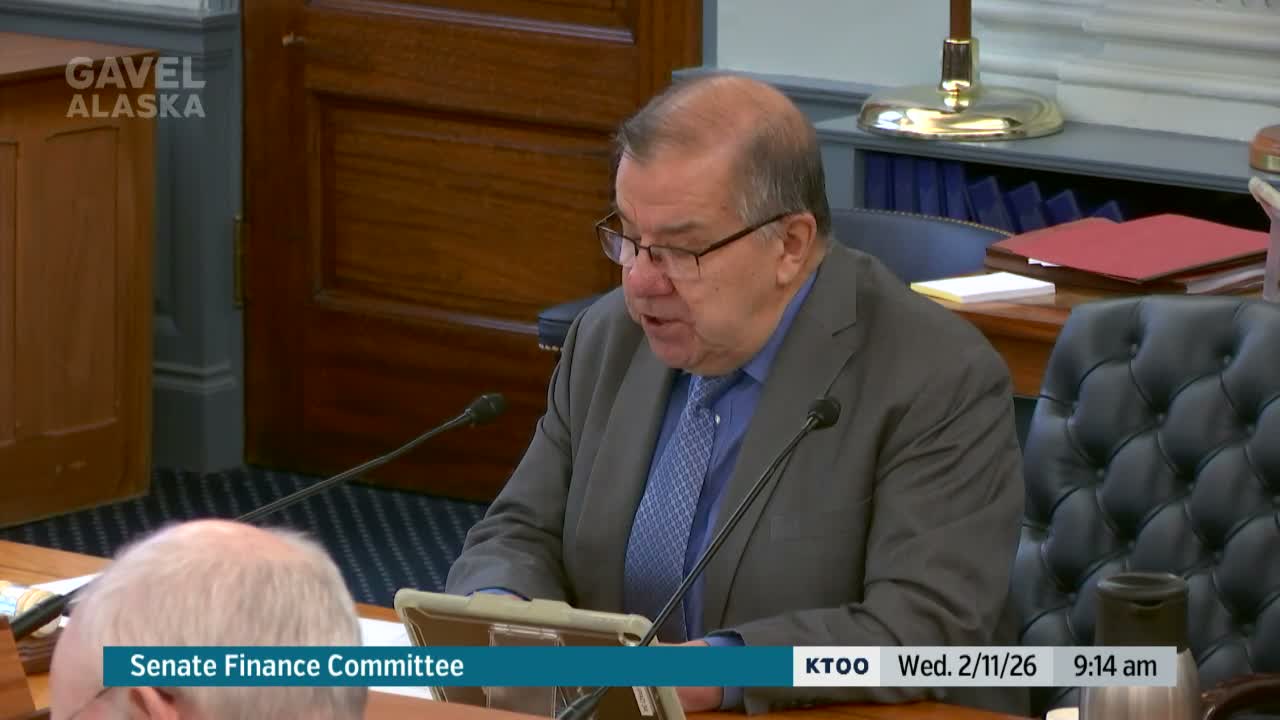
The Alaska Permanent Fund Corporation updated the Senate Finance Committee on Feb. 11 about the fund's 50th anniversary, how it manages assets and risks, and why the corporation recommends caution about changing the fund's 5% percent-of-market-value (POMV) draw.
"This is the fiftieth anniversary of the fund's creation by the Alaska legislature," said Devin Mitchell, chief executive officer of the Alaska Permanent Fund Corporation, noting the 1976 constitutional amendment and the intergenerational intent behind the fund. Mitchell cautioned that reported balances can overstate the constitutional principal because unrealized gains sit between principal and the earnings reserve.
Marcus Frampton, the fund's chief investment officer, told the committee the corporation manages a diversified portfolio across public equities, fixed income, private equity, real estate and other asset classes and that the fund's formal return objective is "CPI plus 5." He said external advisors and internal analysis indicate a 5% draw is at the high end of what is sustainable: "We've uniformly suggested that 5% is either the maximum or too high." Frampton warned that in market crises a fixed 5% draw could materially erode the fund's value because draws during depressed markets remove capital that otherwise would participate in recovery.
The briefing also addressed statutory net income and unrealized gains. Frampton said the fund had about $17 billion in unrealized gains as of December and described modeling that assumes the fund historically churns roughly 25% of unrealized gains in a given year; under that assumption, forecasted statutory net income could reach $5–6 billion, but a severe market decline would sharply reduce realizable gains and statutory net income.
On private investments, Frampton described the due-diligence process for a recent digital-infrastructure allocation to Digital Bridge: initial screening, consultant-led due diligence, co-investment selections and a final commitment to an individual company. Mitchell estimated external legal review costs for a private-deal review in the range of $20,000–$40,000.
Why it matters: the committee hears the annual operational and risk posture of Alaska's largest state asset. The presentation frames the trade-offs the legislature faces between current draws to support the budget and preserving the fund's purchasing power for future generations.
The committee recessed after the briefing and scheduled an afternoon session at 1:30 p.m.