
Committee advances bill to create New Mexico broadband affordability program while opponents urge ending legacy ARS funding
Get AI-powered insights, summaries, and transcripts
Subscribe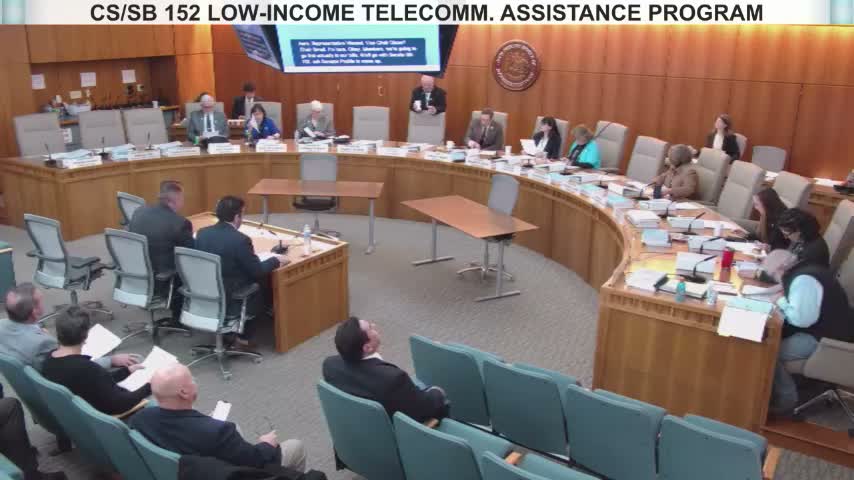
Summary
The House Appropriations & Finance Committee gave a do-pass recommendation for Senate Bill 152, which would create a state low‑income broadband subsidy and restructure State Rural Universal Service Fund allocations; opponents asked that legacy ARS payments be allowed to sunset and redirected to affordability and broadband deployment.
Senate Bill 152, sponsored in the hearing by Senator Michael Padilla, would establish a state low‑income telecommunications assistance program and restructure the State Rural Universal Service Fund to fund both affordability and rural operations. Padilla told the committee SB152 sets an initial affordability cap of $10 million the first year, with the Public Regulation Commission (PRC) authorized to increase the program up to $45 million in subsequent years, and keeps $18 million for rural operations and maintenance and $12 million for continued broadband expansion.
Jeff Lopez, director of the New Mexico Office of Broadband Access and Expansion, told the committee the legislation is modeled on the federal Affordable Connectivity Program (ACP), which provided up to $30 monthly subsidies and additional support until federal funding ended in 2024. Lopez said today’s primary barrier to household broadband adoption is affordability rather than physical access and that SB152 uses existing state funds (the State Rural Universal Service Fund) to create the subsidy while preserving program integrity through ETC (eligible telecommunications carrier) requirements.
Public comment at the committee was broadly supportive of affordability but sharply split on the treatment of ARS (access reduction support) legacy payments. Albert Katnak (SEG 193) urged the committee not to restore ARS, arguing the Legislature previously set ARS to sunset and that returning those dollars would continue subsidizing legacy POTS telephone service rather than modern broadband. Brian Katnak (SEG 303) and others proposed redirecting the ARS dollars entirely to affordability and broadband deployment, suggesting a two‑bucket approach of roughly $20 million each for affordability and broadband rather than the bill’s three‑part split.
Industry groups and rural providers backed the bill’s affordability provisions. Jay Santiannis of the New Mexico Exchange Carrier Group and representatives of tribal and rural carriers said the proposal preserves rural operators’ ability to serve very low‑density areas and that ARS‑style payments remain critical to maintain service where customer density is low. Several speakers representing tribal and small rural providers noted the operational costs of serving reservations and sparsely populated counties and urged support for the combined affordability and operations approach.
Committee members pressed sponsors and staff on implementation details: who awards ETC designations (both the Federal Communications Commission and the state Public Regulation Commission can designate ETC status), the cost and barriers for small providers to become ETC‑certified (the director said costs can average several thousand dollars annually), and how satellite and fixed‑wireless solutions will be incorporated (the Office of Broadband said a technology‑neutral, “all of the above” approach is intended and cited recent federal awards, including a $382 million BEAD‑related award and a $111 million award to the Navajo Nation).
Padilla acknowledged concerns from small providers and said he would convene an interim working group to resolve technical issues about apportionment and ETC access. Representative Herndon moved a do‑pass recommendation on the bill (the motion was seconded by Ranking Member Chatfield); the chair asked for opposition, heard none, and recorded a do‑pass recommendation from the committee.
The committee also discussed and recorded motions related to the bill’s finance committee substitute; committee action advanced the bill with the sponsor’s commitments to stakeholder work during the interim.