
House Energy panel requests agency feedback on measured residential energy code bill
Get AI-powered insights, summaries, and transcripts
Subscribe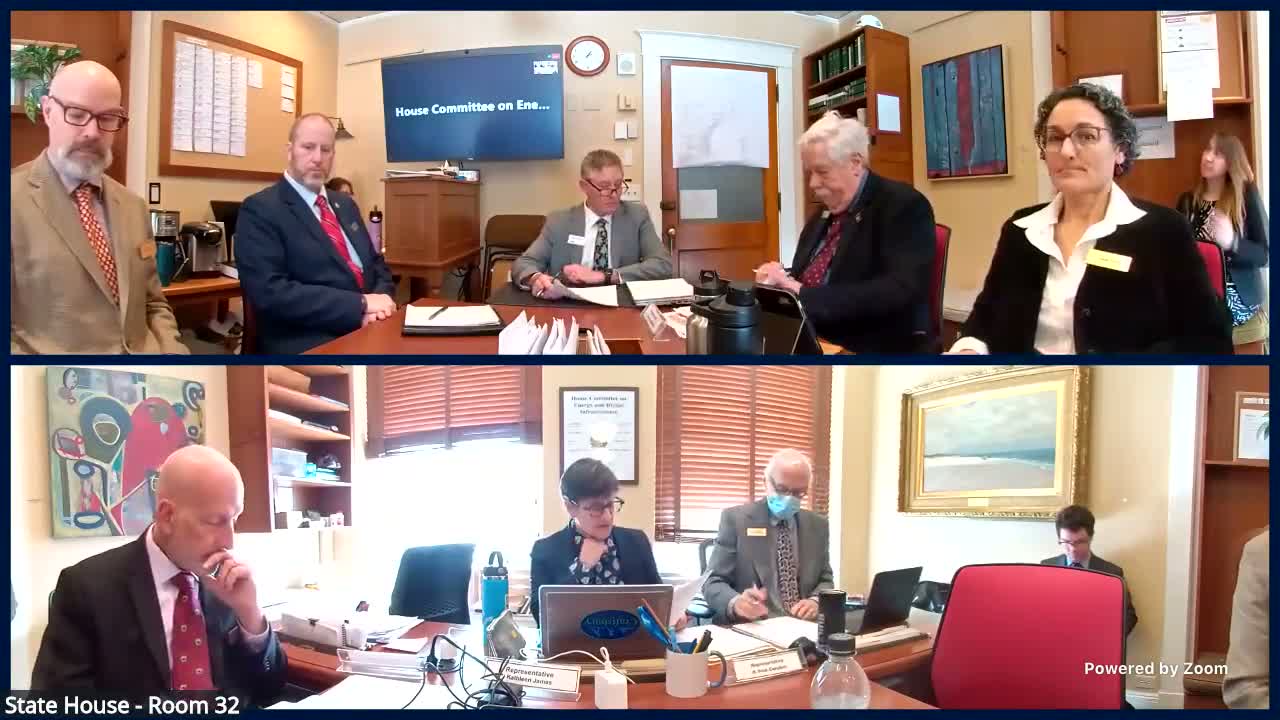
Summary
The House Energy & Digital Infrastructure Committee heard testimony on H.718, a measured bill to study adopting a residential building code, strengthen the contractor registry, clarify municipal enforcement, and stabilize the transition. Members requested written responses from OPR and the League before moving funding or referrals.
Montpelier — The House Energy & Digital Infrastructure Committee spent the session on H.718, a compromise bill that would take incremental steps toward a statewide residential building code while creating study and administrative measures to stabilize the transition, committee members said.
Andrew Brewer, manager of government and public affairs at Downs Rockland Martin, testified on behalf of the Home Builders Association, the Vermont Builders and Remodelers Association, and the Architects Association. Brewer framed the bill as a cautious, pragmatic response to what builders say is growing technical complexity in energy codes without a matching statewide administrative structure. "If the state is gonna attach legal consequences to compliance with a very technical code, that code should operate within a coherent regulatory structure, clear authority, consistent interpretation, training inspection, reasonable liability boundaries," Brewer said.
The bill does not immediately adopt a full residential code statewide, Brewer and other supporters emphasized. Instead, H.718 would study adoption, expand a contractor registry task force to examine certification and licensure questions, clarify municipal enforcement authority, and direct agencies to recommend whether and how to adopt a residential code. Brewer described those steps as "a movement in the right direction" that avoids a sudden leap to full code adoption.
Committee members pressed on several practical issues raised in testimony. Brewer and others warned of a patchwork approach if towns are allowed to adopt different code versions without a unified appeals or interpretation process. He also described a proposed ‘‘safe harbor’’ to protect builders who filed certificates under the 2020 residential code after a governor's executive order: an Attorney General opinion had found procedural defects in that executive order, creating legal ambiguity, and the safe-harbor language would prevent retroactive penalties while rules or a clear date are established.
Cost and technical differences between the 2020 and 2024 code cycles drew close scrutiny. Members and witnesses highlighted that the 2024 update requires balanced mechanical ventilation (for example, heat-recovery ventilators), which adds both capital and operating costs. Brewer cited a builder-commissioned comparison of two houses that found an additional up-front cost of about $12,000 with a modest annual energy benefit (about $143 per year), a point members said affects affordability and consumer decisions.
The testimony also noted that certain specialties are limited in number: a builder who spoke to Brewer said there are only "literally 7 or 8" HERS raters in the state, raising questions about whether a full licensure requirement for that group would be proportionate to market size.
Brewer recounted implementation problems with the rollout of the 2024 code: a nonfunctional online prescriptive path, incomplete manuals, and other administrative shortfalls. He suggested using RGGI funds to improve the compliance website and to strengthen the contractor registry and training supports so market mechanisms could encourage voluntary compliance.
Committee members signaled general support for the bill's compromise approach but diverged on funding. Some objected to using RGGI funds for the appropriation (the discussion cited an approximate $88 million fund balance and a roughly $400,000 appropriation under consideration); others said a clear nexus to weatherization and energy outcomes justified the use. No appropriation was finalized in the committee.
Chair Rep. Kathleen James said the panel needs written feedback from OPR and the Vermont League of Cities and Towns before advancing funding or final referral. She also noted a small pending drafting change (striking a general-fund appropriation) and that the committee will await the agencies' written responses before sending the bill to appropriations or taking other formal steps.
The committee did not take a final vote on H.718 during the session. Next procedural steps listed by the chair include receiving written testimony from OPR and the League and reconciling the appropriation language before any formal referral or funding decision.
The session also scheduled a two-hour follow-up next week for H.716 and behind-the-meter battery issues, inviting the Department of Public Service, the PUC, utilities and stakeholder groups to provide additional testimony.