Assembly review finds AB 488 strengthened oversight of online fundraisers but implementation has disrupted some nonprofits
Loading...
Summary
Lawmakers, the Attorney General’s Office, nonprofits and platform representatives told an Assembly outcomes review that AB 488 created new tools to protect donors but that registry delays, ‘good standing’ rules and operational burdens have interrupted fundraising for some charities and small-gift programs.
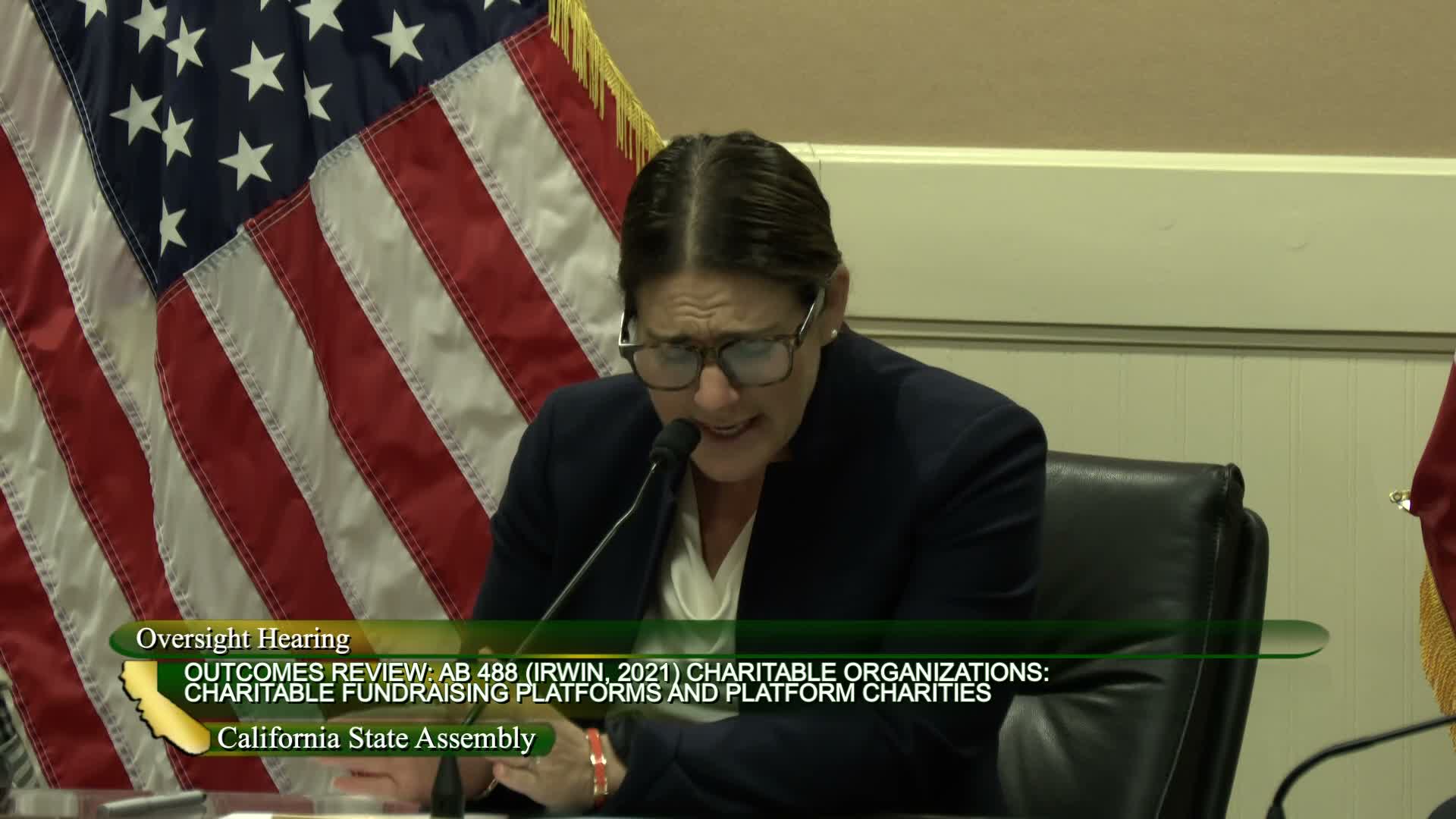
SACRAMENTO — The California State Assembly on Feb. 10 examined how AB 488 (2021) — the law that created a new regulatory category for charitable fundraising platforms — has worked in practice, with officials and industry representatives saying the statute clarified responsibilities but that implementation problems have disrupted fundraising for some charities.
Assemblymember Erwin, the bill’s author, told the outcomes review hearing that AB 488 was intended to “modernize California's charitable solicitation laws” and to give the Department of Justice tools to ensure donor protections online. “AB 488 from 2021 is on that chart and it is currently yellow,” Erwin said, meaning the law is still being monitored for full implementation.
Brian Gerard Armstrong, a supervising deputy attorney general, outlined the Attorney General’s implementing regulations and the office’s enforcement work. Armstrong said the regulations (adopted in phases) require registration and reporting by platforms and set disclosure, consent and distribution rules intended to prevent deception and honor donor intent. “We are committed to continuing to take action where appropriate to safeguard online donations and protect charities and donors from fraud, deception, and other wrongdoing,” Armstrong said.
Armstrong also described the Justice Department’s effort to modernize the Registry of Charities and Fundraisers with an online filing service intended to reduce paper filings, speed processing and improve notifications to charities. He provided the Department’s registration and reporting counts through Feb. 10, 2026, including platform registrations and outstanding annual-report work the registry is addressing.
Platform and nonprofit witnesses largely agreed AB 488 filled important gaps but said aggressive enforcement and slow registry processes have had unintended consequences. Jeff Green, CEO of the California Association of Nonprofits, said the law has been a “mixed bag”: while it improved transparency and gave authorities a clearer tool to act against misconduct, registry delays and the practice of platforms acting as primary messengers about a charity’s standing have frozen some organizations out of fundraising. “We believe that having AB 488 on the books as it is is very helpful,” Green said, while also urging faster, technology-enabled registry processing.
Nick Aldridge of PayPal Giving Fund described the operational burden platforms have borne to comply, including extensive reporting and engineering work, and said about 1,600 charities were currently inactive on PayPal in California because of good-standing issues. Aldridge recommended shortening cure windows, allowing limited additional time in certain reassignment scenarios, and reducing burdens for micro-donation programs that can be difficult to operate under current disclosure requirements.
Emily Barson of GoFundMe said the company supports AB 488’s goals but warned that the current framework has “unintended consequences” that can halt fundraising during prolonged DOJ review or for minor administrative deficiencies. Barson proposed limiting the circumstances that strip an organization’s ability to operate online to final cease-and-desist or suspension orders and urged the registry to adopt a 10-business-day review benchmark used by several other states.
Witnesses and members also discussed high-profile enforcement examples described by the Attorney General’s Office: FlipCause (a platform that stopped remitting donations to thousands of charities and later entered bankruptcy) and a recent episode in which GoFundMe created unauthorized donation pages, prompting prompt remediation after stakeholder outcry. The AG’s office said it has used AB 488 tools to address those problems.
On timing, Armstrong said the department implemented the regulations in phases, with some requirements (including platform registration) becoming mandatory on staggered dates and with certain grace periods to permit compliance. He said the online filing service — expected to roll out in stages — will reduce incomplete filings and speed processing, and that the department has paused delinquencies in certain instances while the system is deployed.
Members pressed for clearer notification and faster processing so that charities with minor administrative delinquencies are not cut off from fundraising while they correct paperwork. Erwin said she is preparing follow-up legislation to address outstanding issues and strike a balance between donor protection and avoiding harms to small nonprofits.
Public commenters supported the review. Martin Radosevich of Candid commended the Assemblymember’s revisiting of AB 488 and urged quick fixes to the registry’s “may not operate” procedure. Melissa Coase of Pacific Gas and Electric Company described an instance in which an IRS-recognized charity’s state standing problem affected employee-directed giving, producing an unintended redirection of corporate matching funds.
The hearing concluded with members expressing intent to pursue statutory and implementation refinements, including improvements to the registry, clearer good-standing thresholds and consideration of special rules for micro-donations. No formal votes were taken at the hearing; members said a follow-up bill is expected to address pointed issues raised by stakeholders.
What’s next: Assemblymember Erwin said staff will compile the hearing’s input and work on follow-up legislation to narrow timelines and clarify the application of good-standing rules, while the Attorney General’s office continues to roll out an online filing service intended to reduce delays.