Higher‑education leaders ask California Assembly for targeted funding to meet enrollment and workforce needs
Loading...
Summary
Chancellors of the California Community Colleges and CSU and the president of the University of California outlined funding requests and policy priorities — including enrollment growth funding, a common cloud data platform, expanded credit for prior learning, and action on transfer pathways — at an Assembly Subcommittee No. 3 hearing.
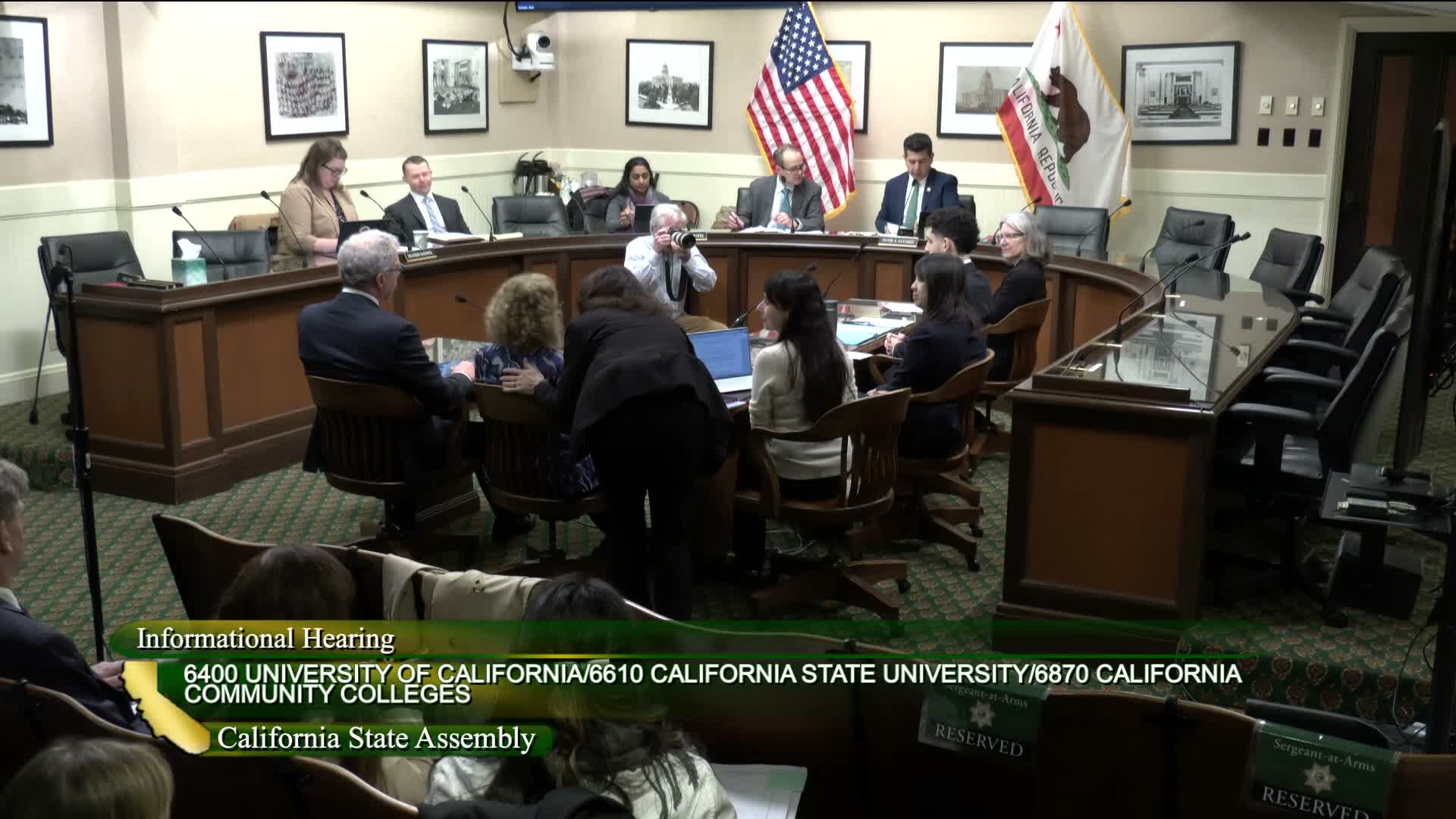
Chair David Alvarez convened the Assembly Subcommittee No. 3 hearing to hear testimony from the three leaders of California’s public higher‑education segments and budget offices.
California Community Colleges Chancellor Sonia Christian told the committee the system has rebounded from pandemic declines and projected further growth. “In 2023 we regrew 4.9%… in 24–25 we surged another 9.6%,” Christian said, and asked the legislature to fund 3% enrollment growth for the next two years, above the governor’s 1.5% proposal.
Christian also asked for additional technology and equity investments: an expansion of a common cloud data platform (she cited last year’s $12 million and requested an additional $35 million), a scale‑up of credit for prior learning with an outcomes‑based allocation to reach a goal of 250,000 Californians, and funding for AI literacy (a $10 million one‑time and $5 million ongoing Prop 98 request).
CSU Chancellor Mildred Garcia described the CSU’s CSU Forward strategic plan and asked support for the governor’s proposal and for one‑time investments to address an estimated $8 billion deferred‑maintenance backlog. Garcia said the system has implemented an enrollment reallocation program shifting about $89 million and 10,000 full‑time equivalent students to higher‑demand campuses to better match capacity and demand.
UC President J.B. Milliken urged sustained compact funding for the University of California, citing record enrollment of more than 300,000 students and noting that federal investigations have put some research funding under review. “State support has never been more important,” Milliken said, asking lawmakers to continue the compact payments in the budget.
Committee members pressed the systems on transfer outcomes, common course numbering, workforce alignment, and how requests would translate to classroom capacity. Members asked for concrete metrics and deadlines; CSU and the community colleges committed to intensifying faculty‑led work on common course numbering and to return with progress within a year.
The Legislative Analyst’s Office and Department of Finance made staff available to assist with technical questions about funding formulas and the mechanics of resident/nonresident enrollment targets. Public commenters — faculty unions, student groups and staff unions — overwhelmingly urged the subcommittee to backfill prior loans to CSU, ensure new funds go to instruction and student support rather than administrative raises, and include accountability language attached to budget appropriations.
The committee requested updated campus‑level enrollment and target data and said each segment’s budget will be considered in upcoming hearings.