
Arizona Senate gives due pass to SCR 1,001 after heated debate over mail‑in voting and voter ID
Get AI-powered insights, summaries, and transcripts
Subscribe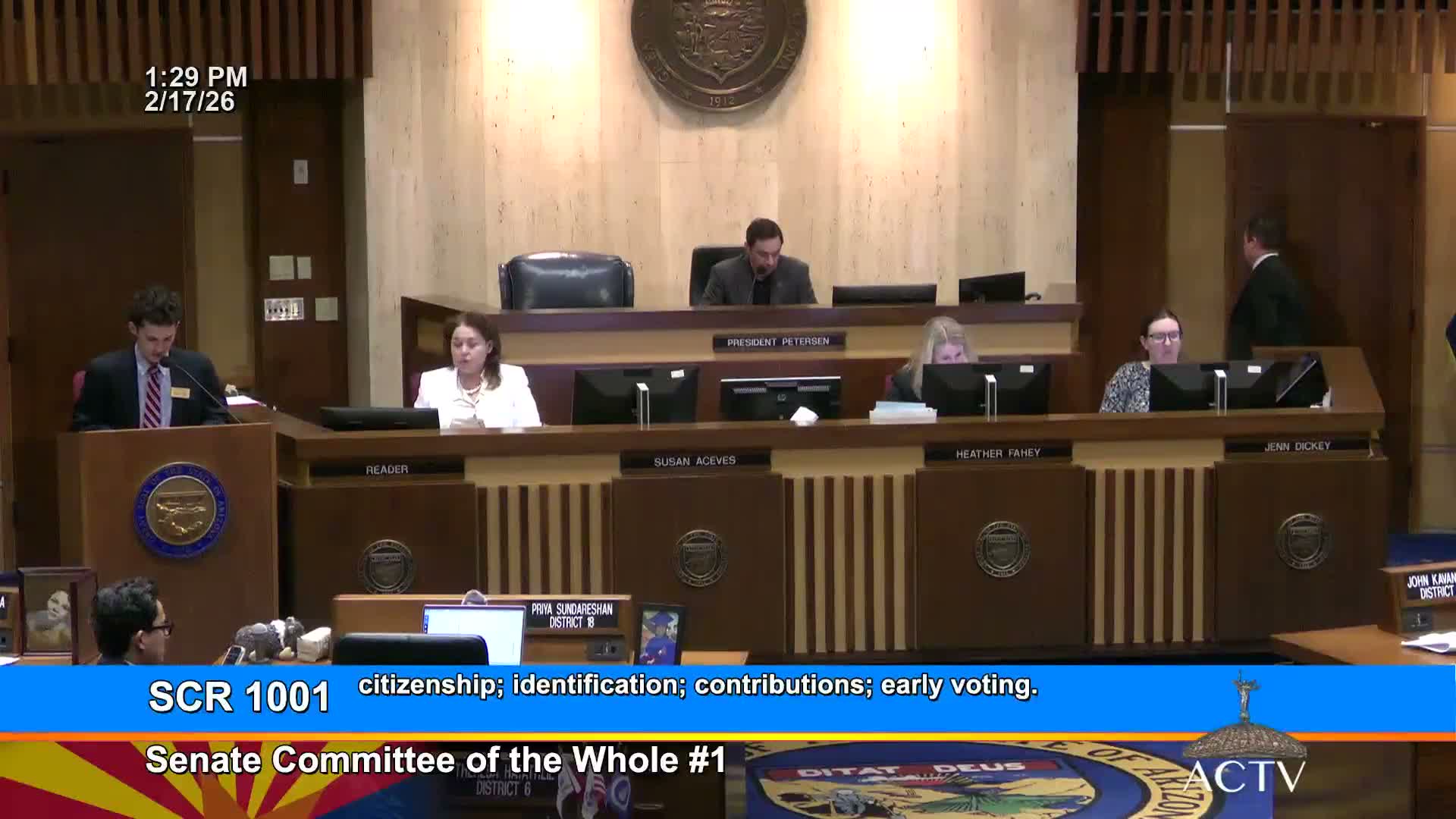
Summary
The Arizona Senate voted 17–12 to give SCR 1,001 (a proposed constitutional amendment) a due‑pass recommendation after extended floor debate over proof‑of‑identity rules and limits on mail‑in ballot drop‑off; supporters framed the change as improving speed and integrity, opponents said it risks disenfranchising mail voters.
The Arizona Senate on Feb. 17 advanced SCR 1,001, a proposed constitutional amendment that would add a new section to Article 7 outlining new proof‑of‑identity and election‑administration rules, after a 17–12 vote sending the measure to the House.
Sponsor Senator Shawna Bullock defended the referral as a measure to strengthen how ballots are handled and to “help ensure that we have not only secure elections by providing ID, but hopefully with the deadline on Friday before the election, we will be able to accurately post election results on election night,” she said in closing remarks.
Opponents countered that the referral would reduce access to mail‑in voting and could disenfranchise thousands. “This bill would ax the early voting system, which Arizona pioneered,” Senator Kubey said, warning the amendment would allow a future legislature to “ban all mail elections entirely.” Senator Ortiz called SCR 1,001 “the last gasp bill,” saying it would make it harder for Black, Latino and indigenous Arizonans to cast ballots.
Debate focused on two contested effects of the referral: a requirement that electors provide proof of identity “to vote in person or through any other means,” and a removal or limitation of the active early voting list and last‑minute ballot drop‑offs. Senators who questioned the sponsor asked how the ID language would work for mail ballots and whether it would create new requirements — such as requiring Social Security numbers or drivers’ license numbers on return envelopes — that would introduce privacy risks and confusion.
Senator Bullock told colleagues that “there are no new ID requirements for mail in ballots” and that the measure is “prescribed by law” (sponsor’s closing comments). Several opponents cited studies and prior state experience in arguing the change would cause practical harm: one senator cited Texas’s experience, saying absentee‑ballot rejections rose to 13% after that state tightened ID rules and argued a similar increase in Arizona could mean “400,000 Arizona voters disenfranchised.”
Supporters, including the majority leader and Committee of the Whole chair, said the referral is intended to speed tabulation while preserving election integrity. “The reason why our results are delayed is because we can't count fast enough because we get this big dump of ballots on election day,” the majority leader said during debate, adding that the state needs to balance speed and accuracy so national attention does not shame Arizona as slow to report results.
The floor adopted a sponsor amendment (the Bullock floor amendment) prior to the vote. After further floor explanations and roll‑call, the Senate recorded 17 ayes, 12 nays and 1 not voting on the measure’s due‑pass recommendation; the clerk recorded that the resolution will be transmitted to the House for further processing as a ballot referral.
What’s next: SCR 1,001 now moves to the House and, if approved by both chambers in the required form, would proceed to voters as a constitutional ballot referral. Any changes between the chambers could alter the text before it reaches the ballot.