
Committee backs bill to require at least one school employee trained in CPR, first aid and AED use
Get AI-powered insights, summaries, and transcripts
Subscribe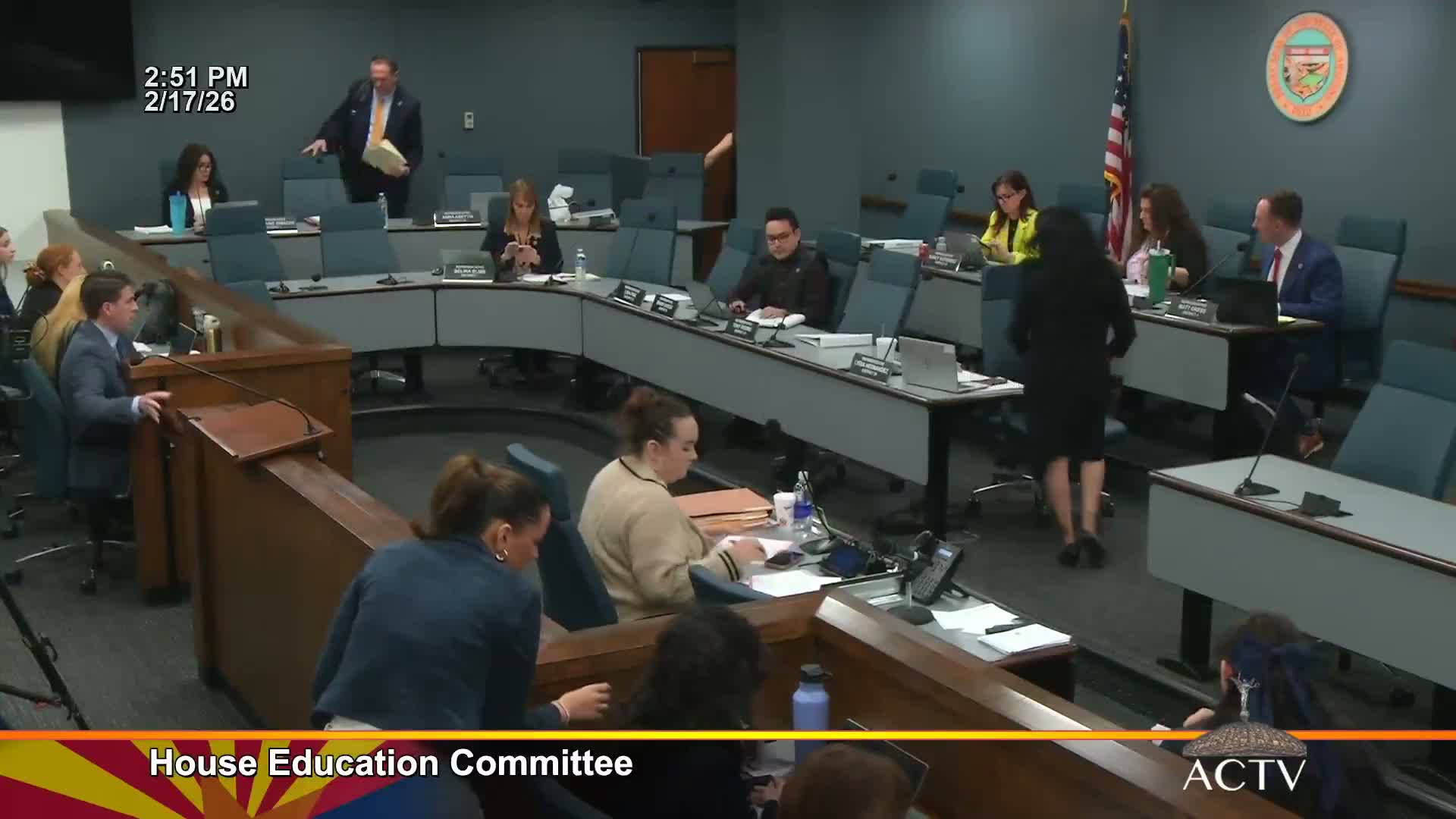
Summary
The Arizona House Education Committee gave HB 4043 a due‑pass recommendation after hearing that the bill would require one staff member at every school to complete nationally recognized CPR, first aid and AED training. The American Heart Association said it was neutral with concerns about single‑person gaps.
The Arizona House Education Committee voted to give House Bill 4,043 a due‑pass recommendation after hearing testimony that the bill would require each school campus to have at least one employee trained in CPR, first aid and the use of automated external defibrillators beginning Aug. 1, 2027.
"Basically, the bill right now says that every district and every school will have one person who's trained in CPR," Representative Windinger told the committee as he described the measure and said he intends to amend it on the floor to specify that a trained person be present "at all times." The sponsor said he does not view the requirement as an unfair mandate and cited constituent testimony about a past tragedy that motivated the proposal.
The American Heart Association’s local representative, Erin Stieger, said the organization supports CPR training generally but announced a change of position to neutral with concerns. "More than 23,000 children each year suffer sudden cardiac arrest outside of the hospital," Stieger said, adding that requiring only one trained employee on campus could create a gap if that person is absent and urging that a plan for cardiac emergencies and access to AED devices be part of the approach.
Members pressed the sponsor about whether the requirement implies schools must purchase AEDs. Representative Gutierrez noted prior legislation that placed AEDs in high schools and asked whether the new bill would impose equipment costs on K–8 campuses. Representative Windinger agreed to work on floor language that would clarify: if a campus has an AED, someone must be trained to use it, rather than obligating every elementary campus to buy a device immediately.
Public comment included a family who described losing a child and urged the committee to make classrooms safer with trained staff. After public testimony the committee took a roll call: by the committee’s tally, the measure advanced with a due‑pass recommendation (7 ayes, 1 no, 4 present). The committee’s action sends the bill to the next stage for floor consideration with the sponsor’s intended amendment pending.
What’s next: The sponsor indicated a floor amendment will be drafted to clarify whether training requirements are conditional on AED availability and to refine the on‑site training timing. The bill’s fiscal and implementation details will be resolved before floor action.