
Alabama committee advances bill to tighten seafood labeling, add random testing and inspection penalty
Get AI-powered insights, summaries, and transcripts
Sign Up Free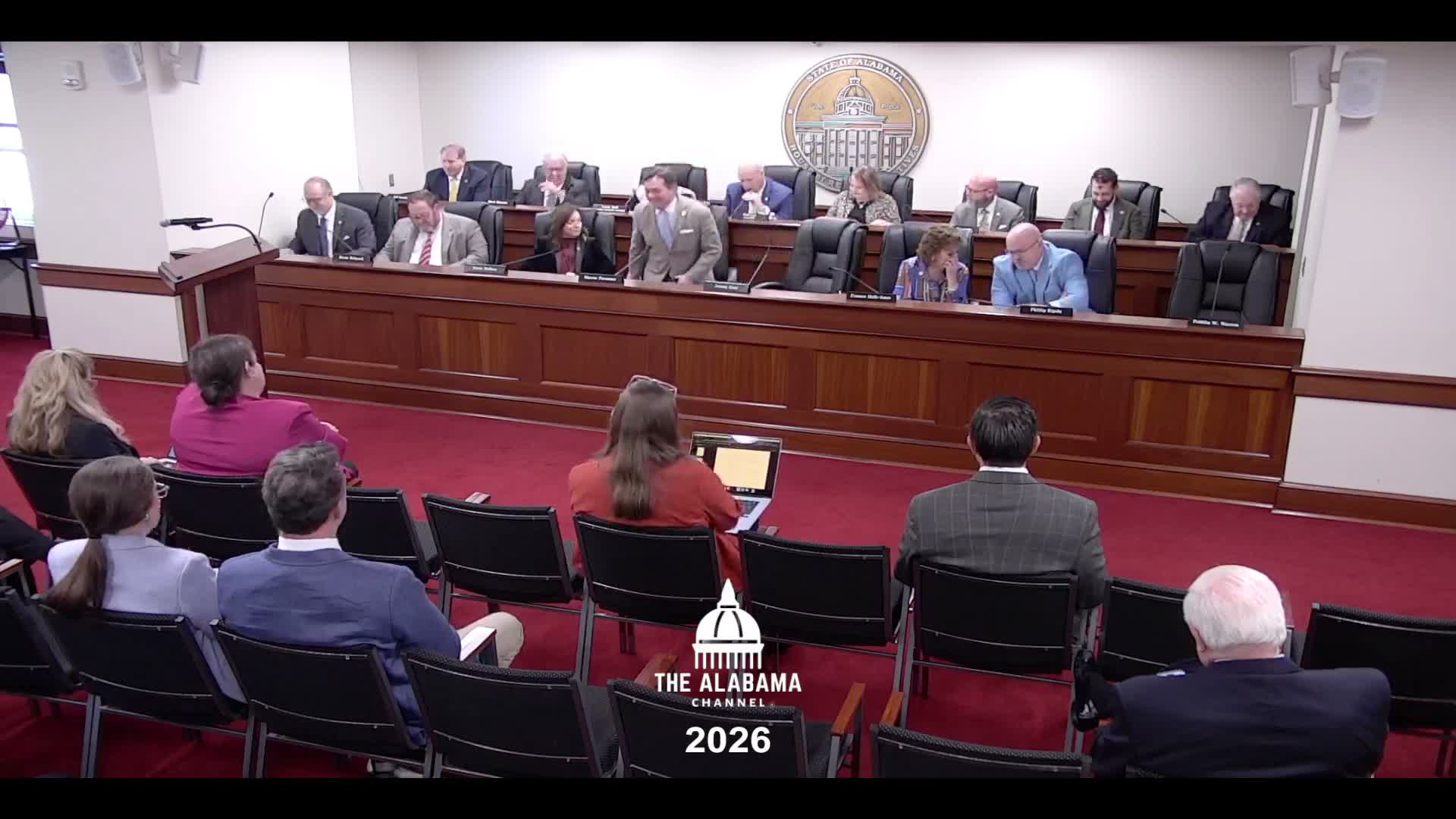
Summary
The House committee passed House Bill 444 after adopting a technical amendment; the bill requires restaurants to disclose whether seafood is imported or domestic and farmed or wild, authorizes random testing by the Department of Agriculture, and adds inspection penalties and quarterly publication of failures.
Representative Grama introduced House Bill 444 on the committee calendar, saying its purpose is "to inform Alabamians where their seafood comes from." The bill updates the state's seafood-labeling law to require restaurants to indicate for each menu item whether seafood is "imported" or "domestic" and whether it is "farm raised" or "wild caught," and it creates enforcement mechanisms including random testing and inspection penalties.
Supporters told the committee the Department of Agriculture can contract with labs that maintain DNA reference lines for shrimp and are improving capability for oysters so on-site testing can verify claims such as "Mobile Bay shrimp" or "Apalachicola oysters." Representative Grama said the department's testing contracts and on-site equipment will allow authorities to check labeling claims and that the proposal targets mislabeling the member described as consumer fraud: "it's essentially, in my opinion, fraud if you... say you're serving gulf seafood when in fact you're not." The bill would make labeling a line item on health inspections and impose a five-point deduction from inspection scores for failures.
Committee members pressed on practical limits. Representative Bradford clarified the bill does not require country-by-country origin labeling; Grama said other U.S. states would be considered "domestic" and the law would not demand country-specific origin because of cost and supply-chain variability. Representative Mooney cited industry sources, saying he found material on the National Fisheries Institute website that "seafood cannot be scientifically tested to verify country of origin," and expressed concern about conflicts with federal labeling rules for processed products. Grama acknowledged concerns and offered to provide contact information for the testing vendors, stressing that the bill's labeling standard is limited to "imported" versus "domestic."
The committee considered a technical amendment that replaces specified lines to clarify that the state health officer or designee acts on verified items and requires the Alabama Department of Public Health to publish information on its website at least quarterly. An unidentified presenter described the amendment as making "really technical changes," and the amendment was adopted by voice vote.
After debate, the committee moved the bill forward. Members recorded a first and second and voted by voice; the chair announced, "The bill passes with a federal report." The record shows voice votes only; numerical tallies were not provided.
What happens next: the bill leaves committee with an amendment requiring ADPH publication and the added testing and inspection provisions; the transcript does not record subsequent steps such as floor scheduling or specific implementation timelines.