
Security Council signatories urge Libya to embed climate resilience in national planning
Get AI-powered insights, summaries, and transcripts
Subscribe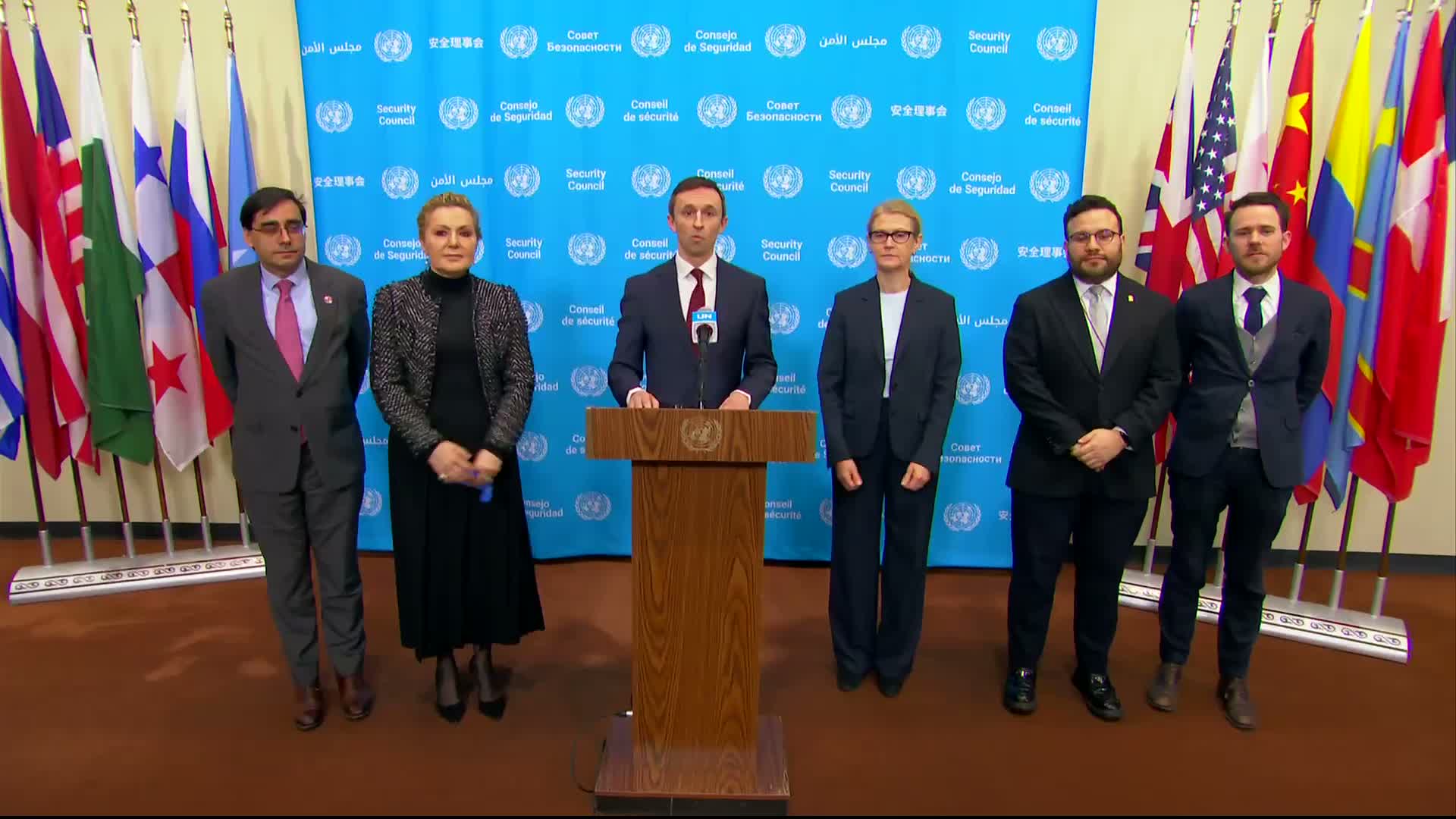
Summary
A representative speaking for signatories to the Joint Pledges on Climate, Peace, and Security urged Libyan actors to resume a Libyan-led political process, integrate climate-related risk management into budgets and planning, strengthen disaster governance after the 2023 Derna floods, and seek international support for a climate finance task force.
A representative speaking for signatories to the Joint Pledges on Climate, Peace, and Security urged Libyan actors to resume a Libyan-led and Libyan-owned political process and to integrate climate resilience into national planning and budgeting during remarks delivered at the United Nations Security Council.
The speaker — identified in the transcript as representing the United Kingdom and speaking on behalf of Denmark, France, Greece, Latvia, Liberia and Panama — said Libya is facing mounting climate stressors that exacerbate fragility and conflict. "As one of the world's most water stressed countries, less than 2% of Libya's land is viable for agriculture," the speaker said, adding that rainfall is projected to decrease about 7% by 2050.
Those conditions, the speaker said, are fueling resource competition and displacement and reducing the country's capacity to manage shocks. The statement set out three central recommendations: first, that Libyan actors resume a Libyan-led political process as soon as possible and embed climate-related peace and security risk management into a unified national budget and planning system with inclusive, community-driven and gender-responsive decision-making; second, that civil society and local authorities be supported to advance innovative local climate action, including prioritizing youth- and women-led initiatives; and third, that Libya strengthen disaster risk governance and climate finance readiness.
The speaker thanked the UN Support Mission in Libya for assistance and highlighted the EcoVision Libya Youth Climate Challenge 2026 as an example of international support for local innovation. On disaster governance the speaker referenced the 2023 Derna floods as "a powerful reminder of the cost of inaction," welcomed the establishment of Libya's National Emergency and Crisis Management Centre and urged it to develop a multi-hazard early warning system and a countrywide climate risk registry to guide reconstruction, land use and water management. The statement also called on international partners to support the creation of a national climate finance task force and to help Libya meet criteria to access essential climate funds.
The speaker concluded by urging that Libya's climate-related fragility be integrated into regional security and cooperation frameworks. Following the statement, the floor moved to questions, where another participant asked, "Ambassador, about this new oil."