Get Full Government Meeting Transcripts, Videos, & Alerts Forever!
Get email alerts on the Drones topic
No spam. Unsubscribe anytime.
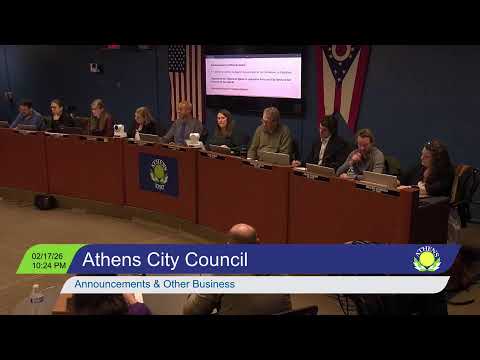
Athens council declines to advance ODOT drone grant after hours of privacy concerns, refers civil-liberties code language to committee
Summary
After extensive public comment voicing privacy and contract concerns, Athens City Council voted not to advance an ODOT Drones for First Responders grant to regular session; council endorsed sending an amendment to Title 3 (advanced technology and civil liberties) back to committee for further drafting and public input.
Athens City Council on Feb. 17 heard more than a dozen public commenters and lengthy council discussion before voting not to advance a proposed application to Ohio's Drones for First Responders (DFR) pilot to regular session.
Council member Sherwood, who introduced the item in the committee of the whole, said the Athens Police Department applied for the ODOT grant and that the city would not pay locally for two years: "for 2 years, the city will not expend any funds on this," he said, adding he would oppose "warrantless surveillance of Athens residents." Sherwood said he supports the pilot only with clear guardrails to govern data retention, access and use.
The mayor and administration described operational uses such as search-and-rescue and scene safety, recounting three recent incidents where a drone would have assisted first responders. The mayor said the city would include policies on retention and access and that the drone is intended for city police and fire business. "The drone was the right tool to use," the administration said when recounting a response to a shooting where officers used a drone to confirm no explosives.
Public commenters focused on privacy, contracts and data sharing. Several people urged rejection of the grant over fears that footage or metadata could be shared with federal agencies. "The drones for first responders grant would directly violate the Fourth Amendment rights of the residents of the city of Athens," a resident testified. Others highlighted private contracts and corporate data practices, noting companies named in the discussion (Flock, Axon and Skyfire AI) and past data breaches involving commercial systems.
Council members pressed both sides. Several members said they received overwhelmingly negative constituent feedback; others argued the pilot is a public-safety tool and could be implemented with stronger local controls. The committee considered three linked items: a code amendment creating an advanced-technology and civil-liberties policy (Title 3 changes), the agreement authorizing the mayor/service-safety director to accept participation in the ODOT DFR grant (ordinance O19-26), and an appropriation amendment to front the equipment purchase pending reimbursement.
When Member Swank moved to advance the grant agreement ordinance to regular session, the motion failed in a show-of-hands vote and "did not have the support to move from committee ... to regular session," the chair announced. The committee did, however, vote by consensus to refer the civil-liberties code amendment back to the appropriate committee for further work and community engagement.
Council and administration also discussed specifics that may be added to local rules if the city revisits the program: monthly drone flight logs to council and the public, annual reauthorization of use after public review, documented destruction of non-evidentiary footage and a near-term requirement for council approval before the city spends funds to continue the program beyond the two-year grant period. The proposed policy text being discussed included a 90-day purge requirement for non-evidentiary data and a prohibition on facial-recognition or biometric matching without a court order.
Next steps: the committee will work with the administration and community stakeholders to refine the Title 3 language in committee, and the grant participation question remains open for future consideration only if council chooses to revisit it.
Note: the mayor and administration repeatedly characterized the pilot as for emergency response and maintenance of public safety; residents raised contract and sharing concerns, and several council members said constituent opposition was decisive in their vote not to advance the grant.