Get Full Government Meeting Transcripts, Videos, & Alerts Forever!
Get email alerts on the Land Development Code topic
No spam. Unsubscribe anytime.
Residents urge council to reject reclassification of Ohio Street; planning board recommended against change
Summary
Residents and the planning board urged the Bangor City council to reject a staff proposal to remove Ohio Street and State Street from the "minor arterial" definition and reclassify Ohio Street as a "major arterial," saying the street does not meet code criteria, would harm residential character and that cited uses are already permitted.
Councilors heard more than a dozen public comments opposing a staff proposal to amend the land development code to remove Ohio Street and State Street from the "minor arterial" classification and add Ohio Street to the "major arterial" definition.
Ann Krige, community economic director, told the Business Economic Development Committee staff began the change after meetings with a prospective developer and that the amendment would add certain uses (for example nursing homes or private schools in some districts) where those road classifications apply. Krige said staff provided maps and a memo describing the process for changing the land development code.
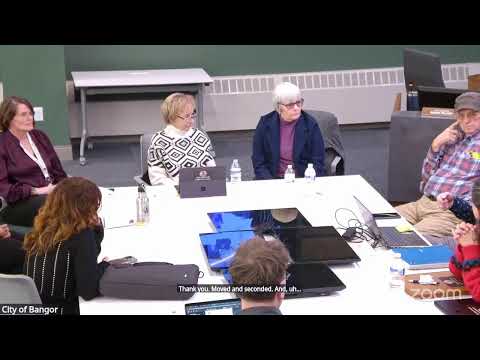
Across three hours of public comment, neighbors and longtime residents said the proposal would conflict with the comprehensive plan and alter the street's residential character. "Ohio Street does not meet the land development code definition of a major arterial street," said Joe Pratt, a Bangor resident, citing the code's traffic-volume threshold and lane-count requirements and saying "no one" spoke in favor at the planning-board hearing. Jeffrey Forney, who lives at 2100 Ohio Street, told the committee he supplied Department of Transportation data showing traffic counts below the 10,000 annual average daily traffic threshold and said several of the uses staff listed as "not allowed" are already present and protected as legal, nonconforming uses.
Former state representative John Schneck, a planning-board commenter, urged splitting the package so State Street (which staff said needs a correction) could be handled separately: "If it ain't broke, don't fix it," he said, arguing that the change should be re-drafted as two orders. Paul Pasquale and other residents emphasized that portions of Ohio Street beyond Davis Road lie outside the growth boundary and are designated "rural" in the comprehensive plan, saying reclassification would run counter to that designation.
Council discussion focused on process and notification. Several councilors said they felt "blindsided" by the emergence of resident opposition and asked staff to include planning-board responses earlier in council packets and to consider workshops before initiating formal code-change notifications. Ann Krige said property owners along Ohio Street were notified before the planning-board hearing and that the planning-board hearing produced comments included in the committee packet.
Councilor Mallor proposed separating the State Street correction from the Ohio Street reclassification so staff could prepare a new order addressing State Street alone; staff advised that under state statute the posted language matters and that the practical approach would be to vote the current order down and direct staff to prepare a new, narrower order. The committee agreed to forward the item to full council with that guidance; the chair said it would likely fail at council given the planning-board recommendation and resident opposition.
The committee did not take final action to reclassify Ohio Street tonight; instead, it directed staff to prepare revised language and additional outreach for council consideration.