Eugene IGR Committee elects Councilor Rose as chair, hears mid‑session legislative update
Loading...
Summary
The City of Eugene’s Intergovernmental Relations Committee confirmed Councilor Rose as 2026 chair and received a detailed mid‑session briefing from IGR manager Ethan Nelson on shelter funding, Clear Lake Road bonding, ALPR rules, airport funding, tax proposals and other priority bills amid the short 35‑day legislative calendar.
The City of Eugene’s Intergovernmental Relations Committee met Feb. 18 and elected Councilor Rose as chair for 2026 before receiving a mid‑session briefing from Ethan Nelson, the city’s intergovernmental relations manager, on priorities and bills moving through the Oregon Legislature.
"We're smack dab in the midpoint of the legislative session," Nelson told the committee, characterizing the short 35‑day session and noting the first‑chamber policy committee deadline had passed. He said a relatively positive state revenue forecast reduced the risk of deep biennial cuts and left room for targeted funding requests.
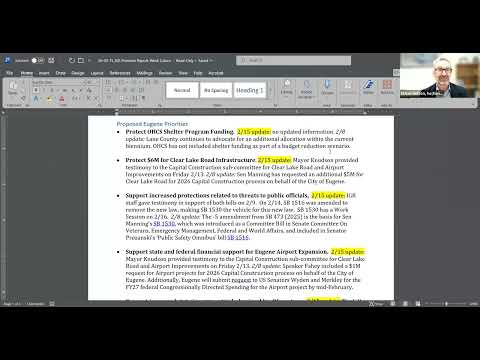
Nelson outlined priority items the city is tracking. On homelessness and shelter funding, he said Lane County — which previously received about half of the prior year’s allocation — is seeking additional funds and that Lane, Benton and Central Oregon counties may coordinate advocacy; he said county commissioner Pat Farr may ask Eugene to join a request for support.
On transportation, Nelson said the city is seeking an additional $5 million for the Clear Lake Road project (phase 1 estimated at $14 million of an $80 million total), beyond the $6 million previously allocated in 2025. He said the city is pursuing that funding through the lottery bond process and has been meeting with capital construction committee staff.
Nelson also reported that Mayor Knudson testified in support of a $1 million capital construction lottery bond request for Eugene Airport and that the request has been submitted to the Ways and Means subcommittee for consideration.
Law‑enforcement and privacy items included changes to automatic license plate reader (ALPR) language. Nelson said a stricter, community‑advocate amendment did not advance but a compromise amendment supported by chiefs and sheriffs did, and ALPR provisions tied to Eugene concerns remain in SB 1516 as the omnibus moves through the Senate.
On other bills, Nelson said HB 4108 (voluntary annexation for Eugene) was amended to narrow its scope and moved out of committee unanimously; HB 3115 repeal efforts were canceled for the short session. He described HB 4148, which would give cities more flexibility in using transient lodging tax revenue, as permissive ("may") and noted strong support from cities and strong opposition from lodging and tourism stakeholders.
Nelson summarized economic development proposals in HB 4084 and SB 1586: Eugene supports a proposed $40 million Business Oregon industrial‑site readiness allocation in HB 4084 and only selective elements of SB 1586 (permissive local tax incentives and an R&D tax credit). He said SB 1586’s land‑use provisions, including a proposed UGB expansion in Washington County, were politically contentious but that an amendment explicitly excluded data centers from the advanced‑manufacturing incentives under consideration.
On prevailing wage (SB 1566), Nelson said the bill was politically contentious, did not receive a work session and will likely return in the long session; the city remained neutral while making staff available to provide information. He reported progress on extended producer responsibility (EPR), micromobility (HB 4007), a likely pass for a ban on speculative ticketing, and other items the city is tracking.
Council members asked how to raise legislative awareness of local government funding needs. Nelson pointed to regional coordination efforts (the Oregon 7), engagement by the incoming city manager in statewide discussions, and internal efforts to prepare a revenue‑reform strategy. He said staff will provide an end‑of‑session brief and could present a timely update to council on March 9, depending on sine die timing.
Before the legislative briefing, the committee carried routine business: correcting and approving December minutes and approving the Jan. 7, 2026 minutes. A motion to select Councilor Rose as IGR chair for 2026 was moved, seconded and recorded by the committee as passing "2 to 0." The committee adjourned following the update.
The committee asked staff to circulate any end‑of‑session materials and to be prepared to brief the council at the March meeting if substantive outcomes require timely local responses.